
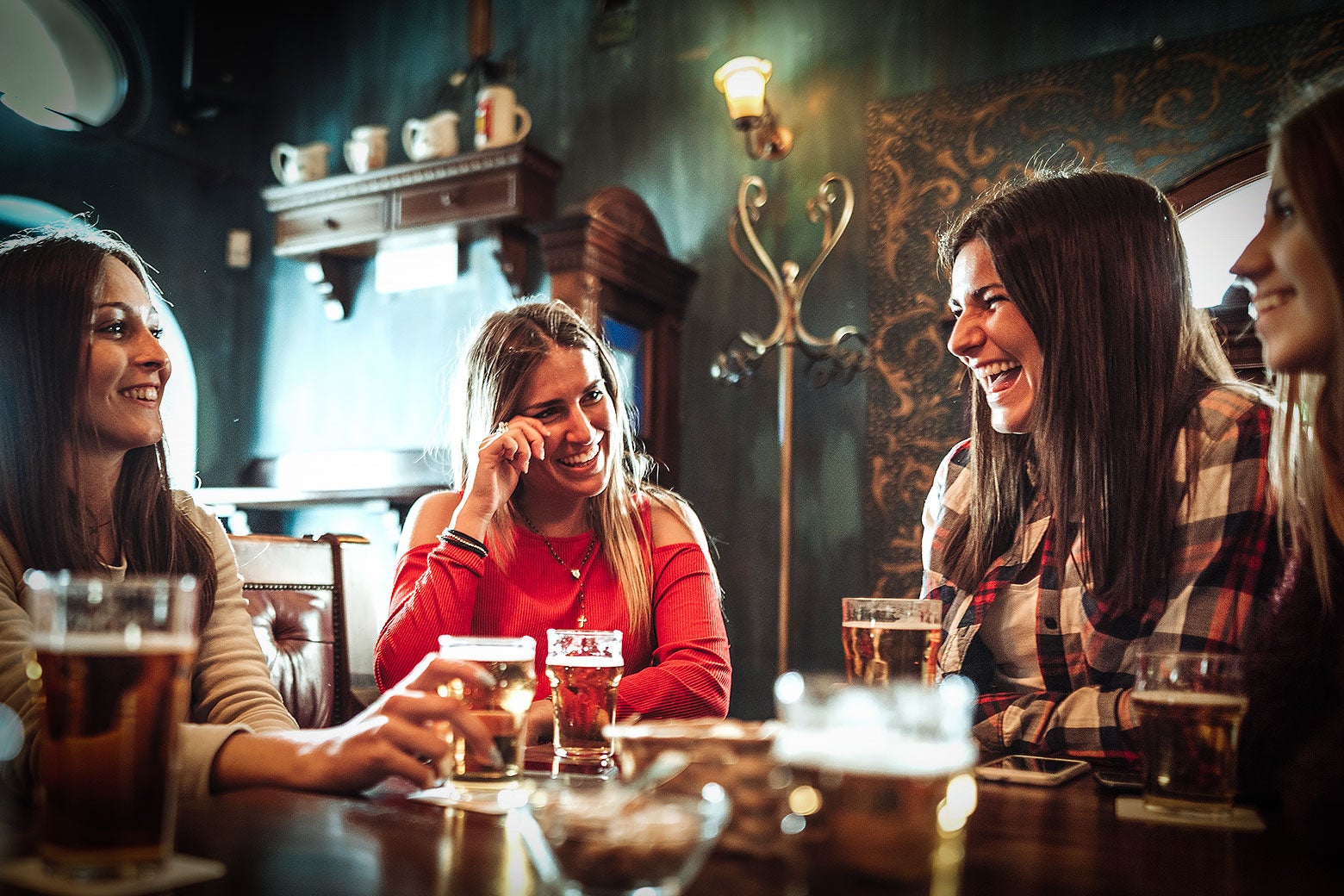
Drink What’s Lost When No One Wants to “Get a Drink” Anymore? When I moved to a new city, I thought I’d make friends the old-fashioned way—over a glass of wine or a cocktail. Instead, I’ve been left high and decidedly dry. franckreporter/iStock/Getty Images Plus Sign up for the Slatest to get the most insightful analysis, criticism, and advice out there, delivered to your inbox daily. When I moved to New York from Stockholm for grad school last year, I was 26. I had anticipated the usual awkwardness of building a social life from scratch. But here, I encountered a new, unexpected problem with making friends: Hardly anyone I met seemed to drink. I first learned this when I invited my classmates—seven women all in their late 20s and early 30s—over for dinner during the first month of the program. I had stocked up on wine and Swedish aquavit, only for two of the guests to ask, when they arrived, for nothing but a glass of water. That was their right of course. But at some point, when I wasn’t paying attention, not drinking had become so widespread that people didn’t even think to let the hostess know so she might be prepared with something else to offer. As the dinner went on, some of my guests continued abstaining. But others did take a glass because they wanted to celebrate the beginning of their New York–era, even though they hadn’t consumed much alcohol in a long time. We imbibers moved between wine, gin and tonics, beer, and aquavit. One drink led to another, and before long, we had gone further than anyone intended. Working on this story, I talked to my classmates about that evening. Turns out, the classmates who drank remember my dinner party as one of their worst post-college drinking experiences. Hearing them talk, I saw flashes of myself looming over the table, wine bottle in hand and urging them to have more. Because of me, one of them barely made it home safely. Another threw up and was reminded why she never has more than just a couple of drinks. Yes, they could have made different choices, but still, it struck me that I had completely missed the sober-curious moment of my generation. So I started asking my friends what drinking—or not—meant to them. Through those conversations, I began to see three different relationships to sobriety. For one friend, it was a season. For another, a stance. For a third, a map. They all led me to the same question: What is lost when “Want to get a drink?” is no longer the obvious way to make plans? One classmate, a 28-year-old Canadian, described sobriety as something she had gradually sunk into; thankfully, she had managed to pull herself out before it took too firm a hold. She was too much of a Type A personality to drink in high school—good grades and always on top of things. Then she drank a shot of Fireball, which was, she recalled, “amazing.” College was about getting as drunk as possible for as little money as possible. During her exchange semester in Paris, everyone seemed to drink wine most of the time. She began to wonder whether there was another way to be with people. She had never had sex sober. In a culture where everyone assumed you couldn’t walk into a bar without ordering a drink, she felt as if choosing not to drink built character. Health problems, followed by COVID, stripped drinking of much of its appeal. Sobriety became a larger part of her identity. At one point, a friend took her to an AA meeting. She bristled at its not-so-subtle evangelical undertone and at what she saw as its black-and-white assumption that anyone who wasn’t a total abstainer was an alcoholic. After moving to New York, she had wine on a first date. She enjoyed the freedom of realizing she didn’t have to be sober forever. She had stopped drinking, she realized, because she wanted to know that she could, not because she had sworn never to drink again. Being sober had hardened into a rule she’d begun enforcing with the same all-or-nothing mindset she had wanted to escape in drinking culture. So she began drinking occasionally again, the season having served its purpose. Another classmate, a 27-year-old who grew up in suburban New York, talked about alcohol like an open relationship: available, occasionally welcome, but never the default. She hadn’t partied much in high school either. She was never cool enough, she said. In college in New Orleans, there was Kool-Aid and vodka at frat parties, and she wasn’t particularly enthusiastic about it. After college, she had a few bad experiences with drinking too much and found herself thinking, I should have done this 10 years ago. I’m too old for this. Today, she doesn’t call herself sober, but drinking only a glass or two of wine infrequently, she’s pretty close. She is especially mindful of occasions when drinking is expected. Celebration is complicated: She wanted to drink at a friend’s wedding, but after a long period of near abstinence, she found it challenging even to finish a small glass of Champagne. She still wants to preserve the possibility of drinking occasionally, without feeling the pressure to drink. She has started going on first dates during the day, over coffee, after reading advice she liked: to have three sober dates before drinking alcohol, because when alcohol makes everything fun, it becomes difficult to form an accurate impression of a person. The third person I asked did not describe sobriety as a phase or a rule. He drew it for me. We were sitting in a café when he pulled the napkin from beneath his saucer and began drawing on it with a green marker. On the left, he drew a neat, rigid grid and wrote MAP in capital letters above it. This, he said—an allusion, I think, to Friedrich Nietzsche—was the “Apollonian” way of life: one defined by structure, straightforwardness, and predictability. He then drew a kind of self-portrait: a circle filled with frantic scribbles that spilled beyond its edges. He labeled it CAULDRON and underlined the word. His life, he explained, had been lived inside the cauldron. He asked why, if he could avoid it simply by not drinking, would he choose to enter the “Dionysian” chaos that alcohol unleashes, sketching another indecipherable blob on the napkin. Season, stance, or philosophical map, talking to these friends made clear that, in many ways, sobriety is the rational choice. It does reduce the risk of addiction, bad decisions, hangovers, and health problems. And yet, I still felt that alcohol had given me something rationality could not quite explain. Having grown up rather sheltered in church, I had to learn how to socialize in high school with the help of less holy spirits. It turned out many of the rituals (playing games, talking crushes, sharing secrets) were the same, whether they took place in an all-girls cabin at a Christian summer camp or in some older brother’s empty-for-the-night apartment in the city. Whereas the church offered clear boundaries, alcohol promised their dissolution. I found immense beauty in the blurred lines, and the way my friend group moved through the night while intoxicated. Our formation was never static. We were one mass instead of a collection of separate bodies; it grew as we ran into people we knew and strangers we decided to trust. We drank too much, said too much, showed one another some of our ugliest, most unhinged selves—and yet the way we cared for one another was among the sweetest things adolescence can bring forth. My faith taught me to see myself as part of an interconnected whole. At 19, it was as if that gospel came true with the help of alcohol. I grew older. Noisy, frenetic nightclubs lost some of their allure. I learned to love the unproductive pleasure of the pub instead, no matter the day of the week. In Stockholm, where I lived for seven years, I would have beer after dance class with my best friend on a Monday. After-work beer with a colleague on a Thursday. Sunday post-concert beer with my husband’s group of classical-musician friends. I think what I’m mourning now is the fact that so many people who reject the substance also reject the culture surrounding it. The classic student bars around NYU’s campus seem to fill up with men in their 50s and 60s. Two members of my school’s administrative staff told me that over the past 10 years, less alcohol has been consumed at evening events at the journalism institute. Meaning, even when it’s free, and the school is trying to make us feel like young intellectuals from an earlier, more louche and liquored demimonde, we stand around nursing flavored seltzer from Wegmans. Alcohol was not an entirely innocent subject in my family. There is a history of problematic drinking, and for a while I was in a relationship with a divinity student with a doctrinal commitment to both Scouting and the temperance movement. He became vegetarian for me; I became sober for him. It wasn’t hard. Not drinking was almost too easy; staying home was easier still. But in an odd way, abstinence made me think about alcohol more—not in the sense of wanting it but in feeling the weight of what my not consuming it signified. Honestly, being sober made me feel superior to other people. While I thought I was taking control of my relationship with alcohol, I was instead organizing my life around the decision not to drink, treating that decision as proof of my moral character. In New York, what I find myself missing isn’t getting drunk so much as having permission to sit somewhere for hours with another person and accomplish absolutely nothing. In Stockholm, the plan to grab “a” beer often turned into two or three beers, maybe even a cocktail. The hours slipped away; not much happened, and nothing got done. Alcohol gave us the simplest excuse to waste time together. It provided us with a social script that, for all its flaws, brought us closer together. “Want to get a drink?” requires almost nothing. Coffee with a friend is like taking the dog for a walk: pleasant, a necessary fix for the dependent, but squeezed into the space between more important things. I also tried a run club; everyone was a man, over 60, and anyway, running requires running. Going to a museum can be fun. But what if I don’t want another hobby? What if an evening doesn’t have to produce another ugly crochet bonnet—or a better version of myself—to have been worth having? What if I just want to get dressed up, sit somewhere too long, and talk? Sometimes, not taking yourself too seriously is part of taking life seriously. I don’t think I’ll be throwing any more dinner parties for a while. I don’t want to be responsible for poisoning anyone. And anyway, I’d rather just sit at the bar alone, at least to start. Not because drinking is good for me, but because I refuse to make every hour count. Dating and Relationships Food Drink Friendship Gen Z
No One Wants to “Get a Drink” Anymore. It’s Not the Good Thing So Many Seem to Think.
Full Article
Original Source
Read the full article at Slate →KhanList aggregates and links to publicly available news content. We do not host full articles from third-party sources. Always verify important information with original sources.