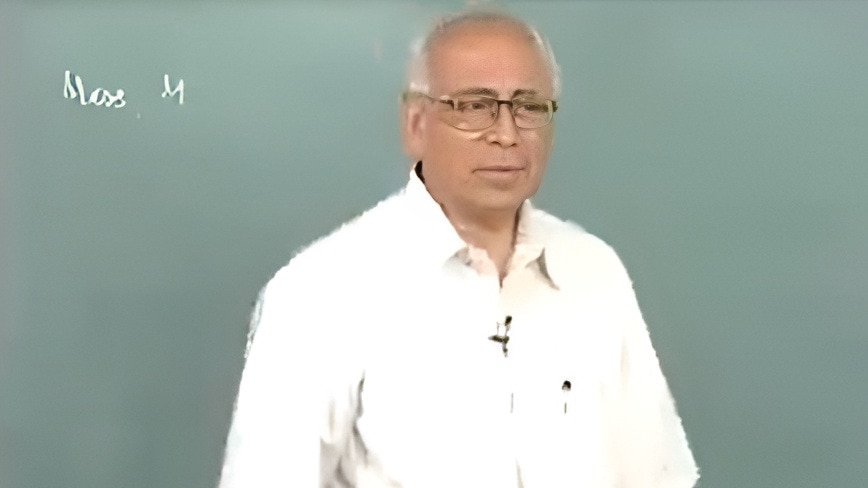
For nearly 17 years, Professor V Balakrishnan's IIT Madras classical physics lectures have sat quietly on YouTube, turning a chalkboard classroom into a global lesson. Its appeal lay in its rare conceptual clarity, praised by students and physicists despite having no slides or polished production.No notes, just a green board: This IIT Madras professor carried physics in his headWhat if one of the world's best physics professors has been teaching on YouTube for 17 years, and almost nobody outside India noticed? That is the story of Professor V Balakrishnan's classical physics lectures from IIT Madras.Filmed in a simple classroom with a green chalkboard, no notes, no slides, and no script, the course has quietly become a hidden treasure for students who stumble upon it.The lecture is Classical Physics --- Lecture 1, taught by Professor V Balakrishnan at IIT Madras and released free through NPTEL, India's national open courseware programme.The video captures something increasingly rare in modern education. Balakrishnan walks into class carrying no papers, no laptop and no presentation. He faces a chalkboard and begins. For the next several minutes, there are no pauses to consult notes or search for the next topic. Every concept flows into the next with remarkable precision.Former students have long described the same experience: it felt as if the entire subject existed in his head. A LECTURE THAT BUILDS PHYSICS FROM FIRST PRINCIPLESRather than rushing into equations, Balakrishnan starts with a fundamental question: What exactly is classical physics trying to describe?He explains the scope of classical mechanics, the assumptions on which it rests, why those assumptions work so well in everyday life, and the precise point where they fail, requiring the transition to quantum mechanics.Instead of overwhelming students with formulas, he constructs the subject logically, ensuring each idea is complete before moving to the next.NO SLIDES. NO SCRIPT. JUST EXTRAORDINARY CLARITY.Watching the lecture today feels almost unusual.Every sentence is complete. There are no verbal fillers, no unnecessary digressions, and no dependence on visual effects to keep attention. Concepts are introduced, explained and concluded before the next begins.The simplicity is striking: one professor, one piece of chalk and a classroom full of students.Yet the lecture never feels slow. It feels deliberate.A HIDDEN GEM OF ONLINE EDUCATIONOver the years, the series has quietly earned praise from physicists and engineering students around the world.One physicist who completed the entire NPTEL course described it as better than several Western university courses he had paid for, citing its conceptual depth and clear progression.Despite such endorsements, the lectures remain surprisingly unknown outside India.Uploaded in low resolution and largely untouched since their release, they have never benefited from the algorithms, promotion or polished production that drive modern educational content.A REMINDER OF WHERE GREAT TEACHING REALLY LIVESThe success of Professor V Balakrishnan's lectures challenges a common assumption, that the world's best teaching is concentrated in the most famous universities or packaged in the most sophisticated online platforms.Sometimes, it isn't.Sometimes, it is found in an ordinary classroom in Chennai, where a professor with nothing more than a green board, a piece of chalk and decades of mastery quietly recorded a course that continues to educate students across the world.Seventeen years later, the videos remain freely available, a timeless reminder that great teaching is measured not by production value or prestige, but by the clarity with which one mind can illuminate another.- EndsPublished By: Apoorva AnandPublished On: Jul 27, 2026 12:44 IST
No notes, just a green board: This IIT Madras professor carried physics in his head
Full Article
Original Source
Read the full article at Indiatoday →KhanList aggregates and links to publicly available news content. We do not host full articles from third-party sources. Always verify important information with original sources.