
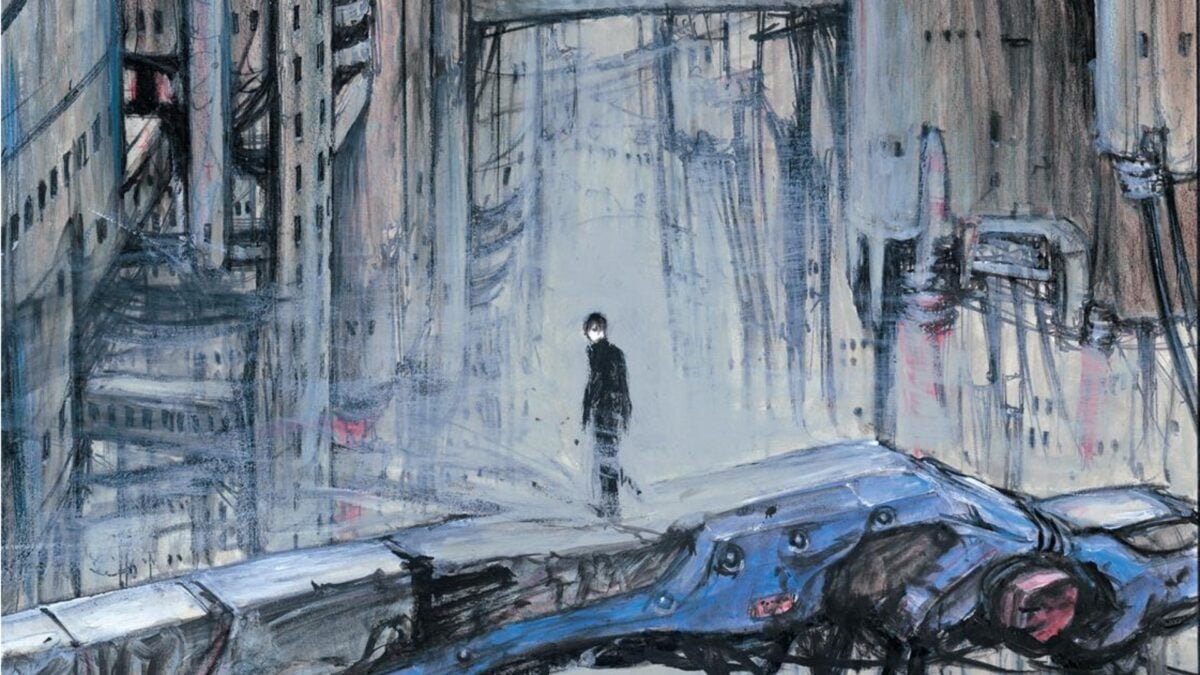
After years of replaying a conversation with an editor who described Tsutomu Nihei’s Blame! with near-religious reverence as “a masterpiece in comic storytelling,” I finally sat down to see what all the fuss was about. Having read it for myself after only experiencing Polygon Pictures’ CG film adaptation, I’m still a ways from claiming to have fully untangled every thread of its circuitous story. What I can say is that I now understand why that editor spoke about the series with such reverence, even though the reasons I fell in love with it weren’t the ones I expected. Before giving Blame! an honest try, all I could recall from the aforementioned Netflix film was a dude wandering aimlessly through a desolate sci-fi wasteland. If anything stuck with me, it was his absurdly cool gun. Even without reading the manga, the Gravitational Beam Emitter’s reputation preceded it. Its name hangs in the rafters alongside the most iconic weapons in sci-fi and manga. Basically, any problem its aptly named protagonist, Killy, encounters is immediately solved by pulling its trigger and watching a beam tear through anything fool enough to obstruct his path. © Tsutomu Nihei/Kodansha Like a fool, I assumed the mystery behind his titular weapon—where it came from, how it worked, and why neither Killy nor many of his sophisticated H.R. Giger-inspired adversaries fully understood it—would be the series’ main point of intrigue. After all, Blame! itself takes its name from the thunderous onomatopoeia of the firearm before its kickback sends Killy flat on his ass or rips his arm clean off. By all accounts, the GBE seemed destined to be the thing I’d spend the entire manga obsessing over. After having finished the series, though, I couldn’t give a shit about the gun’s lore. The real star of Blame! is the liminal brutalist structures Killy roams endlessly through. © Tsutomu Nihei/Kodansha © Tsutomu Nihei/Kodansha © Tsutomu Nihei/Kodansha © Tsutomu Nihei/Kodansha Long before I felt I’d grasped Blame!‘s full scope, I found myself transfixed by the beauty and terror of its liminal spaces. On a literal level, Blame!‘s setting is a giant man-made city that Nihei suggests could be as big as our solar system. I’d go so far as to say it’s like if Backrooms folded in on itself like Demon Slayer‘s Infinity Castle. What makes Blame!‘s setting most interesting is how the endless structures Killy wanders through feel less like impossible architecture and more like an unempathetic, living organism he’s passing through. For entire stretches of chapters, Killy hardly ever comes across other people or the automatons that maintain order on its infinite floors like blood cells. All he does is traverse corridors with fleshy dead ends; he can only assume it means he’s better off not finding out why. Similarly to undarkening spots on a map in a FromSoftware game, Blame! scratches that same itch of discovery. The higher Killy climbs, the more the mystery of why this setting is so alien and fucked up unfurls. Unfortunately, whatever morsels of information Killy gleans along the way only reveal how much better off he is not knowing and getting the fuck out of dodge as soon as possible. © Tsutomu Nihei/Kodansha © Tsutomu Nihei/Kodansha © Tsutomu Nihei/Kodansha © Tsutomu Nihei/Kodansha It’s almost serene flipping through panels and picturesque double spreads that turn Killy into a Where’s Waldo speck in the vastness of Blame!‘s hulking architecture. But every once in a while that deafening silence is broken up by the sound of rubble falling. I, like Killy, know he hasn’t run into a human being for what amounts to months of his wandering. And before either his or my fight-or-flight can kick in, some wicked biomechanical apparition bursts through the floors like the Kool-Aid man, or swarms in on him like a horde of locusts. Sure, Killy inevitably shoots them away in an exciting action sequence worthy of a Mick Gordon score. But what really had me falling in love with the series was the fascination with the colossal architecture and the bizarre entities that call it home. No moment illustrates how terrifying Blame!‘s megastructure setting is more than when it introduces my favorite fear: time dilation. At one point in the manga, Killy gets separated from an ally. To me, he simply fell down a couple levels and needed to climb his way back up to meet her again. When he does, he gets hit with the wallop that, from her perspective, he’d been gone for 30 years. To my abject horror, Blame! really digs time dilation. It gets to the point where elevator rides take up to 800 hours to reach their destination. A fact that only further accentuates the manga’s other tract about what the self is when characters are able to have their consciousnesses reuploaded after their bodies are blown to shit—sometimes taking over each other’s vessels by force—but have their memories wiped. The only peer to Blame!‘s environmental storytelling is Nihei’s other series, Tower Dungeon. © Tsutomu Nihei/Kodansha © Tsutomu Nihei/Kodansha © Tsutomu Nihei/Kodansha © Tsutomu Nihei/Kodansha While I love the thematic quandary of what is the self, that pales in comparison to the sensation that every environment Killy enters existed for a millennium before his undying ass arrived and would continue stretching into infinity after he left. Not out of hostility or hospitality, but out of indifference. Blame! is bespoke architecture at its most anglerfish. That’s ultimately why I’d call Blame! a masterpiece too. Not because I fully understand what Nihei was cooking on a narrative level, but because few manga have left me as captivated by moving aimlessly through its world. Want more io9 news? Check out the best movies and TV shows to stream this month and all the upcoming sci-fi, fantasy, and horror books that should be on your radar.
No Manga Nails Liminal Spaces Quite Like Tsutomu Nihei’s ‘Blame!’
Full Article
Original Source
Read the full article at Gizmodo →KhanList aggregates and links to publicly available news content. We do not host full articles from third-party sources. Always verify important information with original sources.