
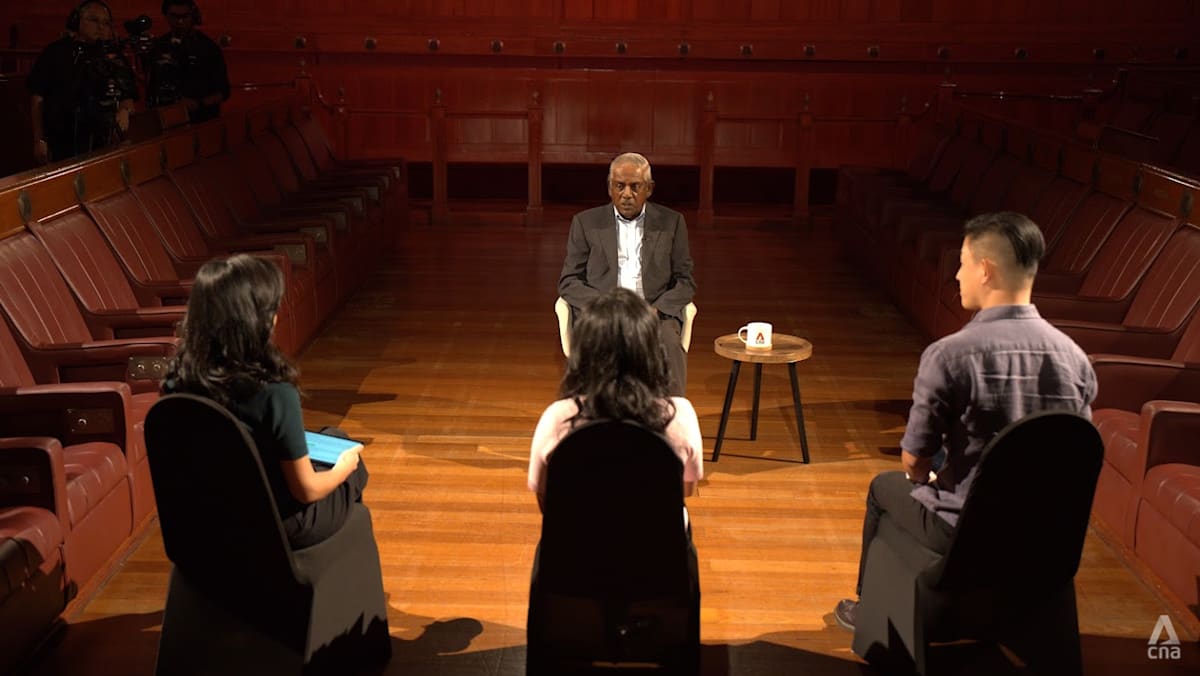
Singapore The former senior minister recalls honing his parliamentary skills, after being “arrowed” by Lee Kuan Yew to field questions from opposition leader JB Jeyaretnam. Former Senior Minister S Jayakumar during an exclusive interview with CNA at The Arts House at the old parliament building on Sep 14, 2026. (Photo: CNA/Timothy De Souza) New: You can now listen to articles. This audio is generated by an AI tool. This is the last of three articles from CNA’s interview with former Senior Minister S Jayakumar, who recently launched his book Creating Three Unique Singapore Laws: An Inside Story. The book chronicles how the elected presidency, Group Representation Constituencies and Non-Constituency Members of Parliament were established through constitutional amendment.SINGAPORE: Newly appointed as a political office holder in 1981, Professor S Jayakumar was “arrowed” by then-Prime Minister Lee Kuan Yew to field questions in parliament from lone opposition lawmaker JB Jeyaretnam.The Workers’ Party leader had won the Anson by-election earlier that year to become the first opposition Member of Parliament.Prof Jayakumar, then minister of state for home affairs and law, said handling Mr Jeyaretnam’s questions improved his parliamentary skills and convinced him that no government should fear having an opposition in the House. Mr Jeyaretnam spoke up more than 40 times, tabling questions on topics such as human rights, law and order, security and punishments.“It had a big effect on me in the sense that I had to be on my toes. You never knew what supplementary questions he was going to ask, where he would be coming from, and I had to do that much greater preparation,” Prof Jayakumar told CNA in an exclusive interview held at the Old Parliament House, now The Arts House, where laws were debated and passed.“The whole experience, I guess, enabled me to hone my skills as a debater and explainer of policies and issues.”It also taught him within a very short span of time how to respond effectively to questions in parliament.“But more importantly, it also made me convinced that the opposition had an effective role in parliament,” he added.“No government should really be scared or afraid of having opposition presence in parliament, and I think it convinced me that it was necessary for the democratic process in Singapore.” CREATING THE NCMP SCHEMEIn his book, Prof Jayakumar wrote that the Non-Constituency Member of Parliament (NCMP) scheme was first mooted to ensure that younger ministers from the ruling People’s Action Party would always have “sparring partners”, as he had in Mr Jeyaretnam.Today, NCMP seats go to the best-performing losing opposition candidates if fewer than 12 opposition candidates are elected in a General Election. The two current NCMPs are Mr Andre Low and Ms Eileen Chong of the Workers’ Party.From a debate standpoint, Prof Jayakumar said he never found any difference between facing an elected MP and an NCMP.“It all depends on how articulate and persuasive that particular opposition member is. The fact that he did not have a constituency, the only difference is he could not say, ‘I've spoken to my constituents and these are the issues they want me to raise’,” he said.“But quite apart from that, I did not sense any big difference in dealing with NCMP or elected opposition MP.”When the scheme was introduced, NCMPs could not vote on matters such as constitutional amendments and supply bills. Prof Jayakumar saw “no indication” that this made it harder for the public to accept them as full participants in parliamentary proceedings.“I don't think people paid attention to the details of what they could vote on, what they could not vote on,” he said. Deputy Prime Minister and Minister for Defence Tony Tan Keng Yam, Senior Minister Lee Kuan Yew, Prime Minister Goh Chok Tong, and Minister for Law and Foreign Affairs S Jayakumar at the swearing-in of MPs at Parliament House on Mar 25, 2002. (Photo: National Archives of Singapore) In 1984, the first General Election with the scheme in place, opposition candidates rejected the seats and the positions went unfilled.“Initially, yes, one or two did not accept. But we did not regret at that time making the amendment, because it was a mechanism that could be defended, that we are prepared to have this mechanism, we are prepared to have opposition in parliament,” said Prof Jayakumar.He noted that opposition parties have accepted the seats in every General Election since.“Whatever they may say, they have actually accepted and taken up the opposition NCMP seats,” he said.In his book, Prof Jayakumar wrote that the scheme also served an “unintended purpose” by letting unsuccessful opposition candidates raise their profiles through parliamentary performances, improving their chances at later elections.He told CNA he does not see this as a negative development, as it still helps guarantee the number of opposition lawmakers in parliament.He added that the scheme would remain relevant even if parliament one day had at least 12 elected opposition members. The objective of a minimum opposition presence is achieved whether that number is made up of elected or non-constituency members, he said. ACHIEVING CONSENSUSDuring discussions on the NCMP scheme, the Cabinet relied on a number of “informal indicative votes”, said Prof Jayakumar.These tracked the constantly shifting views as talks progressed, he said.“It was still in the spirit of reaching a consensus. But we had to keep track of which option seems to have a greater majority,” said Prof Jayakumar.While there was no time pressure on pushing the policy across the line, he said “we could not have interminable, non-ending meetings”.“Don't forget Cabinet also had to discuss so many other major issues of the day. We had to set aside time for this,” he said.Prof Jayakumar added that deliberations today would take far less time because of advances in communication tools.“In those days we didn't have email, we didn't have Skype, we didn't have Zoom. So everything had to be done by either physical meetings or through hard copy letters which we cannot imagine today,” he said.“Just remember that this was in the 80s, and two years at that time may not have been long. Today, probably the NCMP (discussions) would have been concluded within less than a year.”
No government should fear having opposition in parliament, says former SM Jayakumar
Full Article
Original Source
Read the full article at Channelnewsasia →KhanList aggregates and links to publicly available news content. We do not host full articles from third-party sources. Always verify important information with original sources.