
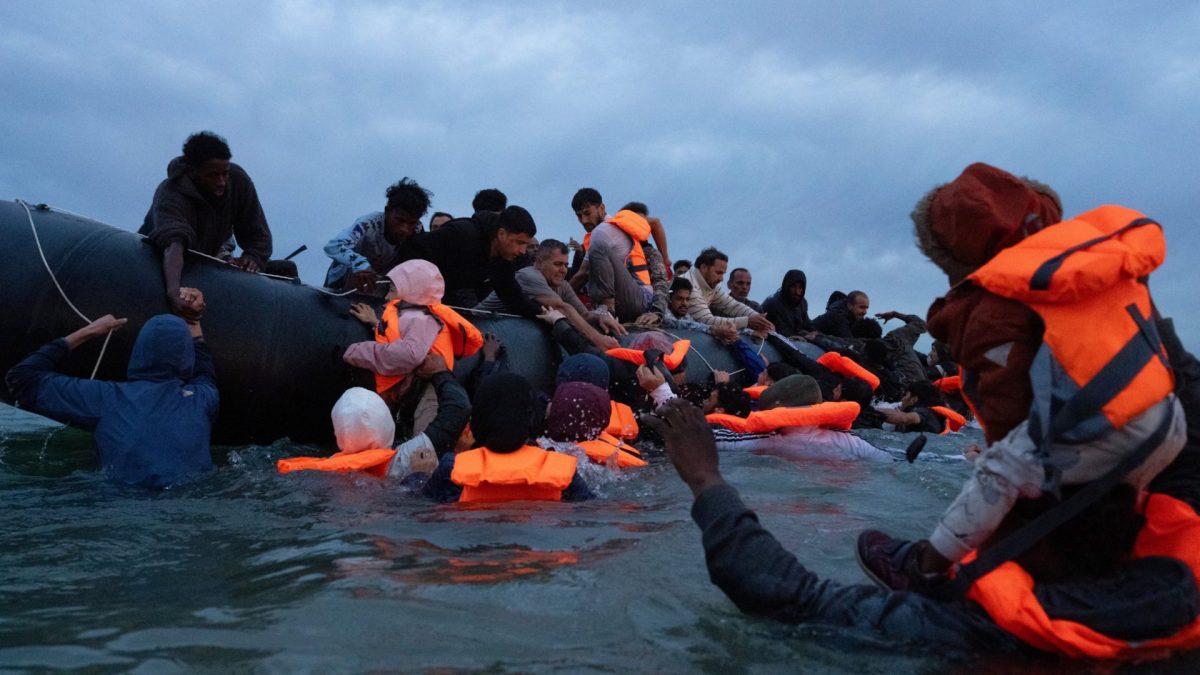
Reform UK has pledged to use the Royal Navy to “intercept” small boats crossing the English Channel and return them to France. But it isn’t quite that simple. Nigel Farage’s party said the plan would constitute the “largest military operation” in the Channel since the Second World War, and would be coined “Operation Fortress”. Farage claimed on Monday that he was “entirely confident” the plan would not break maritime law. More than 2,000 migrants have arrived on small boats since Andy Burnham became Prime Minister last month, but crossings so far this year are down 43 per cent compared with the same period in 2025. However, deploying the Navy for such a task would face serious challenges, say experts. Shorts Professor Kevin Rowlands – who worked on Operation Sophia, an EU naval mission aimed at stopping people smugglers in the Mediterranean – said the “idea of a naval fortress might sound decisive”, but in reality “it doesn’t sit well with international maritime law, sovereign borders, and the physical unsuitability of modern warships for small-boat interdiction in the Dover Strait”. Could the Royal Navy carry out the plan? With Russian aggression rising and senior military figures warning the British Armed Forces are already strained, the plan is unlikely to be top of the agenda of the First Sea Lord – the head of the Royal Navy. Rowlands, editor of the Royal United Services Institute Journal, said the Navy was “already stretched” and “diverting attention and resources from the Navy’s core military role to perform a function better discharged by specialist civilian agencies will not make us safer. “It isn’t the job of a nuclear submarine, or an aircraft carrier, or an anti-air destroyer or anti-submarine frigate to act as a coastguard vessel. “We should remember what the Royal Navy is there to do. It is investing heavily in high-end warships, uncrewed systems, and artificial intelligence to meet genuine and growing threats, particularly from Russian undersea activity in the North Atlantic and High North, as well as to keep chokepoints such as the Strait of Hormuz and the Bab al-Mandab open.” French police watch as migrants board dinghies in 2025 in Gravelines, France (Photo: Carl Court/Getty) Reform home affairs spokesman Zia Yusuf said the plan had been endorsed by “former senior members of our Armed Forces”. But Admiral Lord West, the former head of the Navy, described it as “pie in the sky” because “it depends on the French accepting illegal immigrants back and they won’t”. Should such a plan be implemented, West said the Navy would be likely to use small craft and Border Force vessels, rather than warships, but there “would be a manpower requirement” on the force. Shadow Home Secretary Chris Philp said the Conservatives were not “against the principle of turning boats around, but our military is rightly focused on protecting us from global threats”. He added: “If Reform wants them to also patrol the Channel for illegal immigrants they must find the money.” Andrew Fox, a former Parachute Regiment officer who is now a conflict analyst, said intervention by the Navy could put lives at risk. A warship “cannot ram the boat, create a wash beside it or undertake aggressive manoeuvres without risking a capsize”, he posted on social media. “Sending a boarding party alongside an overcrowded dinghy creates another opportunity for dozens of frightened people to shift their weight at once and end up in the water.” Would France agree to the plan? A spokesperson for the French interior ministry said a plan for the British military to return migrants with or without French permission “would be a violation of French sovereignty as well as a violation of maritime law and international law”. They added: “Separately, as part of the measures put in place with the UK and the arrangements deployed at the local level, the interior ministry states that the number of crossings is down in 2026.” The UK cannot simply sail into French waters and disembark people without permission. One military insider said the announcement was “performative politics with no actual plan”. The insider added: “What if France says no? Are we just going to start a war?” Dr Peter Walsh, senior researcher at the Migration Observatory at the University of Oxford said that the plan depended on if France agreed to the returns.” “If the UK returned asylum seekers to France without its permission, one plausible scenario is that this would have major diplomatic consequences, prompting France to suspend existing co-operation such as intelligence sharing and beach patrols in northern France,” Walsh said. “It is possible it would attempt to repel the British ships to prevent further returns.” Yusuf accepted that the UK and France could have “a diplomatic argument” over the plan, but insisted they had a “commitment under international law” to process migrants. Migrants crossing the Channel after leaving northern France on 27 April (Photo: Dan Kitwood/Getty) Under international law, vessels must provide assistance to those in distress at sea, irrespective of their migration status. Under the 1951 Refugee Convention, the principle of non refoulement means that asylum seekers cannot be automatically returned to the place they have fled or places where they would face threats to life or freedom. After a rescue, they can only be dropped off at a place which does not pose a risk to them. States do have an obligation to work with ships dealing with rescued people, but it doesn’t mean they are automatically required to provide haven, as the American Society of International Law said. Instead, without French agreement, the Navy may be forced to rescue people and bring them to the UK. The French embassy did not respond to a request for comment. Has it been done before? The Royal Navy was previously handed primacy for English Channel patrols in 2022, in an operation the Conservative government claimed would be a “deterrent”. Instead, it cost at least £50 million and coincided with the all-time peak for small boat crossings. Under the operation, codenamed Isotrope, naval vessels patrolled the Channel to intercept small boats, but the military made clear it would not be involved in pushbacks at sea or use force against migrants. A 2022 memorandum of understanding between the Home Office and Ministry of Defence said: “The objective of Military Primacy is to prevent uncontrolled small boat landings in the UK and ensure that migrant boats are identified, safely intercepted and that individuals on board are appropriately brought into the Home Office immigration system.” The agreement stated that Navy personnel would “act only within the limits of their current powers, in particular the power to use force only with consent, or pursuant to the right of self-defence”. Prime Minister Andy Burnham and Minister for Border Security and Asylum Anna Turley listen to John Craig, Interim Chief Coastguard, by a recovered small boat, which was used by migrants crossing the English Channel, yesterday (Photo: Reuters/ Jack Taylor/Pool) A retired naval commander told parliament’s Defence Committee at the time that the Navy was bound by international maritime law and added: “I cannot conceive of a situation where you are physically turning these ships back that is either legal or, perhaps more importantly, safe.” Operation Isotrope ran from April 2022 to January 2023, with the Navy touting its involvement a success because of a fall in the number of small boats reaching British shores without interception, but the Conservative government was embarrassed by record arrivals in the period. James Heappey, who served as the Conservatives’ Armed Forces minister at the time, told the Defence Committee in July 2022 that the Royal Marines had conducted trials of pushbacks off the coast of Weymouth but the operations were found to be “operationally unviable”. “It would be a breach of the saving life at sea convention consciously to seek to collide with another vessel in an international shipping lane,” he added. “We were involved in trials when the concept was being explored … when people heard the evidence from the trials and the professional judgement of the mariners within the Royal Navy, the idea was dropped.”
No, Farage, the Royal Navy can’t stop small boats. This is why
Full Article
Original Source
Read the full article at Inews →KhanList aggregates and links to publicly available news content. We do not host full articles from third-party sources. Always verify important information with original sources.