
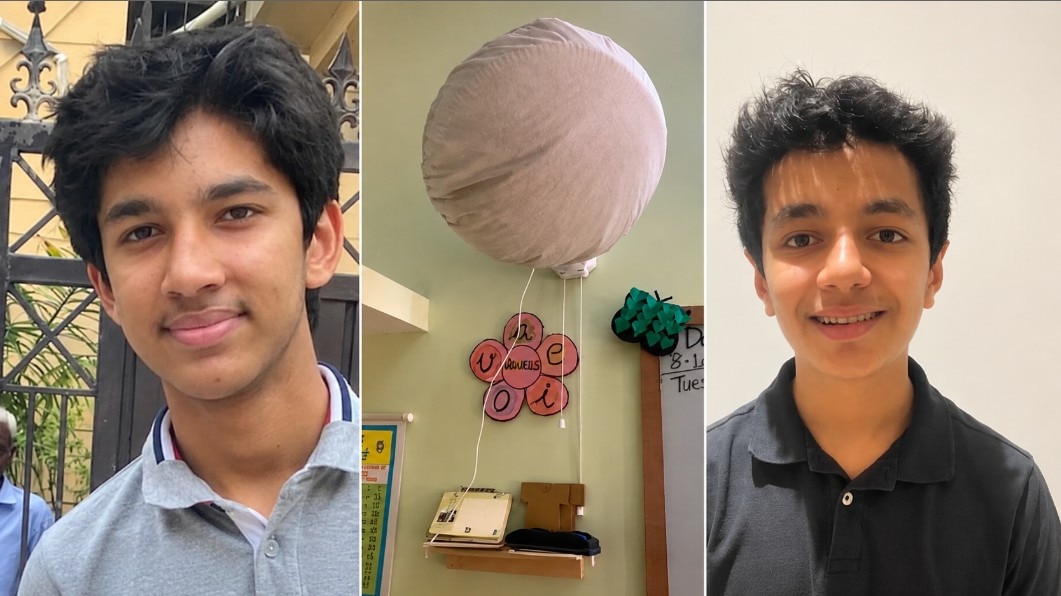
Instead of investing in expensive air purifiers, two young Delhi innovators decided to make existing classroom fans do more. Their Project Vayu filters cost just Rs 140 and are helping tackle indoor air pollution across underprivileged schools, earning 2026 Diana Award Roll of Honour.No expensive purifier, just a fan and a Rs 140 filter: Delhi student duo wins Diana Award (Image: projectvayu.com)New Delhi,Nov 10, 2026 14:37 ISTFor thousands of children in Delhi, cleaner classroom air may no longer require expensive air purifiers. Two young innovators, Krish Aggarwal and Samarth Meattle, co-founded Project Vayu to turn ordinary classroom fans into affordable air purifiers using filters that cost just Rs 140. Savya Meattle also played an early role in shaping the project's direction before leaving to study at Stanford University. Aggarwal has now been named to the 2026 Diana Award Roll of Honour for his efforts.Aggarwal's initiative addresses a problem that often receives less attention than outdoor pollution: the quality of air children breathe inside classrooms. While expensive air purifiers may not be practical for many schools, Project Vayu offers an alternative by making use of equipment they already have.According to the Diana Award's official website, Aggarwal co-founded the initiative to improve access to clean air for children in schools with limited resources. The project has distributed filters across under-resourced schools in Delhi, benefiting more than 10,000 students.THE IDEA BEHIND PROJECT VAYU: WHY DID THEY CHOOSE CLASSROOM FANS?The idea began with a simple question: If an affordable filter could be developed and installed within seconds, why shouldn't every classroom have one? According to Project Vayu's website, the founders were concerned about children spending several hours every day in classrooms where polluted outdoor air could enter without being filtered. A simple innovation aims to turn ordinary classroom fans into air purifiers. (Image: projectvayu.com) In Delhi, where air quality can deteriorate sharply, fine particulate matter such as PM2.5 poses a particular concern. However, installing standalone air purifiers in every classroom can be expensive, especially for schools with limited budgets. The founders wanted a solution that would not require schools to purchase new appliances or replace their existing fans. To develop the technology, the team collaborated with Hollingsworth & Vose, a global filtration manufacturer headquartered in Massachusetts. The partnership involved joint research and development, with the company supplying 700 metres of filter media for the initiative.The team eventually developed a retrofit filter using electret media, which can be attached to regular fans. Project Vayu also states that it holds the copyright for the filter design.HOW DOES A REGULAR FAN BECOME AN AIR PURIFIER?Unlike conventional air purifiers, the Vayu Filter uses airflow from an existing fan, eliminating the need for a separate motor or filtration unit. Made of electrostatically charged fibres that trap fine particles, including PM2.5, it fits around a fan grille using an elastic lining and can be installed in under a minute without tools or adhesives.The technology has been designed around four practical considerations: filtration efficiency, airflow, surface area and ease of installation.First, the electret filter media uses electrostatic forces to attract and capture fine particles rather than relying only on physical filtration. This allows it to trap pollutants without using an excessively dense material that could restrict airflow.Second, its low-pressure-drop design means ordinary table and wall fans can push air through the filter without requiring a motor upgrade. Project Vayu lists the filter's pressure drop at 0.23 inches of water column.Third, the filter has a distinctive balloon-like design. A standard fan has a face area of approximately 1.4 square feet, but when the Vayu Filter is switched on, air pressure inflates it to more than five square feet. This larger filtration surface provides more area for air to pass through the filter. A comparison of the new filter and the same filter after a month of use. (Image: projectvayu.com) Finally, an elastic lining holds the filter securely around the fan grille. Teachers can stretch it over the fan and install or replace it in under a minute, without requiring technical assistance.Project Vayu has also reported encouraging results from a controlled-room performance test.HOW HAS A RS 140 FILTER REACHED THOUSANDS OF STUDENTS?Keeping the technology affordable was central to the project. According to its website, each filter costs around Rs 140 to manufacture. The cost is divided into three components: Rs 85 for the filter media, Rs 15 for the elastic lining and Rs 40 for stitching and transportation.Project Vayu provides the filters free of charge to schools and also supplies fans to classrooms that do not have one.The distribution model is designed to make installation and maintenance equally accessible. Once a school receives the kit, teachers can fit the filter onto an existing fan. Switching on the fan inflates the filter, allowing it to begin filtering the air. The team also supplies fresh filters every month, so schools do not have to arrange replacements themselves.The monthly replacement cycle is important because filters accumulate trapped particles over time. Project Vayu has also shared comparisons of new filters with used ones after a month of use in a Delhi classroom, showing visible discolouration. The filters developed to help improve indoor air quality in school classrooms. (Image: projectvayu.com) Its pilot covered 295 classrooms in Delhi, with 602 filters installed, reaching around 8,000 students. According to the Diana Award's official profile, the initiative has since benefited more than 10,000 students.Project Vayu now plans to expand to 45 more schools across New Delhi, its largest rollout so far. The founders also aim to partner with Delhi government bodies, NGOs and corporate sponsors to reach more government schools.RECOGNISING HIS FIGHT AGAINST INDOOR AIR POLLUTIONThe Diana Award, established in memory of Diana, Princess of Wales, honours young people making a difference through social action and humanitarian work. Krish Aggarwal was included in the 2026 Roll of Honour for his efforts to tackle indoor air pollution and make clean air more accessible to children from underprivileged communities.The award also recognises his commitment to evidence-based environmental solutions and youth-led climate action.Through Project Vayu, Aggarwal and his team have combined research, innovation and community participation to develop an affordable approach to improving classroom air quality.With a low-cost filter, a simple installation process and a model that uses fans already available in schools, the initiative aims to make classroom air filtration accessible beyond well-funded institutions.- Ends
No expensive purifier, just a fan and a Rs 140 filter: Delhi student duo wins Diana Award
Full Article
Original Source
Read the full article at Indiatoday →KhanList aggregates and links to publicly available news content. We do not host full articles from third-party sources. Always verify important information with original sources.