
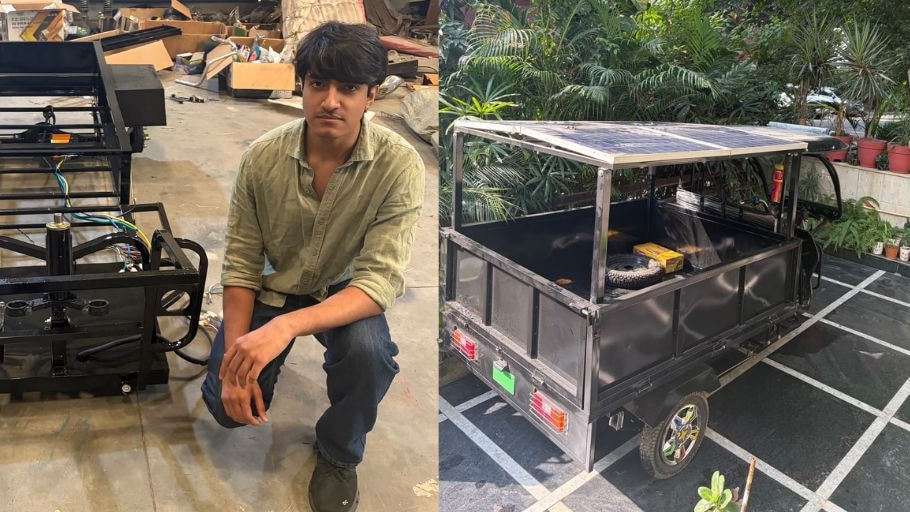
"I didn't have a workshop, a team of engineers or a big budget. I had a question, some school maths and physics, and a lot of curiosity," says 17-year-old Akshit Khera from Gurugram.While most students are busy preparing for their Class 12 board examinations, Akshit has turned that curiosity into a working solar-assisted three-wheeler, designed to make everyday transportation more affordable for lower-middle-income families.A student of Heritage International Experiential School in Gurugram, Akshit has built a multi-purpose three-wheeler featuring a weatherproof, two-seat cabin, a cargo box and a 400W solar-powered canopy. Developed with a target budget of Rs 1 lakh, the vehicle's final cost came to Rs 1,02,536, with an estimated running cost of just 13 paise per kilometre.But the idea did not emerge from a laboratory or an engineering workshop. It began with a conversation with his housemaid's family. The family had migrated to Gurugram and was struggling with expensive local transportation. The man of the household worked as a driver, transporting cargo. When Akshit asked why he did not purchase a vehicle and start his own small cargo business, the answer was simple: the upfront investment and running costs were too high.Electric loaders offered lower operating costs, but their purchase price of Rs 1.5 lakh to Rs 2 lakh remained beyond the family's reach. "I spoke to about 20 more families, and it became clear that there was a real need for an affordable, low-running-cost vehicle that could serve different purposes," says Akshit. He wanted to build a vehicle that could transport goods, accommodate passengers and support everyday transportation needs without putting additional financial pressure on families.FROM A SOLAR CAR IDEA TO A VEHICLE FOR EVERYDAY FAMILIESAkshit's interest in automobiles grew over the years, while his concern for sustainability became stronger as he witnessed the pollution that returns to Gurugram every winter.The two interests eventually came together in his initial idea of building a solar car. However, he wanted to create something functional rather than a model or simulation."I was clear from the start that I wanted to build something that works, not just a simulation," he says. His initial plan was to develop a completely solar-powered vehicle. However, calculations around seasonal sunlight availability and the distance the vehicle needed to cover showed that relying entirely on solar energy would not be practical.He therefore settled on a solar-assisted design with a target price of Rs 1 lakh to Rs 1.2 lakh, a running cost below 50 paise per kilometre, a carrying capacity of up to 300 kg and seating for two.The vehicle can travel at least 50 km on a single charge, with additional range supported by solar charging during the day. Unlike conventional three-wheelers, its solar panel serves a dual purpose. Installed on the cargo box, it acts as a protective roof while generating electricity to power the vehicle.According to Akshit's calculations, solar energy can meet around 63 per cent of the vehicle's daily electricity requirements, assuming an average daily run of 50 km. The contribution varies seasonally, falling to around 41 per cent during the monsoon and rising to as much as 87 per cent in peak summer.HOW DID A 17-YEAR-OLD KEEP THE COST SO LOW?Keeping the vehicle affordable without compromising on safety or quality was one of Akshit's biggest challenges. The initial estimate was nearly Rs 1.35 lakh. To bring costs down, he reworked individual components after assessing the vehicle's actual requirements.He reduced the battery requirement from 5.38 kWh to 3.072 kWh. Using heavier steel tubes only at key load-bearing points also helped save around Rs 2,100 and reduce the vehicle's weight by 26 kg.He switched to a 400W monocrystalline solar panel, which was cheaper than the 300W polycrystalline panel he had initially considered. Akshit also negotiated with vendors at Delhi's Mayapuri automobile market, collecting multiple quotations for components costing more than Rs 1,000. This helped him save over Rs 17,000.He chose a lithium-ion battery over a lead-acid alternative, citing its longer lifespan and lower environmental impact.Explaining the running cost, Akshit said the vehicle consumes around 2.46 kWh to cover 50 km. With solar energy meeting approximately 63 per cent of its electricity requirement, the estimated electricity cost comes to just 13 paise per kilometre. For a daily run of 75 km, this rises to around 21 paise per kilometre.MORE THAN A DOZEN WORKSHOPS REJECTED THE PROJECTBeyond the engineering calculations, finding a fabricator willing to take on the project proved challenging. Akshit visited more than a dozen workshops across Gurugram, Delhi and Faridabad before finding Arun, who agreed to help build the vehicle.His workshop was around 30 km from home, making every visit an exercise in careful planning. There were technical setbacks, too. Solar panels available in the market were either too small or too large for the vehicle's roof. Finding the right size required several discussions with panel vendors and the fabricator.Switching to the 400W monocrystalline panel also created an electrical design challenge. Since the panel operated at a lower voltage than the battery, the conventional buck charge controller he had initially planned to use would not work. He had to redesign the electrical system around a boost controller.Another decision involved the cargo box floor. Although plywood appeared cheaper and lighter on paper, Akshit realised that repeated exposure to rain during the monsoon could cause it to swell and deteriorate. He eventually chose painted steel sheets. Akshit with his self-designed solar-powered three-wheeler. (AI generated image) "The biggest lesson for me was that every setback was cheaper to fix on paper than in reality," he says. His earlier experience with STEM Racing also helped him navigate these challenges.In 2025, Akshit served as the lead design and manufacturing engineer for Apex Racing at the STEM Racing World Finals in Singapore. Competing against 82 other teams, the team achieved the seventh-fastest average time.PARENTS' SUPPORT AND PRIDE IN HIS JOURNEYThroughout the project, Akshit's parents, Amit Khera, senior partner at McKinsey & Company, and Kanchan Khera, founder and CEO of Zykrr Technologies, supported him as he worked through months of calculations, discussions and workshop visits.They recalled feeling a mix of disbelief and relief when the vehicle finally started working. One moment that particularly made them proud was his decision to choose a lithium-ion battery over a cheaper lead-acid alternative, despite the additional cost. They saw it as a sign that he was thinking beyond the initial price and considering the vehicle's long-term performance and environmental impact.For Akshit's parents, the project was not just about building a vehicle but also about watching their son turn an idea into a functional innovation through persistence and practical learning.CAN THIS RS 1-LAKH VEHICLE BECOME A COMMERCIAL PRODUCT?Akshit sees the three-wheeler as a prototype rather than a finished product. His immediate priority is to establish its performance through more extensive real-world testing.The vehicle has been undergoing initial testing for the past two to three weeks. However, he believes it needs more rigorous evaluation across different sunlight conditions to verify its actual solar contribution and running costs.He estimates that manufacturing at scale could bring costs down by 10 to 20 percent, as the current prototype was assembled using components purchased individually at retail prices. A partnership with an automobile manufacturer, he believes, could help take the vehicle beyond its current stage.He would particularly like to work with an established manufacturer on safety validation, durability testing, certification, affordable component sourcing and a reliable service network. Akshit's solar-assisted three-wheeler prototype, which he hopes to take to commercial production. (AI generated image) However, he has one condition: the original price point must remain central to the project. "If the partnership turned it into a premium product, it would miss the point," he says.Akshit has also committed to donating the vehicle to a family in need. He hopes to connect with entrepreneurs and companies in the mobility sector who could help develop the concept further.WHAT'S NEXT FOR THE 17-YEAR-OLD INNOVATOR?Akshit's interest in mathematics has grown through its practical application in engineering. He hopes to pursue higher studies in the subject, particularly exploring its real-world applications, although he has not yet finalised a university.For him, the project has been as much about learning as it has been about building a vehicle.Looking ahead, Akshit hopes to make the vehicle more reliant on solar power by exploring lighter solar cells, advanced materials and smarter energy management systems. He also envisions swappable batteries and shared solar charging points for cargo and e-rickshaw drivers.His message to aspiring young innovators is simple: do not wait for the perfect resources, the right team or the ideal age to begin. At 17, Akshit has shown how curiosity, persistence and a willingness to experiment can turn an idea into a working innovation.- Ends
No engineers, no workshop: 17-year-old Gurgaon boy builds Rs 1 lakh solar vehicle
Full Article
Original Source
Read the full article at Indiatoday →KhanList aggregates and links to publicly available news content. We do not host full articles from third-party sources. Always verify important information with original sources.