
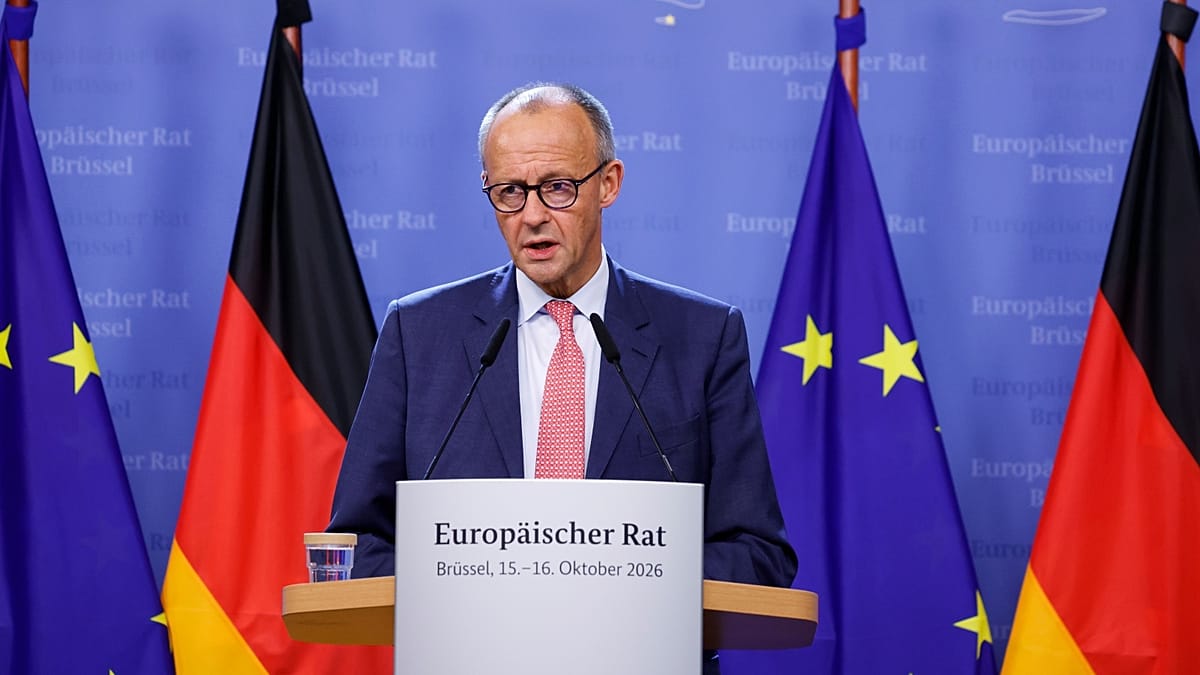
German Chancellor Friedrich Merz has made the deal on the European Union's next budget conditional on fresh support for Ukraine, bringing together two politically sensitive topics that have exposed deep divisions among member states. ADVERTISEMENT ADVERTISEMENT Kyiv is staring down a €70 billion shortfall in its 2027 budget caused by Russia's relentless airstrikes. The EU has promised to cover two-thirds of this gap, roughly €45 billion, through a yet-to-be-defined instrument. "A collective commitment that all of us, without exception, will contribute fairly to closing this gap is an essential prerequisite for resolving this issue and for discussing any further matters, particularly those with financial implications," Merz said in a letter addressed to European Council President António Costa and seen by Euronews. Merz argued that the ongoing negotiations on the bloc's seven-year budget should guarantee "a solution supported by all member states that ensures a sound and multiannual financing perspective for Ukraine from 2028 onwards, including the interest liabilities that have already accrued". The interest refers to the ongoing €90 billion support loan, which is backed by common borrowing among 24 countries. Hungary, Slovakia and the Czech Republic secured an opt-out from the credit line in exchange for providing the necessary unanimity. The principal will not be repaid until Russia agrees to war reparations. However, interest payments will start falling due next year. Initially, Brussels estimated €3 billion per year, but the steep rise in borrowing costs has altered the calculation. The €45 billion that the EU intends to provide Kyiv in 2027 will come on top of the existing loan. Given the massive scale of the gap, a new round of joint debt has quickly emerged as the frontrunner option. The European Commission is set to present countries with possible options ahead of a special summit at the end of the month. In the letter, Merz asks Costa to accelerate the timeline for discussions by putting the matter as a "priority" at this week's informal summit in Dublin. The topic was not originally foreseen in the agenda. The chancellor pointedly regrets that financial and military support for the war-weary country is "distributed unevenly and carried mostly by only a few member states". "Supporting Ukraine is a matter of our indivisible European security, and so must be the burden sharing for that support," he writes. Germany is the largest bilateral donor to Ukraine. Other key backers, such as Denmark, Finland, the Netherlands and Sweden, share Merz's grievances and want to merge the budget and Ukraine into one single package. All these countries happen to belong to the so-called "frugals" or "modernisers" who advocate across-the-board cuts to the draft budget. This has put them on a collision course with the "Friends of Cohesion", who are fighting to retain a high level of expenditure. The Czech Republic, Hungary and Slovakia are signalling they will once again exempt themselves from joint debt to support Kyiv. Bulgaria, a vocal critic of weapons deliveries, is expected to follow suit. The four sit in the cohesion group. Their refusal to participate has angered the so-called “frugal” countries. "The cohesion camp cannot have their cake and eat it," a diplomat said. "There is no money tree in Brussels, so we need to make political choices." Simon Harris, Ireland's finance minister, whose country holds the rotating presidency and moderates negotiations, sided with the "frugals". "It's very hard to have a serious conversation about the European budget for the next several years without Ukraine and the financing of Ukraine," Harris said on Monday morning before heading into a ministerial meeting in Brussels. "We do need to frame this correctly. This is actually European security." But not all member states share the same position. Ignacy Niemczycki, Poland's deputy minister in charge of European affairs, argued last week that the two issues are fundamentally distinct and binding them together could "backfire" and make a final deal "even more difficult" than it is now. Meanwhile, Slovak Prime Minister Robert Fico warned that such a link would be "very dangerous".
No deal on Ukraine aid? Then no deal on EU budget, Merz says
Full Article
Original Source
Read the full article at Euronews →KhanList aggregates and links to publicly available news content. We do not host full articles from third-party sources. Always verify important information with original sources.