
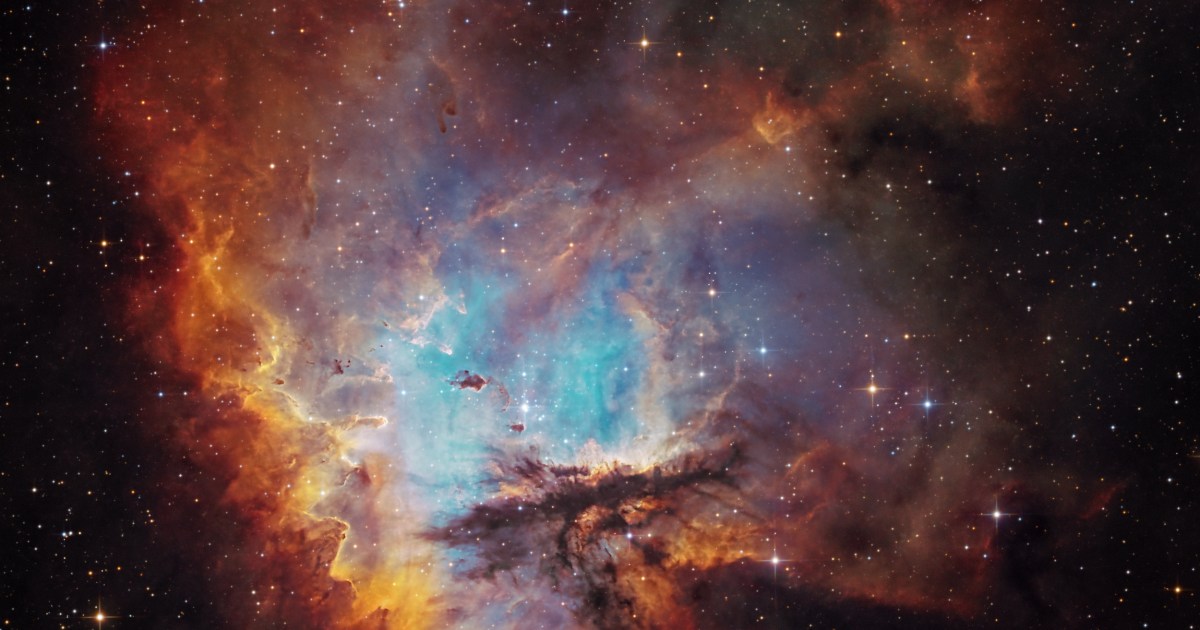
Krisztián Fekete from Budapest, Hungary The Pacman Nebula (NGC 281) is an emission nebula about 9,600 light-years away in Cassiopeia, lit by the star cluster IC 1590 at its center. Dark dust lanes cut across its glowing gas, shown here primarily in Hubble-palette colors — with a subtle enhancement. To enrich the color palette, the imager also added data that reflects singly ionized nitrogen (NII) emission at 658.3 nanometers. This emission line lies just redward of Hα (656.3 nm). Although the imager did not have a dedicated NII filter, he created a proxy by taking an image with a 7-nm Hα filter — which includes NII emission — and subtracting an image taken with a narrower 3-nm Hα filter. The light left behind traces NII, though it can still contain some Hα. July–November 2026 · 8-inch Newtonian reflector at f/3 (with Starizona Nexus 0.75x reducer) · ZWO ASI1600MM Pro camera · 44 hours of total exposure (Hα 9½ hours, OIII 13.1 hours, SII 12.8 hours with Antlia 3nm filters; Hα 4.8 hours with Optolong 7nm filter; RGB 4 hours with ZWO filters)
Nitrogen boost
Full Article
Original Source
Read the full article at Astronomy →KhanList aggregates and links to publicly available news content. We do not host full articles from third-party sources. Always verify important information with original sources.