
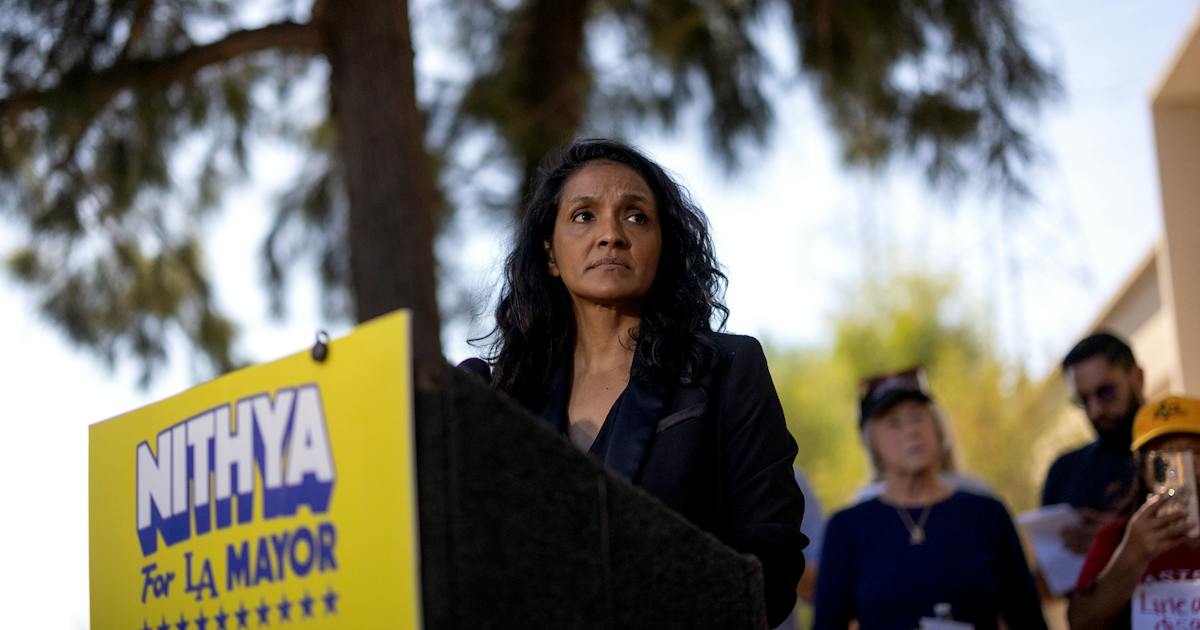
The signs in Los Angeles are everywhere. There are giant billboards for movies, TV shows, and ambulance-chasing attorneys. The eyeline of the average commuter is a running narrative of graffiti: along the highways, snaking under the overpasses, even climbing the skyscrapers downtown. Still, motoring through Los Angeles, there is one sign that’s mostly missing: the campaign yard sign. Hardly any of those familiar political advertisements seem to have appeared in Angelenos’ front yards.Sure, you might spy campaign signs at high-traffic intersections. The local school board candidates have planted their names and slogans at nearly every litter-strewn freeway entrance from Pasadena to Malibu. But nobody seems to be running for anything higher than the school board. Signs supporting Xavier Becerra, who would be the first Latino governor of California, are few and far between. A similar census of yard-borne advertisements for Steve Hilton (who would be California’s first Tory governor) yields few, if any, results. The same is true for the city’s mayoral contest. If incumbent Mayor Karen Bass or her upstart challenger Nithya Raman—the Democratic Socialists of America–aligned Harvard graduate aiming for a generational upset of the sort that Zohran Mamdani undertook in New York—have ardent fans, you wouldn’t know from the city’s front lawns.But even if Angelenos aren’t declaring their preferences in their front yards, that doesn’t mean they’re unaware of the upcoming election. The ads run constantly, the ultrarich are spending a million dollars a day trying to kill this year’s billionaire tax, and the national press regularly frames Raman as the Mamdani of the West. The Mamdani comparisons have become a refrain mostly because they make for a good headline and, at least in the right-wing press, because red baiting drives clicks. But when you take a minute to examine this framing, the comparison fails on two counts. In the first place, Raman and Mamdani are vastly different political creatures. More importantly, the offices they represent are wildly distinct. The mayoralty of Los Angeles is unlike the Big Apple’s equivalent—and intentionally so. In the national political landscape, to be the mayor of L.A. is, well, its own little thing. It’s not nothing, but neither is it a perch to lead a political revolution of the sort that Mamdani wrought. Mamdani is a core DSA member; he spent nearly a decade building the group’s New York infrastructure before harnessing it to knock on something like 1.6 million doors. Raman is also a DSA member, but she joined mostly as a political maneuver to boost her first campaign for City Council in 2020. In the intervening period, she has brokered an uneven relationship with the lefties of Los Angeles. She split with DSA L.A. when she voted to confirm the current chief of the Los Angeles Police Department. The local DSA declined to endorse her in the primary. Even after a hotly contested debate within the chapter, she barely earned its endorsement ahead of the general election. DSA L.A.’s eventual decision to endorse Raman—which was made via an all-member vote—opened the group’s infrastructure to her campaign. Since then, it has knocked on 30,000 doors for her. The DSA’s rise in Los Angeles has run parallel to Raman’s own political story. “This moment in Los Angeles has been building for several years,” says Tal Levy, a member of DSA L.A.’s electoral committee. “Nithya’s first victory to City Council was a major breakthrough—she was the first City Council member to unseat an incumbent in a generation, and on the back of her victory, DSA endorsed and won three more City Council seats.”Still, the city’s other three DSA City Council members have all endorsed Karen Bass, declining to flip their endorsements despite Raman’s lead in the polls. This isn’t that surprising: Raman herself had endorsed Bass before jumping into the race at the last minute to run against her. She’s defended her about-face with the line that “every elected [City] Council member endorses the mayor, you have to do that when you’re in City Hall, that’s how you get resources.” It’s a strange defense, not so much because it is true (it isn’t), but because it positions the City Council as subordinate to the mayor—and the Los Angeles City Council is the most powerful municipal body in the United States. “They have enough power to cause shenanigans for the mayor,” explains longtime California strategist Steven Maviglio. Just last year, for instance, the City Council cut Bass’s proposed additions to the LAPD in half. The year before that, it was one vote shy of overriding the mayor’s veto powers—an action it took in 2021 against Mayor Eric Garcetti.The mayor of New York, by contrast, endures no such nonsense from the New York City Council. But Los Angeles’s division of power is deliberate, and it’s led to the confusing notion that the person supposedly running the whole city is merely a ceremonial figure around town.“The mayor’s office in L.A. was explicitly designed to be unlike the mayors of New York and Chicago,” says Raphe Sonenshein, executive director of the Haynes Foundation. Sonenshein told The New Republic that L.A.’s original City Charter (written in the early 1920s) embodied the theories of the then-dominant progressive reform movement. L.A’s original charterers envisioned a city with “no machines, no bosses, no mayor who could appear to control everything … none of the accoutrements of what were strong mayor systems, usually with large City Councils,” says Sonenshein, adding that “usually, the bigger the City Council, the more powerful the mayor.” New York, for example, has 51 City Council members. Chicago has 50. Los Angeles, by contrast, has 15.But the century-old intention to fashion the mayor of Los Angeles as a weaker figure than the mayor of New York doesn’t validate the common perception that the mayor of the city is powerless. Since the City Charter was written, the mayor’s power has expanded—often to the consternation of the City Council. In the 1950s, Mayor Fletcher Bowron created the position of city administrative officer, a move that gave him substantial power over the budget. Originally, the mayor couldn’t even remove the heads of departments. That began to change after the Rodney King riots when Mayor Tom Bradley initiated a reform to remove the civil service protection from the chief of the LAPD. A few years later, in 1999, voters approved another reform of the city’s charter, giving the mayor the power to fire department heads (excepting the LAPD chief). Again, this complex system is easy to misunderstand. It is not true, for example, as one Wall Street Journal writer recently claimed, that “only the board [of commissioners] can remove” the chief of the LAPD. The City Council can do that too. “There are a lot of personalities on that council,” says Maviglio, “It’s constantly a tug-of-war.” Los Angeles is a city of continual politicking. It is in this respect that a Mamdani type—an affable and charismatic power broker—might thrive. But Raman is far better when talking about policy than she is when she’s talking to people. In most cities, once a mayor has gotten themselves elected, it doesn’t matter so much if they can vibe on podcasts. That’s not the case in Los Angeles, where throughout their tenure, the mayor is constantly forced to play people-first politics.While Raman may not have Mamdani’s charisma, she was sharp enough to read the tea leaves a few months ago. She figured out that this election looks a hell of a lot like one of those cycles where change is on the ballot. So while there might not be many Nithya Raman signs in the front yards of Angelenos, there is an ambient appetite for change in the air. Last year’s wildfires coupled with the ongoing homelessness crisis have bottomed out Bass’s popularity. The fact that Spencer Pratt got a quarter of the city’s vote despite running a campaign devoid of any discernible policies is evidence of L.A.’s appetite for something, anything, that might constitute change. If Mamdani had to hustle to earn his mayoralty, all Nithya Raman really has to do is be there when it happens. And if she can tie her race to the progressive insurgency currently unfolding on the national political scene, that’s a bonus. In a recent appearance on the Higher Learning podcast, Raman sounded on script when she positioned her race against Bass as something that’s just “not done in the Democratic Party—you don’t challenge incumbency. I think that’s a problem.” Her well-timed entrance and her history of shifting positions have led to the criticism that Raman is running for mayor simply in furtherance of her own political ambitions. But this is where hype collides with reality: The mayoralty of Los Angeles offers very little to a striver with political ambition; in fact, it is historically incapable of providing a perch for further political ascension. No mayor here has ever won an election to higher office. Meanwhile, one of the early Democratic front-runners for president, Gavin Newsom, is the former mayor of San Francisco. Asked about this limiting aspect of the role, Maviglio suggested, “I think it’s because the rest of the state looks down on L.A. as an urban mess.… It’s also a problem that California has with the rest of the country. People look at California as that crazy place west of the Rockies.”Los Angeles mayors do not become governors or senators. Instead, they occupy a bizarre nowhere space in the national political landscape. Sure, they’ll be invited to offer platitudes on the opening night of the odd Democratic National Convention. They’ll occasionally get nominated for ambassadorships to Asia (only to have their nominations languish for years in the Senate). The mayor of L.A. may not be a ceremonial figure within the city—that is to say, they have more control than people suspect, but in the larger Democratic firmament, they will typically graduate to a wider variety of mostly ribbon-cutting roles. The mayor cannot dictate the outcome of congressional races within their territory, as Mamdani recently did in New York. Even Tom Bradley—often cited as L.A.’s most powerful mayor—was eventually proven to be weaker than the city’s representatives in Washington. Bradley’s tenure is instructive. He was the mayor of Los Angeles for 20 years, during which time he expanded the power of his office, lost two gubernatorial elections, and presided over the 1984 Olympic Games. The Olympics are returning in 2028, and Bass has attempted to convince voters that Raman is uniquely incapable of leading the city through the event. In the final debate before the election, the sitting mayor called the upcoming Olympics “the greatest sporting event in U.S. history” and said the “city would be destabilized” if Raman is elected. But Angelenos don’t seem to care about these supposedly high stakes. Five days later, that mayoral debate stream had been viewed 81,000 times, which sounds like a big number until you hear that, in the same respective time frame, the Mamdani-Cuomo debate stream had 1.2 million views. So, as you drive through Los Angeles, you may not notice many yard signs dictating preferences in the mayoral race. Maybe that’s a meaningless metric. Maybe it’s too anecdotal. Maybe the Santa Ana winds blew all the yard signs into the Pacific while no one was looking. Still, it seems more likely that the position—the actual job of running Los Angeles—just doesn’t prompt the kind of race that inspires people to put out yard signs. Maybe the role of mayor of Los Angeles isn’t a stepping stone, or a position of pivotal significance. Maybe it’s just a sideshow—a seat for pseudo-political dreamers, ruling a city that’s best known for breaking dreams.
Nithya Raman May Be L.A.’s Next Mayor. Don’t Expect a Revolution.
Full Article
Original Source
Read the full article at Newrepublic →KhanList aggregates and links to publicly available news content. We do not host full articles from third-party sources. Always verify important information with original sources.