
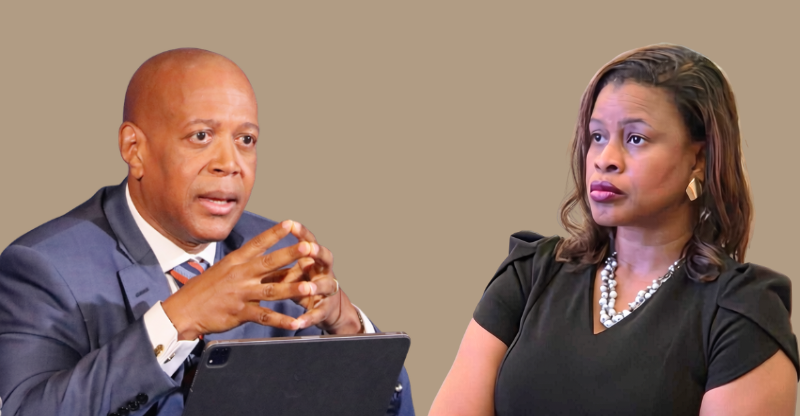
Central Bank of Barbados Governor Dr Kevin Greenidge (left) and Lisa Wade, principal and consulting actuary at Eckler Limited (right). (Photos by: Ricardo Roberts, File Photo) The last major reform of the old-age contributory pension came in 2003-04, when the contribution rate went up from 14 per cent to 18 per cent and the age for a full pension rose from 65 to 67. The 17th actuarial review of the scheme warned that without corrective measures, the National Insurance Fund could run out of money between 2034 and 2041. A reform package followed in 2023. Labour Minister Colin Jordan set out the changes in a ministerial statement on July 28 that year. Under the amended law, the pensionable age stays at 67 until the end of 2027. It rises to 67.5 from January 2028 and to 68 from January 2034. The earliest age for a reduced pension is also going up, from 60 to 61 in 2025, 62 in 2028 and 63 in 2031. The reforms did not raise contribution rates for employers or employees. They did increase the contributions needed to qualify for a pension from 500 weeks (about 10 years) to 750 weeks (about 15 years). This does not affect people who were 60 or older on January 1, 2024. A revised formula for new pension awards will also gradually make average new pensions about seven per cent smaller over five years. Trade unions oppose the higher pensionable age. The Congress of Trade Unions and Staff Associations of Barbados called it “unwarranted”. Employers urged to consider moving retirement age closer to 68 You Might Be Interested In Employers and pension trustees are being urged to consider moving workplace retirement ages closer to 68, as National Insurance reforms are expected to meaningfully reduce state pension benefits for future retirees. Pension trustees, plan sponsors and financial policymakers across Barbados face mounting pressure to rethink retirement norms, strengthen plan governance and expand access to credible long-term investments as the country navigates demographic shifts and a rising state pension age. Addressing a pension investment conference, Lisa Wade, principal and consulting actuary at Eckler Limited and Central Bank of Barbados Governor Dr Kevin Greenidge underscored that pension arrangements represent a solemn promise to working Barbadians. Both speakers stressed that while defined contribution plans have become the dominant model in Barbados and abroad, shifting investment risk onto individual members makes active oversight, regular benefit reviews and clear member communication essential. Wade warned that the recent formalisation of reforms arising from the 2023 National Insurance review is likely to result in a meaningful reduction in old-age contributory pension benefits for future generations of retirees, while current retirees continue receiving their existing benefit levels. She noted that steep penalties for retiring before the age of 68 make maintaining a traditional retirement age of 65 less affordable for employees. Wade said: “It is going to be a sea change for us, but it is something that needs to be seriously considered at this point in time, given the changes that have been made to National Insurance.” She urged employers and trustees to examine whether workplace retirement ages should move closer to 68, so workers can qualify for higher state pensions and gain three extra years to build savings in defined contribution plans. She criticised a widespread “set it and forget it” approach to defined contribution schemes in Barbados. She noted that plans are often set up without ongoing reviews of benefit adequacy, contribution levels or investment performance. She also pointed out that because participation has been voluntary since the enactment of the Occupational Pension Benefits Act, younger workers — such as a 25-year-old opting out — may not grasp the long-term financial consequences of bypassing workplace retirement savings. “One change that we would hope to – and we are advocating for, and have advocated for in many cases – is that the Occupational Pension Benefits Act indicates that joining a pension plan can be voluntary,” Wade said. Eckler would like to see the law amended so employers can make plan membership a term and condition of service alongside voluntary options, she said. On taxation, Wade welcomed raising the income tax threshold to $70 000 a year, which makes pensions largely tax-free for most Barbadians, but argued more is needed to reward additional saving. She called for tax neutrality on voluntary pension contributions so that saving through a pension plan is not penalised compared with other savings vehicles, and urged the removal of double taxation on voluntary contributions. Dr Greenidge described pension funds as a vital pool of long-term capital that must be deployed carefully to protect members’ retirement security while supporting national resilience. He cited Financial Services Commission data showing 238 registered occupational pension plans at the end of October, comprising 138 defined contribution plans, 75 defined benefit plans and 25 hybrids. He noted that an ageing population and a widening gap between deaths and births make adequate retirement income even more urgent. Macroeconomic stability has improved markedly since 2018, with international reserves rebuilt to roughly $2.8bn (about 23 weeks of import cover) and credit ratings strengthened. But Dr Greenidge said growth moderated to 1.4 per cent in the first half of the year amid shorter tourist stays and higher energy costs. The governor acknowledged that the domestic capital market remains shallow, with limited secondary market liquidity and heavy concentration in sovereign exposure and a handful of large funds. “We have to be truthful, our domestic market is just too shallow,” Dr Greenidge said. “We have savings in the bank – probably close to $16bn in savings in the financial system –but the market is yet to provide enough instruments [that] offer a range of returns, maturity, liquidity and risk that you as pension fund managers and pension funds will need.” Renewable energy, energy storage, water, housing and regional capital market initiatives were touted as promising areas. But he said projects needed to be properly structured, with credible cash flows, independent valuations and clear risk allocation, and are not automatically treated as bankable investments. On overseas diversification, Dr Greenidge said the Central Bank accommodates prudent foreign investments within reserve limits. He encouraged trustees to plan their annual foreign exchange needs in advance and to submit full-year requests rather than piecemeal applications. “At the end of the day, the money belongs to the plan members,” Dr Greenidge said. “The duty of you as trustees is to protect those interests.” (RR)
NISSS Pensions: What to Know
Full Article
Original Source
Read the full article at Barbadostoday →KhanList aggregates and links to publicly available news content. We do not host full articles from third-party sources. Always verify important information with original sources.