
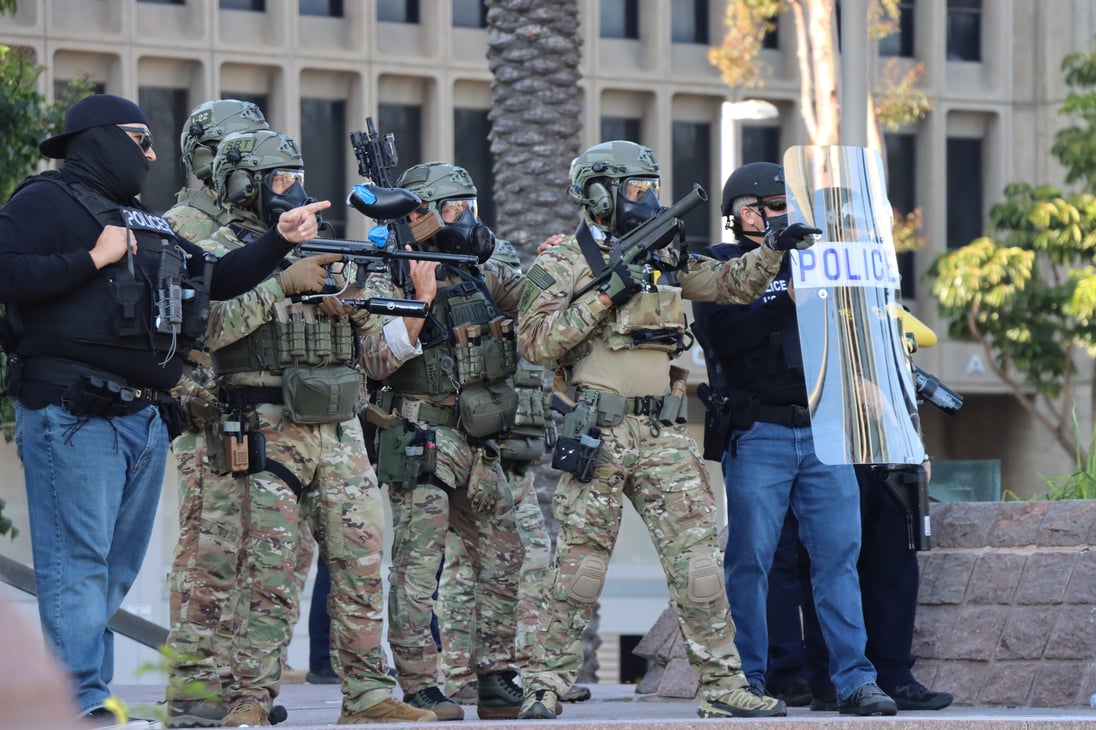
The appellate panel found the California law is void insofar as it seeks to regulate the federal government without congressional authorization.PASADENA, Calif. (CN) — The Ninth Circuit on Wednesday ruled California’s “No Vigilantes Act,” which requires federal law enforcement agents to wear visible identification when on duty, violates the supremacy clause of the U.S. Constitution and can’t be enforced.The appellate panel had previously issued a stay pending appeal of the trial judge’s ruling that the federal government wasn’t entitled to a preliminary injunction to halt enforcement of the law while its legality was unresolved.In a unanimous decision Wednesday, after they had conducted a hearing on the government’s appeal in August, the three-judge panel reversed Senior U.S. District Judge Christina Snyder’s denial of the federal government’s request for a preliminary injunction and ordered her to issue one.“The supremacy clause prohibits states from directly regulating federal operations even when regulating state operations in the same manner,” U.S. Circuit Judge Mark Bennett, a Donald Trump appointee, wrote for the panel.“if a state law directly regulates the governmental conduct of the United States without congressional authorization, it is void irrespective of whether the regulated activities are essential to federal functions or operations, and irrespective of the degree to which the state law interferes with such functions or operations,” he added.U.S. Circuit Judge Jacqueline Nguyen, a Barack Obama appointee, and U.S. Circuit Judge Daniel Collins, a Trump appointee, joined the opinion.“Transparency and accountability are the foundation of good law enforcement — law enforcement refusing to identify themselves undermines our collective safety,” the California attorney general’s office said in response to the ruling. “We’re disappointed in today’s decision and reviewing the court’s opinion.”Lawmakers passed the “No Vigilantes Act” in 2025 in the wake of the unprecedented U.S. Immigration and Customs Enforcement crackdown on people suspected of being in the country without proper authorization.The Trump administration unleashed its immigration crackdown in Southern California in June 2025. Roving patrols of ICE agents, typically wearing face masks, no identification and driving unmarked cars, rounded up people who looked like working-class Latinos at Home Depot parking lots, car washes, bus stops and towing yards.Governor Gavin Newsom signed the No Vigilantes Act and the No Secret Police Act, which prohibits federal law enforcement agents from wearing face masks while performing their duty, in September 2025 as part of a package of legislation that was intended to push back at President Trump’s “secret police” tactics in California.“For Trump and Miller, the only metric is mass arrests, detentions and removals — even at the expense of Americans’ constitutional rights,” Newsom said at the time, referring to White House Deputy Chief of Staff Stephen Miller. “ICE agents have wrongfully arrested citizens, concealed their identities and undermined transparency.”Snyder blocked enforcement of the provision of the No Secret Police Act that prohibits federal agents from wearing face masks because the provision doesn’t apply to some state law enforcement agents and, as such, was discriminatory.The Bill Clinton appointee wasn’t persuaded, however, by the government’s argument that “discretionary” masking and identification policies were essential to safety of its law enforcement agents in the current, tense political climate.“Security concerns exist for federal law enforcement officers with or without masks,” Snyder wrote. “If anything, the court finds that the presence of masked and unidentifiable individuals, including law enforcement, is more likely to heighten the sense of insecurity for all.”In addition, Snyder found the government’s argument that face masks are needed to protect its agents is belied by the fact that there are no requirements for the agents to wear them.The two laws were initially supposed to take effect Jan. 1, but California agreed to stall enforcement until the judge had had an opportunity to review their legality. Homeland Security, which includes ICE, had indicated it didn’t intend to comply with California’s requirements.Subscribe to our free newslettersOur weekly newsletter Closing Arguments offers the latest about ongoing trials, major litigation and rulings in courthouses around the U.S. and the world, while the monthly Under the Lights dishes the legal dirt from Hollywood, sports, Big Tech and the arts.Additional Reads
Ninth Circuit strikes down California ‘No Vigilantes Act’ as unconstitutional
Full Article
Original Source
Read the full article at Courthousenews →KhanList aggregates and links to publicly available news content. We do not host full articles from third-party sources. Always verify important information with original sources.