
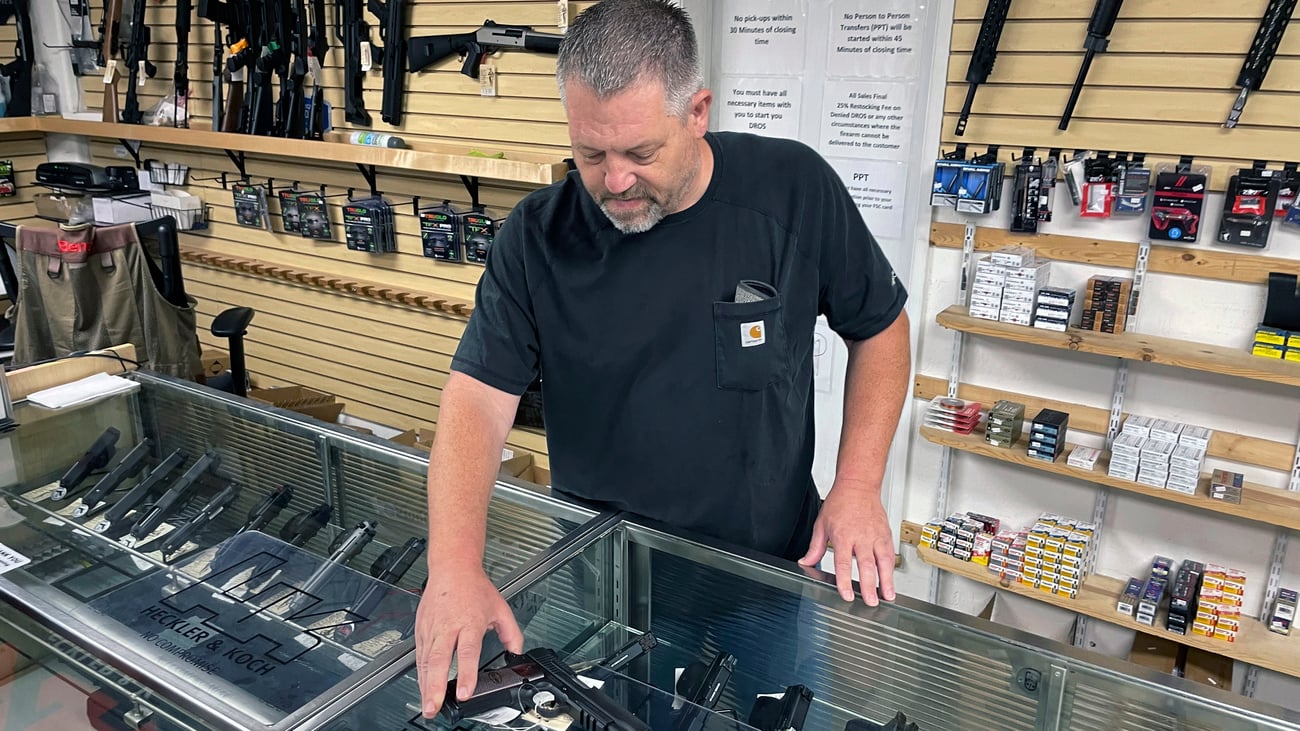
Firearm dealers had described the surveillance system requirement as a government-mandated eavesdropping device.PASADENA, Calif. (CN) — Federally licensed firearm dealers in California will still need to maintain a surveillance system after a Ninth Circuit panel ruled in favor of the state on Thursday.The plaintiffs, private licensed firearm dealers who operate out of storefronts and home businesses, say a state law passed in 2023 requiring the surveillance systems is a violation of their First, Fourth and Fifth amendments. The law, California Penal Code Section 26806, requires the firearm dealers to maintain 24-hour video and audio surveillance systems on their business premises.The plaintiffs described the surveillance system requirement as a government-mandated eavesdropping device. The plaintiffs argued the surveillance systems violated their rights regardless of whether the state ever viewed the recordings.A federal judge in the U.S. District Court for the Central District of California dismissed the plaintiffs’ complaint for failure to state a claim in January 2025. In a 2-1 decision authored by U.S. Circuit Judge Lucy Koh, the Ninth Circuit affirmed the ruling.Beginning with the plaintiffs’ Fourth Amendment claims, Koh, a Joe Biden appointee, found the California law did not violate the constitutional rights in the plaintiffs’ complaint.“The panel rejected plaintiffs’ contention that a search occurs the moment that a federally licensed firearm dealer’s recording system begins to record any audiovisual data,” Koh wrote. “Plaintiffs failed to state a cognizable claim that Section 26806 violates the Fourth Amendment because plaintiffs failed to allege any physical intrusion or access of recordings by the state and failed to allege that mere compliance with Section 26806’s requirements transforms federally licensed firearm dealers into state actors.”This does not mean federally licensed firearm dealers could not object to specific Fourth Amendment violations by the state but rather that the threat of a possible inspection is not sufficient to prohibit the law, Koh wrote.However, the plaintiffs were bolstered by a sharp dissent from U.S. Circuit Judge Kenneth Lee, who described the law as an unprecedented invasion of gun owners’ private place of business that would inevitably chill speech.“As the plaintiffs explain, gun stores are a hub of political activism where owners and patrons discuss their Second Amendment rights and their involvement in political activities,” Lee, a Donald Trump appointee, wrote. “California’s surveillance law, however, will likely impede the exchange of this core First Amendment speech because people are wary of speaking freely if they know that they are being audiotaped, especially if the government may potentially listen to these conversations up to a year later. The First Amendment shrivels under the constant surveillance of even a benevolent Big Brother.”Lee worried the law was overbroad and needlessly required constant recordings of the firearm dealers’ businesses. The law also opens the door to needless inspection at the government’s whim, he wrote.“California’s federally licensed firearm dealer surveillance law is staggering in scope,” he continued. “California should not trample on the constitutional rights of its citizens and gun retailers under the vague guise of safety.”The panel also concluded the plaintiffs failed to raise a Fifth Amendment claim, rejecting their argument that the surveillance systems also amounted to a physical taking, or regulatory taking, of private property. The plaintiffs argued this requirement invaded private property and did not promote a common good.But Koh also shot these arguments down.“The California Legislature determined that enacting Section 26806 would promote the common good by aiding law enforcement in combating and deterring firearms trafficking, theft, straw purchases and other gun crimes,” she concluded. “Plaintiffs have given us no reason to question that judgment.”The panel also rejected the claim that the surveillance systems would effectively chill First Amendment rights by monitoring their speech and activities.“Plaintiffs’ contention that Section 26806 will ‘inevitably’ chill speech failed because plaintiffs did not allege that a person of ordinary firmness would fear adverse action from the government and instead alleged only a subjective fear that the state might misuse recordings in some unspecified way,” Koh wrote.The lawsuit was filed in late 2023 by individual firearm dealers who operate their businesses from their residences, as well as shooting instructors and Second Amendment rights organizations.Chuck Michel, president of the plaintiff organization California Rifle & Pistol Association, was disappointed by the decision on Thursday, likening the surveillance requirement to Flock cameras.“California politicians continue to do all they can to deprive people of guns for sport and self-defense through intimidation, exorbitant fees and useless red tape,” he wrote in a statement to Courthouse News. “These cameras, like Flock cameras, invade everyone’s privacy and record political speech accompanying every gun purchase. They are useless in fighting unlawful sales. We will be seeking review of this 2-1 decision by the en banc court, and the Supreme Court if it comes to that.”U.S. Circuit Judge Ana de Alba, also a Biden appointee, joined Koh in her opinion.Spokespersons for the California Attorney General’s Office and the firearm dealers did not respond to requests for comment.Subscribe to our free newslettersOur weekly newsletter Closing Arguments offers the latest about ongoing trials, major litigation and rulings in courthouses around the U.S. and the world, while the monthly Under the Lights dishes the legal dirt from Hollywood, sports, Big Tech and the arts.Additional Reads
Ninth Circuit rules California gun dealers must keep surveillance systems
Full Article
Original Source
Read the full article at Courthousenews →KhanList aggregates and links to publicly available news content. We do not host full articles from third-party sources. Always verify important information with original sources.