
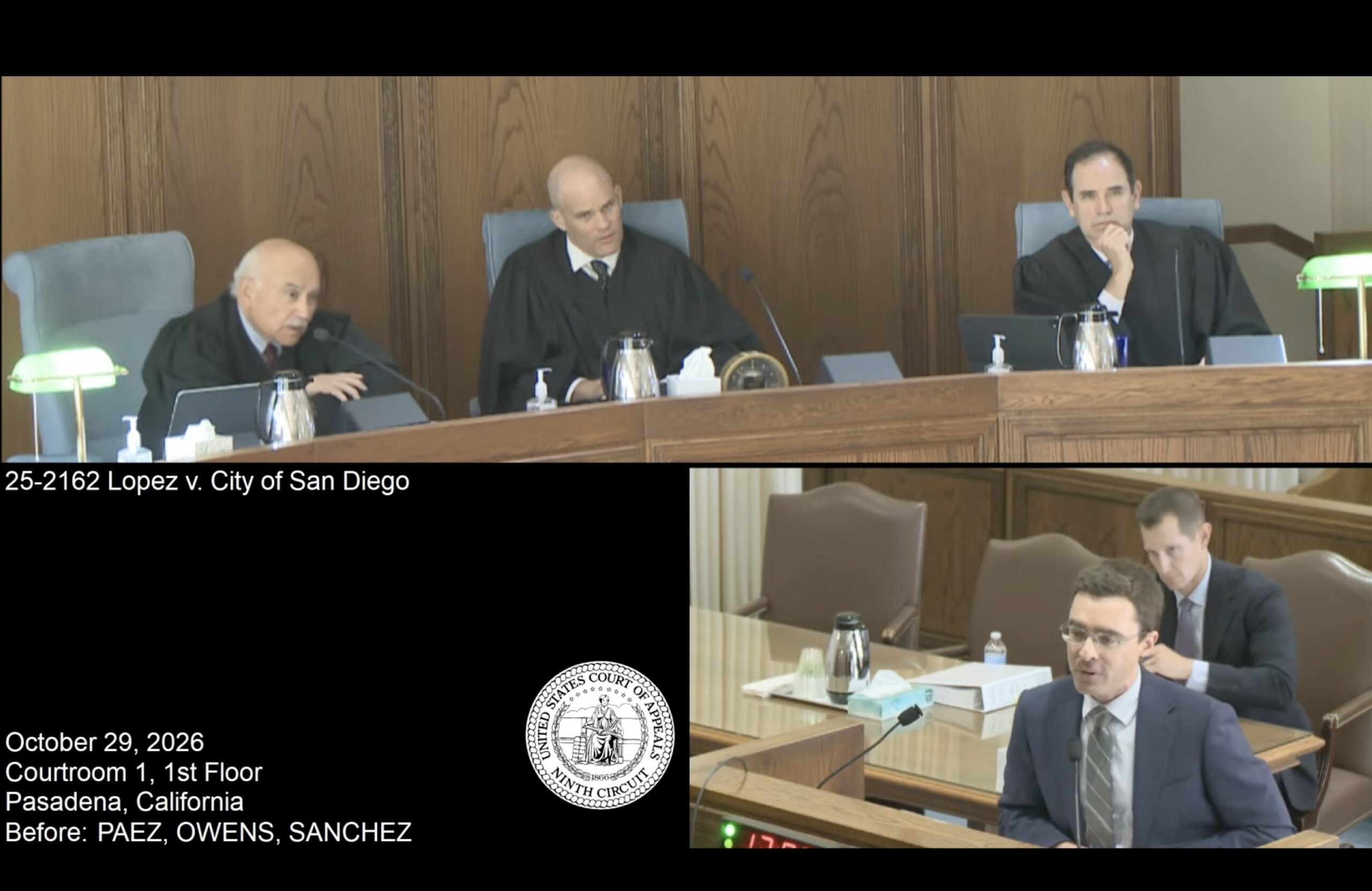
A Ninth Circuit panel pressed attorneys on whether San Diego's restrictions on speech outside abortion clinics are unconstitutionally vague, as an anti-abortion protester seeks to revive his dismissed lawsuit.SAN DIEGO (CN) — An anti-abortion protester urged a Ninth Circuit panel on Thursday to revive his lawsuit challenging a San Diego ordinance restricting speech outside abortion clinics, arguing that it unconstitutionally limits peaceful sidewalk counseling.The plaintiff, Roger Lopez, says the city violated his First and Fourteenth Amendment rights when it enacted the ordinance. He asked athree-judge panel to reverse the dismissal of his lawsuit and denial of a preliminary injunction that would block enforcement of the ordinance while his case proceeds in federal court.“Mr. Lopez is a peaceful sidewalk counselor, who seeks to have caring, face-to-face conversations with women entering clinics about resources available, if they choose to carry their pregnancies to term,” attorney Michael McHale, of the Thomas More Society, told the panel. “But San Diego has effectively stifled that message, adopting a multi-pronged ordinance that unnecessarily sweeps in and criminalizes peaceful pro-life sidewalk counseling.”But McHale faced immediate skepticism as all three members of the panel peppered him with questions within the first minute of his argument.Senior Circuit Judge Richard Paez, a Bill Clinton appointee, asked why the lawsuit was not entirely determined by Hill v. Colorado, a 2000 Supreme Court decision finding a state law restricting protests outside health care facilities did not violate the First Amendment.The city argued that its ordinance was based on the Colorado law in a motion to dismiss Lopez’s lawsuit, filed in September 2024. A U.S. district judge dismissed the lawsuit in March 2025, relying on the Hill decision.Lopez argues that the ordinance is unconstitutionally vague and overbroad and discriminates against anti-abortion protesters.The ordinance expands an existing law that created buffer zones extending 100 feet from the entrances and exits of schools, health care clinics and places of worship. Within these zones, it prevents people like Lopez from approaching anyone entering or leaving the buildings within 8 feet to speak with them or hand them literature without their consent.Lopez challenged specific restrictions in the ordinance, including the 8-foot rule and provisions governing harassment and noise. McHale argued that Hill did not address bans on vaguely defined harassment or noise.“The definition of the harassment [provision] talks about knowing and willful targeting of a specific person in a way that would seriously alarm or aggravate, cause substantial distress to intimidate, terrorize, threaten or torment a reasonable person,” Circuit Judge Gabriel Sanchez, a Joe Biden appointee, said. “That’s a very conduct-based definition. Why is that not sufficiently specific for a person to understand that they couldn’t harass someone else?”McHale argued that approaching someone with a pamphlet could constitute harassment under the ordinance as written. Similarly, someone driving past a protected area while playing offensive or sexually explicit music could be perceived as violating the ordinance, he said in response to the panel’s questions.But San Diego Deputy City Attorney Matthew Zollman disputed those interpretations. Harassment must be knowingly and willfully directed at a specific person entering or exiting a protected facility, and the conduct must be alarming to a reasonable person, he said.“The ordinance also gives concrete examples of what would be harassment, for example, following someone who has said ‘no,’ unwanted touching, threatening gestures, and it creates a safe harbor for displaying signs for more than 8 feet,” Zollman said. “To be clear, it’s not the message itself that constitutes the harassment.”The panel also expressed skepticism about the city’s noise restrictions.Zollman argued that the provision primarily regulates protest volume that could interfere with access to facilities, rather than speech that might cause emotional discomfort.Circuit Judge John Owens, a Barack Obama appointee, asked whether someone could hypothetically hum the Darth Vader theme song as a person entered or left a facility.“Would that be a violation?”No, Zollman said.“It’s a sound regulation, not a content regulation,” he argued.But Sanchez said that distinction was not clear from the ordinance.“I still don’t see how it doesn’t fall short of a vagueness challenge, because how are we, or anyone supposed to know that noise is not meant to encompass forms of speech, as you were just describing to us now?” he said. “It doesn’t seem apparent from the face of the ordinance.”Zollman argued that, read in context, the ordinance is tailored to ensure safe access to facilities and protect their operations.Lopez, who has not been cited under the ordinance, can continue his sidewalk counseling, Zollman said.Lopez claims the city enacted the ordinance in retaliation for the Supreme Court’s 2022 Dobbs decision.Other conservative demonstrators have also challenged the ordinance.Subscribe to our free newslettersOur weekly newsletter Closing Arguments offers the latest about ongoing trials, major litigation and rulings in courthouses around the U.S. and the world, while the monthly Under the Lights dishes the legal dirt from Hollywood, sports, Big Tech and the arts.Additional Reads
Ninth Circuit panel skeptical of San Diego abortion clinic speech restrictions
Full Article
Original Source
Read the full article at Courthousenews →KhanList aggregates and links to publicly available news content. We do not host full articles from third-party sources. Always verify important information with original sources.