
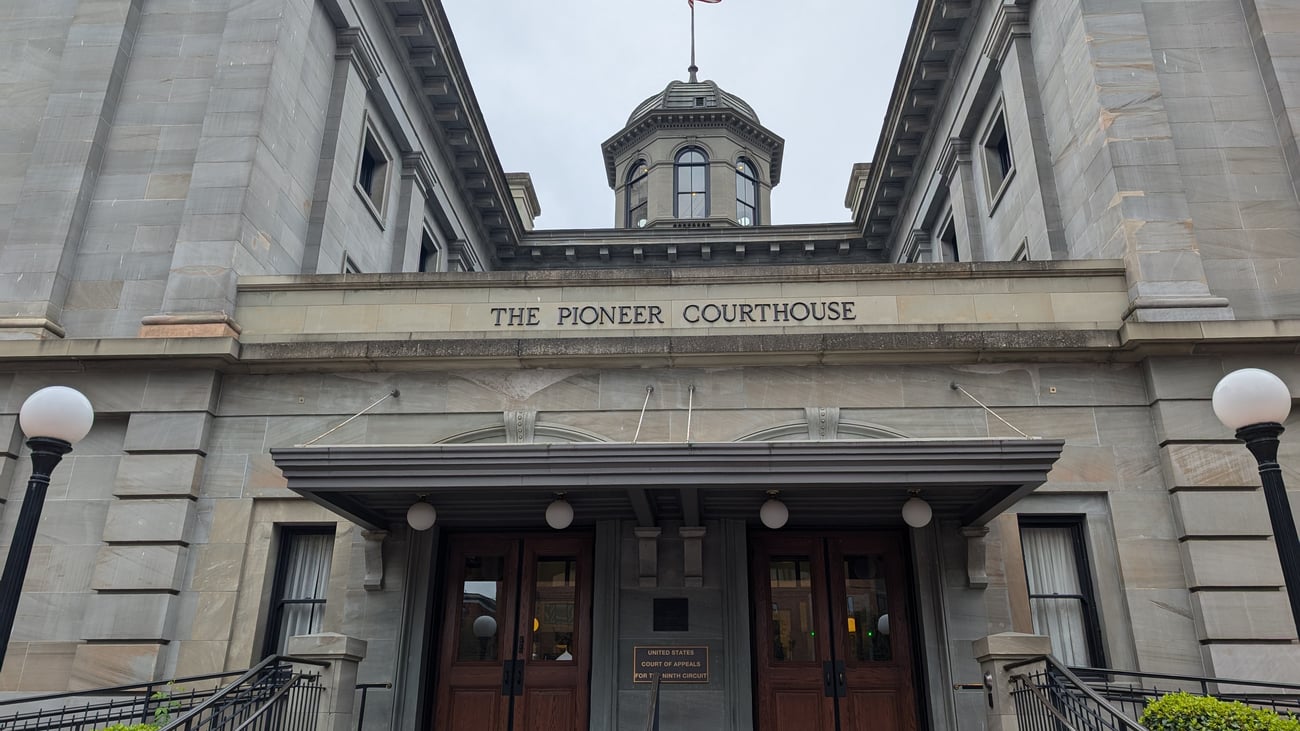
(CN) — A three-judge panel on the highest federal court in the Western states ruled that Idaho had violated the First Amendment by enforcing a “process-first” policy that resulted in a blackout of new court pleadings when they are received.In clear and undiluted language, the Ninth Circuit addressed and rejected the arguments against public access advanced by Idaho and other states in fighting cases brought by Courthouse News.“The right of public access to judicial proceedings ensures that the individual citizen can effectively participate in and contribute to our republican system of self-government. The right therefore falls within the heart of the First Amendment’s coverage,” wrote Judge Margaret McKeown.The challenge by Courthouse News started five years ago and landed in front of U.S. District Court Judge David Nye who ruled in favor of Courthouse News after months of depositions and document-gathering as well as written and oral arguments in his courtroom in Boise.He issued an injunction ordering the Idaho courts to stop withholding access. It was put on hold while Idaho appealed his ruling. With the Ninth Circuit decision Wednesday, his injunction kicks to the “on” position.Idaho’s appeal was heard last December in the historic Ninth Circuit courthouse in Portland, before judges McKeown, Jennifer Sung and Sidney Fitzwater, a federal judge from Texas sitting with the appeals court temporarily.The case for Courthouse News was argued by Jon Fetterly who worked with Katherine Keating, both from the Bryan Cave law firm in San Francisco. Keely Duke with the Duke Evett firm in Boise argued for Idaho.In affirming Nye, the Ninth Circuit slammed a key defense argument used by Duke and many state court clerks. They claim they are protecting privacy. McKeown made the point often argued by Courthouse News — that the person filing the pleading is the one responsible for what’s in it.“Idaho’s interest in protecting litigant and third-party confidentiality is not, properly construed, Idaho’s duty at all — it is the duty of filer, and not the clerk or the Idaho courts,” she wrote.In the main opinion, where all three judges were in agreement, McKeown applied the granddaddy of public access decisions — named after the Riverside Press-Enterprise newspaper which challenged a closed court hearing — where the Supreme Court said the government must have an overriding reason to refuse public access and, even with an overriding reason, there must be no reasonable alternative.Courthouse News showed there were reasonable alternatives to denying access. Many state courts, as well as the federal courts, give access to new pleadings immediately, by setting up a queue where the new complaints can be seen as they arrive at the courthouse, or by automatically accepting them into a public docket.“Idaho has failed to demonstrate that automatically accepting newly filed complaints is an unreasonable alternative to its current unconstitutional process-first policy,” wrote McKeown. “Accordingly, Idaho has not proven that its process-first policy survives Press-Enterprise scrutiny."The ruling comes with a history.Another legal war — costing millions of dollars in legal fees with three trips to the court of appeals — took place in California after the state court in Ventura started doing the same thing as Idaho, holding back the new pleadings until the news in them was stale, like day-old bread.The California case, called Courthouse News v. Planet, took nearly ten years to litigate but resulted in a Ninth Circuit opinion in 2020 that established a foundational principle: the First Amendment right of access attaches to public documents at the time they arrive at the courthouse.In Thursday’s Ninth Circuit ruling against Idaho, the reasoning used in that earlier 2020 Planet opinion was the subject of second, concurring opinion by McKeown that accompanied her main opinion. She was joined in that second opinion by Judge Jennifer Sung but not by Fitzwater.In the concurring opinion, McKeown and Sung said the earlier Planet opinion had incorrectly described the restriction on access and also incorrectly described the standard used to decide First Amendment public access cases.The Planet opinion categorized the withholding policy Courthouse News was challenging as a “time, place and manner” restriction comparable to restrictions on speech in public settings. The Planet panel also described the Press-Enterprise test as one that involved “rigorous” scrutiny — rather than much tougher “strict” scrutiny.While the difference may seem a matter of words, the use of “rigorous” rather than “strict” in the Planet decision has in fact caused a great deal of argument, confusion and legal expense in other federal circuits. It has allowed court clerks to argue that a little bit of restriction is OK.“Our court, in the Planet cases, misidentified Ventura County’s process-first policy as a time, place, and manner (TPM) restriction,” wrote McKeown. “That error, which originated in our court, has proliferated in our sister circuits as CNS continues to litigate this issue across the country.”Despite misidentifying the type of restriction as a time, place and manner restriction, and also misstating the test as rigorous but not strict, the Planet ruling did apply the Press-Enterprise standard and came to the right conclusion. “Two wrongs made a right,” she wrote. “Indeed, every court to have reached the merits of CNS’s challenges to process-first policies has applied Press-Enterprise scrutiny."Outside of her court opinions, Judge McKeown has written extensively for law journals. She is also the author of a well-received book: Citizen Justice: The Environmental Legacy of Justice William O. Douglas — Public Advocate and Conservation Champion.And her court, the Ninth Circuit, practices what she preaches.Anybody can sign up for notifications of filings in cases pending in the Ninth Circuit. Chris Marshall, the Courthouse News bureau chief in charge of coverage in the Western states, received notice of Thursday’s opinion at the exact same time as the lawyers in the case.The ability to track cases and request notice of new entries in the docket is something Courthouse News has been asking courts to implement over the past two decades. The requests have often been akin to a wolf howling on a post-apocalypse planet. While a number of federal courts have agreed to allow journalists and others to receive notices, many have denied or simply ignored the requests.The District Court in the Southern District of New York eventually provided journalists with the ability to track new docket entries but only after a letter and repeated requests from Courthouse News, plus establishment of a committee headed by a judge who is the daughter of a famous First Amendment advocate, and then only as a pilot project, out of concern that the requests would crash the court’s software. The pilot project has since been made permanent.Not a single state court in the nation allows the public or press to track individual cases by receiving notifications of new entries in the docket, as the Ninth Circuit does.Coming back to Thursday’s ruling, Judge McKeown ended the 29-page pair of rulings by addressing the importance of free discussion in governmental affairs — an issue that is particularly relevant in the current run of news over government tactics.“It should be very difficult to survive Press-Enterprise scrutiny. The First Amendment right of public access to judicial proceedings protects the free discussion of governmental affairs, which lies at the heart of the First Amendment. The watchful eyes of the public and free press are essential to the functioning of our government. When unconstitutional closure occurs, appeal to the judiciary is often the only method by which the press can have its rights vindicated.“A state may impose an access delay only so long as its policy can survive our most exacting scrutiny,” she wrote in wrapping up her opinion. “Such is the importance of the First Amendment right of public access.”Subscribe to our free newslettersOur weekly newsletter Closing Arguments offers the latest about ongoing trials, major litigation and rulings in courthouses around the U.S. and the world, while the monthly Under the Lights dishes the legal dirt from Hollywood, sports, Big Tech and the arts.Additional Reads
Ninth Circuit delivers sweeping victory to news service on public access
Full Article
Original Source
Read the full article at Courthousenews →KhanList aggregates and links to publicly available news content. We do not host full articles from third-party sources. Always verify important information with original sources.