
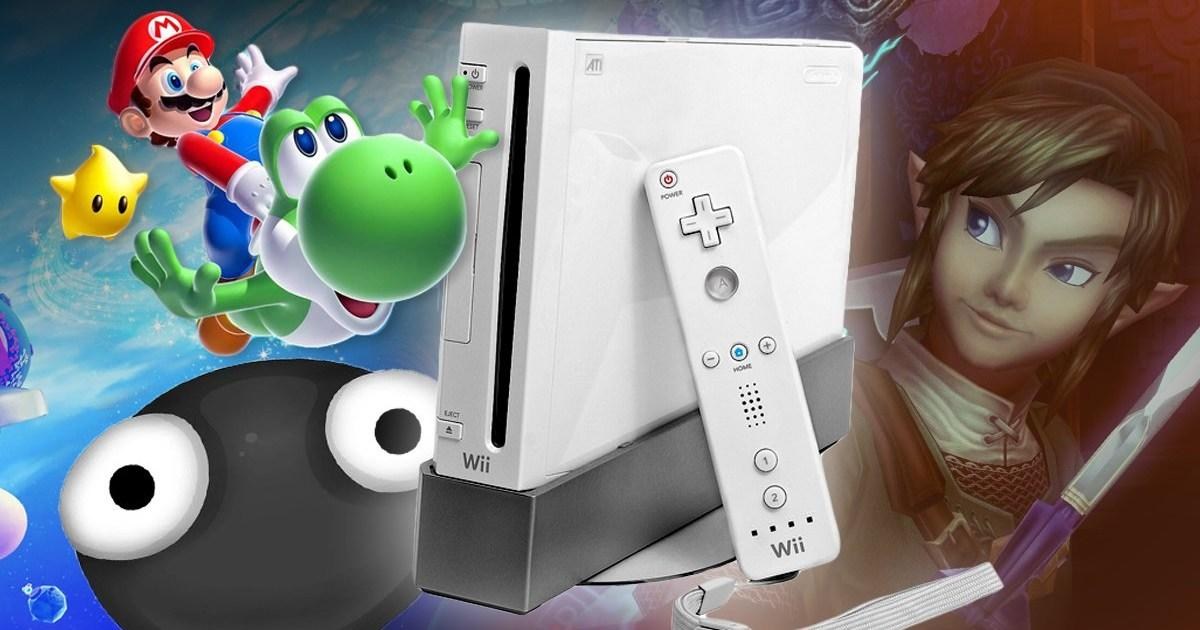
What are you fondest Wii memories? (Nintendo/2D Boy/Metro) To celebrate the Wii’s 20th birthday, GameCentral looks back at how the console became a success and rates its best games. November 19 marked the 20th anniversary of the Wii, having debuted on that day in the US back in 2006 (the UK didn’t get it until December 8, nearly three weeks later). It’s not an exaggeration to say it’s one of the most important consoles in Nintendo’s history and yet it has a very mixed reputation. Aside from being incredibly successful, lasting seven years, and selling 101.63 million consoles, its success fundamentally changed Nintendo’s approach to designing new hardware and its influence can still be felt to this day with the Nintendo Switch. So, to celebrate the Wii’s birthday, we’re going to look back at its origins, its impact, and its best games, that still hold up all these years later. The history of the Wii While the GameCube is fondly remembered by many, it was far from the success Nintendo was looking for. Want GTA 6 news? Sign up to the GameCentral newsletter for the latest GTA 6 news, reviews of new games you should play and exclusive analysis of the biggest stories of the week. If it weren’t for the Wii U, it would be Nintendo’s worst performing console and while still profitable, it was outdone by the original Xbox and especially the PlayStation 2. There were multiple reasons for this – a weak launch line-up of games, limited third party support, and Nintendo being perceived as only ‘for kids’ – but the end result was a change in tack from Nintendo. Rather than try to win over the hardcore gamer crowd, Nintendo opted to go in the opposite direction and appeal to a broader audience – families and those who don’t typically play games at all – while offering a unique gimmick not seen on rival hardware; a decision motivated by the success of the Nintendo DS handheld and its dual screens. This in turn prompted the idea of creating a very simple controller; one that even your grandma could understand how to use. Thus, the Wii Remote offered motion controls and only a handful of buttons, requiring you to simply point ‘n’ click to navigate its menus, just like a TV remote. Then Nintendo president Satoru Iwata made a point of showing how compact the Wii was compared to other consoles (YouTube) Initially codenamedRevolution, Nintendo finalised its name as the Wii, because it sounds like the word ‘we’ and thus ‘emphasises that the console is for everyone.’ There was, unsurprisingly, plenty of mockery about the name and combined with Nintendo eschewing graphical power and focusing on non-gamers, as well as the continued perception that Nintendo was just for children, some people were convinced the new console was doomed. Obviously, that’s not how it turned out and a lot of crow was eaten come the Wii’s launch. It became the must-have Christmas present in 2006 and supply struggled to meet the overwhelming demand for it. Thanks to the freebie that was Wii Sports, Nintendo successfully demonstrated how the console could serve casual audiences and bring them into Nintendo’s ecosystem. Although they also tried to placate the dedicated gamer crowd, with launch title The Legend Of Zelda: Twilight Princess, the newest entry in the prestigious series which went on to become the best-selling Zelda game ever (until Breath Of The Wild 11 years later). While Nintendo wasn’t the inventor of motion controls in video games, it did popularise them thanks to the Wii Remote’s motion tracking being very accurate. There were anecdotes after launch, of people accidentally throwing their controllers into their TVs, but since the Wii had frequent warning messages about keeping the wrist strap on, this did little to harm the console’s reputation. In fact, it did too good of a job because the Wii’s success prompted Sony and Microsoft to implement motion controls for their own consoles. The PlayStation Move was an especially blatant copycat of the Wii Remote while the Kinect was completely hands-free, letting you play games with your body. Neither came close to the Wii’s level of popularity, though, and have long since been abandoned. As for what this meant for Nintendo, the Wii cemented that the company could no longer just offer progressively more powerful consoles; there needed to be a one-of-a-kind hook. And the subsequent results were… mixed. The Nintendo 3DS, which offered a 3D gimmick without the need for special glasses, was decently successful but the Wii U was a complete bust thanks to poor marketing, being not enough of a technological upgrade, lacking core online features that were now commonplace, and its chunky GamePad controller. It was certainly novel, but it had a poor battery life, and people simply weren’t enamoured enough with the idea of needing to look up and down between their TV and the GamePad to play games. There’s a reason all the Wii U’s best games were ported to the Switch (Nintendo) Nintendo could have played things safe and had the Wii U’s successor be a much simpler console, but instead it stuck to its line of thinking and bounced back with home console/handheld hybrid the Nintendo Switch. While the Switch is perhaps a better reiteration of what the Wii U was trying to accomplish, it too owes its existence to the original Wii. Not only did Nintendo retain motion controls for the Switch’s Joy-Cons, but they were also explicitly designed to be a more compact version of the Wii Remote. Additionally, Nintendo kept its strategy of appealing to a wide audience, rather than retreat to the core gamer market. The market remained well fed but between all ages fare like Super Mario Party Jamboree and Wii Sports and Wii Fit successors Nintendo Switch Sports and Ring Fit Adventure, the Switch has become the go-to console for families; an audience Sony and Microsoft seem to have completely abandoned. And much like the Wii, Nintendo’s gamble has paid dividends. In fact, it’s found even greater success, as the Switch is its best-selling console and the second-best selling console of all time, performing so well that Sony conveniently found some extra PlayStation 2 sales so it can retain the top spot. It’s difficult to tell where Nintendo’s initiative will take it next, especially as the Switch 2 has mostly served as a more powerful hardware revision, rather than something radically new. It’s not without some neat gimmicks, particularly its mouse controls, but there was an air of disappointment from some Nintendo fans over the lack of any innovation. But as we’ve discussed, the Wii clearly remains at the forefront of Nintendo’s mind even 20 years later. It’s also one of the company’s best-selling consoles (fourth place behind the Switch 1, the DS, and the Game Boy), which proved the viability of Nintendo’s approach to hardware and designing games to complement it. Whether intentionally or not, its influence will likely still be felt with the Switch 3, no matter if it’s found in innovative hardware or the types of games Nintendo makes for it. The 14 best Nintendo Wii games Zack & Wiki: Quest For Barbaros’ Treasure We’ve touched upon Zack & Wiki in the past, including our list of the best pirate video games, but it bears repeating that this Capcom oddity was one of the Wii’s best exclusives, thanks to its inventive puzzles and quirky presentation. Capcom doesn’t like to acknowledge the game since it was a massive flop but considering the company’s been getting more experimental lately, and revisiting neglected franchises, some kind of Switch 2 port would be most welcome. World Of Goo The Wii debuted some delightfully memorable indie games, which were distributed through the console’s WiiWare service, and while it’s long dead, some of those games are thankfully still available. Highlights include the charming 2D platformer LostWinds (which you can grab on Steam for just £7) and the Bit.Trip series of arcade rhythm games, which each offered different gameplay styles and are all available on Switch via the Bit.Trip collection. If we had to pick one, though, we’d go with World Of Goo, a fantastic physics-based puzzle game that has you guiding blobs of goo through levels while merging them together to make bridges and platforms to progress. It too saw a Switch port and even got a sequel just a couple of years ago. Donkey Kong Country Returns While Nintendo’s decision to remaster this game for the Switch was clearly done to pad out the release schedule ahead of the Switch 2’s launch, and bolster DK’s profile in preparation for Donkey Kong Bananza, this is still a great continuation of the original 2D platformers by Rare. It’s perhaps too faithful in its retro stylings, with more than a few frustratingly challenging moments, but its superb controls make it hard to stay annoyed for too long. Plus, for a 16-year-old Wii game, it still looks and sounds great. Metroid Prime: Trilogy We are cheating here, since it’s three games in one and two of them were originally for the GameCube, but the Metroid Prime: Trilogy was the best way of enjoying all three entries during the days of the Wii. You had to use the Wii Remote, with no option to use the original joypad controls, but that did suit the game and the design of its main character. Metroid Prime remains a perfect video game and its two sequels, while not of the same calibre, are top quality follow-ups. Metroid Prime 3: Corruption is also quite ambitious and is best suited to the motion controls, since it was specifically built for them. WarioWare: Smooth Moves A game so good that Nintendo kind of just made it again, as WarioWare: Move It, WarioWare: Smooth Moves is perhaps the quintessential WarioWare game, because it realised that if it was going to have ridiculous ideas for its microgames it should make you look ridiculous while playing them. Much like Move It, Smooth Moves is a perfectly enjoyable time waster when playing solo but it’s best experienced in multiplayer, as everyone is forced to make silly poses to clear its vast array of quick-fire microgames. We’d even argue its motion controls hold up better than Move It’s, despite coming out 20 years ago. Xenoblade Chronicles Although its graphics look chunky by modern standards, the original Xenoblade Chronicles was one of the Wii’s best-looking games and a technical marvel, with a fantasy world set atop the corpses of two titantic creatures. The amount of depth offered in its exploration explains why Nintendo enlisted Monolith Soft’s assistance for Breath Of the Wild and its layered combat and respect for players’ time made it a shining example of Japanese role-playing games. Although it was modestly successful for the time, Xenoblade has since become a core property for Nintendo, scoring multiple sequels, re-releases, and a fresh reboot in 2027. Super Smash Bros. Brawl Super Smash Bros. Brawl isn’t fondly remembered among competitive Smash fans, because of its efforts to be a more casual experience, with a much slower pace and the infamous tripping mechanic. Put that aside, though, and Brawl is as much of a chaotic blast with friends as its bigger sequels. Between its 39 playable fighters, 41 stages, multiple gameplay modes, and a wealth of music, trophies, and stickers to unlock, it was the most jam-packed entry in the series at that point. It even took a stab at a proper story mode and although the results were mixed, some of its more dynamic cut scenes remain fan favourites today. And while its inclusion of third party characters like Solid Snake and Sonic the Hedgehog seems quaint nowadays, these were monumental reveals for the time and were the first step on the road to Smash Bros. becoming a celebration of not just Nintendo’s history, but the history of video games as a whole. Mario Kart Wii Mario Kart Wii was the game that debuted the gloriousness that is Moo Moo Meadows, which is reason enough to include it on this list. However, it is also one of the best entries in the series, maintaining Mario Kart’s trademark approachability while introducing bikes as a new vehicle type and offering solid online multiplayer. It was a huge hit with fans, since it was the best-selling Mario Kart game for years until Mario Kart 8 Deluxe, and even now it sits at a respectable 37.38 million sales, sandwiched between Super Smash Bros. Ultimate and Breath Of The Wild. The Legend Of Zelda: Twilight Princess & Skyward Sword Neither of the Wii’s Legend Of Zelda games are amongst the franchise’s very best, but they’re still great adventures worth experiencing, if you’re hungry for more after wrapping up the Ocarina Of Time remake. Twilight Princess’s efforts to replicate Ocarina Of Time means it lacks originality, but it does have an expansive version of Hyrule, full of things to do outside of the excellently designed dungeons. It also gave us Midna, the franchise’s best character and an endlessly entertaining companion from beginning to end. Skyward Sword has a bit more ambition, since it makes plenty of use of the Wii’s motion controls, with sword combat being the highlight. It also offers superior visuals and some of the best dungeons in Zelda history; something not even Breath Of The Wild or Tears Of The Kingdom can boast about. Wii Sports & Wii Sports Resort We can’t not talk about the best Wii games without mentioning Wii Sports. One of the best killer apps for any video game console, Wii Sports was championed for bringing families together and getting players active in the comfort of their living rooms. It’s a premise so simple and so ingenious, with anyone from little kids to grandparents able to engage with its five sports, that other publishers must’ve been kicking themselves for not thinking of it sooner. Wii Sports Resort wasn’t as much of a juggernaut, but it’s fondly remembered for its island resort setting and expanded selection of sports, including a nostalgically pleasing Pilotwings throwback. So much so that Nintendo just put out Nintendo Switch Sports Resort as a spiritual successor. Super Mario Galaxy 1 & 2 No matter which you think is better (it’s the second one), both Super Mario Galaxy games are the best 3D Mario platformers Nintendo has ever made, stuffed to the brim with so many imaginative ideas, in every level, that you’re guaranteed to keep being surprised and delighted right up until credits. Super Mario Galaxy 2 just barely ekes out over the first one thanks to a better array of power-ups and a genuinely challenging post-game, that forces you to rethink how you explore each level in your hunt for craftily hidden green stars. With the amount of creativity on display, along with gorgeous Wii era visuals that still look good today, and a stellar soundtrack, the Super Mario Galaxy games aren’t just some of Nintendo’s best work but two of the best video games ever made. Email gamecentral@metro.co.uk, leave a comment below, follow us on Twitter. To submit Inbox letters and Reader’s Features more easily, without the need to send an email, just use our Submit Stuff page here. For more stories like this, check our Gaming page. Arrow MORE: Games Inbox: Would you watch a GTA movie? Arrow MORE: Devil May Cry creator wants to make a ‘truly insane’ Castlevania game Arrow MORE: Call Of Duty veteran tells young people not to become video game developers GameCentral Get the latest GTA 6 news, reviews of new games you should play and exclusive analysis of the biggest stories of the week.
Nintendo Wii is 20 years old and its legacy is still felt to this day
Full Article
Original Source
Read the full article at Metro →KhanList aggregates and links to publicly available news content. We do not host full articles from third-party sources. Always verify important information with original sources.