
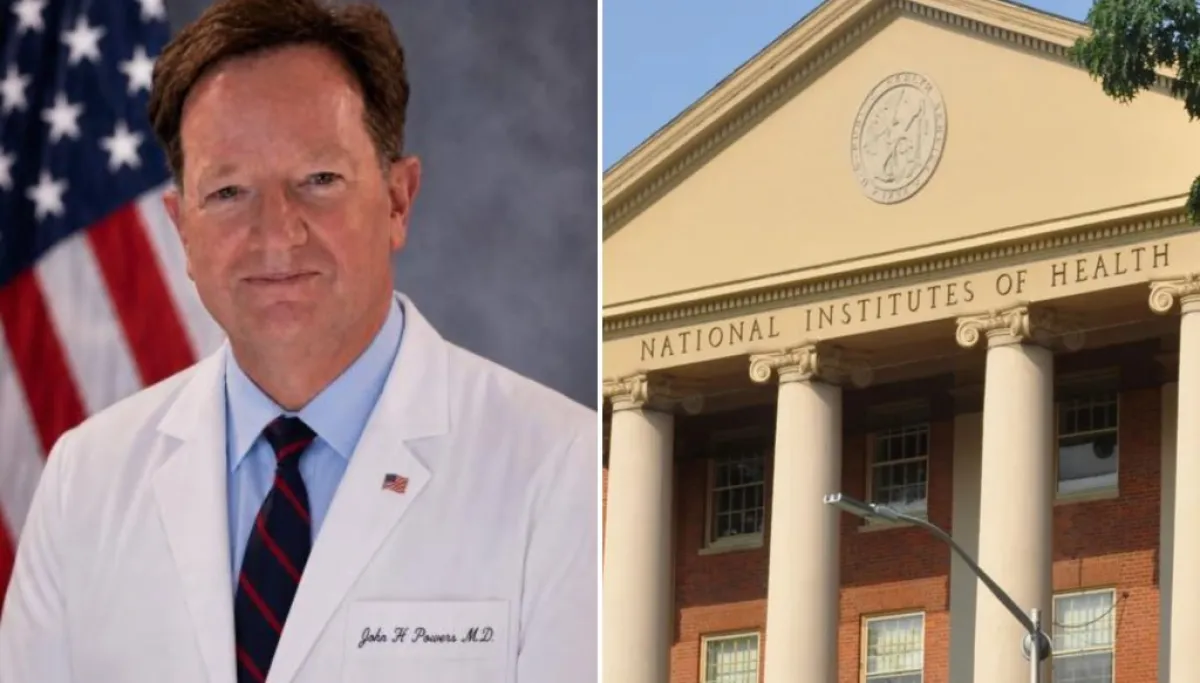
The National Institutes of Health appointed Dr. John Powers III as the permanent director of its infectious disease institute, marking a turning point for an agency that has been the source of controversy following the COVID-19 pandemic.Powers has been serving as the acting director of the National Institute for Allergy and Infectious Diseases since June, which had previously been led by Dr. Anthony Fauci for nearly four decades.NIAID under Fauci’s leadership came under scrutiny from Republicans for its alleged involvement in funding potentially dangerous research projects for the purposes of biodefense, including experiments at the Wuhan Institute of Virology in China that may have been the origin of SARS-CoV-2, the virus that causes COVID-19. On a call with journalists on Monday, Powers said that, under his tenure, the agency would return to its narrower “primary mission” of disseminating public information about infectious, allergic, and autoimmune diseases, rather than including biodefense as a core agency objective.“It actually says in our congressional remit for the formulation of this institute that dissemination of scientific information is in our remit,” Powers said. “So that’s our job: actually put the information out and then to help clinicians and the patients to understand where a particular intervention might be beneficial or not.” Dr. John Powers was named the permanent director of the National Institute for Allergy and Infectious Diseases on Nov. 16, 2026. (Provided by the National Institutes of Health) Powers, who earned his medical degree from Temple University, has served as an infectious disease physician at NIAID since 1999. Before joining NIH, he served as the lead medical officer for antimicrobial drug development at the Food and Drug Administration.NIH Director Dr. Jay Bhattacharya said of Powers in a statement that he “has spent more than three decades caring for patients, teaching and mentoring the next generation of investigators, and playing an integral role in research that improves lives.”“He has been a trusted and valued colleague within NIAID for several decades, and will bring a focus on rigor, transparency, and research outcomes to leading the institute into the future,” Bhattacharya said.During the press call on Monday, Powers said the agency, with its nearly $6.6 billion annual budget, would focus more resources on understanding the human immune system’s interactions with diseases and therapeutics.“We are continuing to do work on individual microbes, but really a lot of the reasoning behind why people aren’t doing better on current therapy has a lot to do with the host immunologic response,” Powers said. “And that allows us to actually expand research opportunities for investigators into areas like host-directed therapies, microbiome, bacteriophage, and other areas that have not been as well explored in the past.”NIAID under Fauci’s leadership was also criticized by members of the scientific community and congressional Republicans, notably Sen. Rand Paul (R-KY), for its role in funding potentially dangerous gain-of-function research involving the manipulation of pathogens to create new viruses.Fauci and others in NIH leadership during the early 2000s and 2010s advocated gain-of-function research as a means of anticipating the next pandemic-causing pathogen and creating preventive measures and treatments.When asked by the Washington Examiner about his view of gain-of-function, Powers said his priority is “to work on diseases that are actually harming people today” rather than anticipating the next pathogen that may or may not cause another pandemic.“Walk across the street from my office to the clinical center. There’s folks over there now that are suffering from illnesses that you know really need our help,” Powers said of the NIH patient treatment center. “So we’d like to focus on those things, and actually that’s what’s, you know, harming people today, and that does not require manipulating those microbes.”Powers also did not directly answer questions from multiple journalists on Monday as to whether he personally believes vaccines cause autism, a debunked premise that has driven a rise in vaccine hesitancy.US LOSES MEASLES ELIMINATION STATUS AMID SURGE IN CASES“My reading of the literature is not what’s relevant,” Powers said, adding that questions of a link between vaccines and autism are “child development issues more than anything else.”The United States lost its measles elimination status last week after the Pan American Health Organization determined a single strain of the virus has been continuously circulating in the country for more than 12 months. The national rise in measles cases and deaths follows years of declining vaccination rates among children.
NIH names John Powers as director of infectious disease institute
Full Article
Original Source
Read the full article at Washingtonexaminer →KhanList aggregates and links to publicly available news content. We do not host full articles from third-party sources. Always verify important information with original sources.