
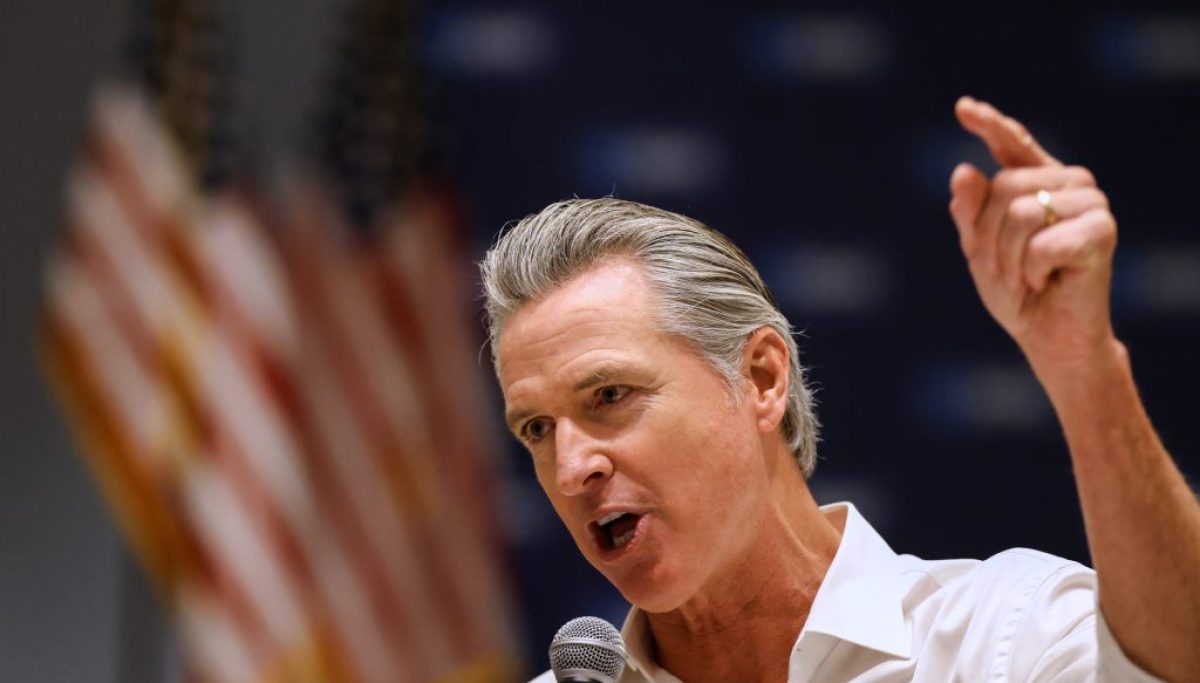
DENVER — Gov. Gavin Newsom (D-CA) could announce a 2028 presidential bid as early as January, hoping to establish himself as the Democratic front-runner. But two potential rivals have already made it clear that the California governor won’t dictate when they enter the race.Gov. Josh Shapiro (D-PA) and Rep. Ro Khanna (D-CA), speaking Friday at the “What’s Next” post-midterm Democratic conference in Denver, both dismissed the idea that Newsom’s timetable would influence their own decisions. Newsom, for his part, wasn’t in Denver, but instead opted to attend the COP31 climate summit in Turkey, reprising his self-appointed role of shadow president where he repeatedly bashed President Donald Trump.Shapiro, fresh off a dominant election win earlier this month, told the Washington Examiner: “Ultimately, this is a conversation with me and my wife and my children, and I wish Gavin and everyone else the very best as they go through their process.” Khanna was less diplomatic, taking a swipe at Newsom’s political network.“He’s consulting the billionaires in California,” Khanna told the Washington Examiner. “I called [for] taxing them. I’m consulting the grassroots donors and people like Bernie Sanders.”Their responses highlight the challenge facing Newsom as he tries to establish himself as a leading Democratic contender. A January announcement could give him a head start on fundraising, organization, and national campaigning. It could also make him an early target for a crowded field of Democrats eager to offer an alternative.“I don’t think Gavin Newsom is setting the pace for the entire Democratic field,” Democratic strategist Juven Jacob told the Washington Examiner. “He is setting the pace for Gavin Newsom. Getting in first does not necessarily translate into an advantage when voters finally make their choices.”The potential field includes former Vice President Kamala Harris, Shapiro, Maryland Gov. Wes Moore, Illinois Gov. JB Pritzker, and Sens. Jon Ossoff (D-GA), Raphael Warnock (D-GA), Ruben Gallego (D-AZ), and Cory Booker (D-NJ). Former Transportation Secretary Pete Buttigieg and Khanna are also possible contenders.Democratic strategist Michael Fahey sees Newsom’s January target as an attempt to force those ambitions into the open.“Gavin Newsom isn’t just testing the presidential waters,” Fahey told the Washington Examiner. “He’s trying to control the tide. By putting January on the calendar, Newsom forces every other potential candidate to answer a question they’d probably prefer to avoid for another six months: Are you in or are you out?”But Fahey warned that Newsom could become the candidate other Democrats organize against rather than rally behind.“The last thing some Democrats want is another presidential nomination that feels decided before voters get a meaningful say,” he said. “Newsom’s greatest strength is also his greatest weakness. He’s recognizable, outspoken, and impossible to ignore. But familiarity doesn’t automatically translate into enthusiasm.”An advantage to being out of office Newsom’s departure from the governor’s office gives him an advantage over several potential competitors who were reelected in November. Unlike Shapiro, Moore, Pritzker, and Ossoff, he will have no governing responsibilities when he potentially announces in January.California-based veteran political expert Garry South said that distinction could make an early announcement particularly advantageous.Candidates who have just secured another term risk angering voters if they immediately turn their attention to the White House, South said.“Nothing ticks off home-state voters more than just reelecting a governor or senator, based on the wonderful things they promised to do if they would only be given a second term, then 15 minutes after being sworn in saying, ‘Oh sorry, now I’m running for president,'” South said. “Voters feel like they’ve been the victim of a bait and switch.”South pointed to former California Gov. Pete Wilson, whose presidential ambitions after winning reelection in 1994 damaged his standing at home.“So it would be smart for Newsom to announce sooner rather than later,” South said.Still, Newsom’s California record could become a liability. Republicans are likely to highlight the state’s affordability problems, homelessness, and cost of living, while Democrats may question whether another California politician can appeal to voters nationally after Harris’s 2024 defeat.“Are they looking for someone who can win an argument with Donald Trump, or someone who can win back voters who abandoned their party?” Fahey said. “Those are two very different political assignments.”Jacob said Newsom will need to demonstrate that he can build a coalition beyond California, particularly in battleground states such as Georgia, North Carolina, and potentially Texas.“I also wouldn’t assume that Democrats will rally around Newsom simply because he enters early or appears to be an initial front-runner,” Jacob said. “Democratic voters will be looking strategically at who can connect with voters across the country and defeat the Republican nominee.” Newsom’s announcement may not prompt an immediate rush of competing campaigns. Jacob expects more activity, including exploratory efforts, around the summer of next year, when potential candidates will have a better sense of their political standing.A lesser-known contender such as Khanna could benefit from getting an early start, Jacob said, adding that candidates with greater national recognition, including Buttigieg, Moore, Shapiro, and Ossoff, have more room to wait.Dave Spencer, host of the Practically Political podcast, said January is already a conventional time for presidential announcements following the midterm elections.“Newsom isn’t establishing a new timetable, and other potential candidates will likely make their announcements around the same time,” Spencer told the Washington Examiner.Spencer was also skeptical that Newsom’s political standing would translate into a successful presidential campaign. He said the governor’s national momentum peaked around August 2025, during his push for California’s Proposition 50 redistricting effort.“I also think he has very little chance of becoming the Democratic nominee,” Spencer said.He predicted other Democrats would use Newsom’s California record to distinguish themselves from him, while Republicans would make the governor a central target.Fahey offered a different assessment of why Newsom is moving now: The governor is leaving office and needs a new political identity.“His next political chapter needs a storyline, and there’s no bigger storyline than the White House,” Fahey said.But the bigger challenge, he added, is one Newsom cannot resolve simply by announcing early.CHRIS VAN HOLLEN RULES OUT 2028 RUN TO FOCUS ON OUSTING CHUCK SCHUMER AS SENATE LEADER“Democrats have no shortage of people who want to lead the party,” Fahey said. “What they haven’t settled is what direction they want to go.”Newsom may be ready to run for president, but “the bigger question is whether Democratic voters are ready to run with him.”Speculation about who will run on the Republican side is rampant, with the likes of Vice President JD Vance, Secretary of State Marco Rubio, Sen. Ted Cruz (R-TX), Gov. Ron DeSantis (R-FL), and more all repeatedly linked to bids. While an announcement from a Republican seems nowhere close, it’s worth remembering Trump announced his candidacy to ice the Republican field on Nov. 15, 2022.
Newsom’s 2028 announcement puts Democrats on notice, but rivals aren’t rushing to follow
Full Article
Original Source
Read the full article at Washingtonexaminer →KhanList aggregates and links to publicly available news content. We do not host full articles from third-party sources. Always verify important information with original sources.