
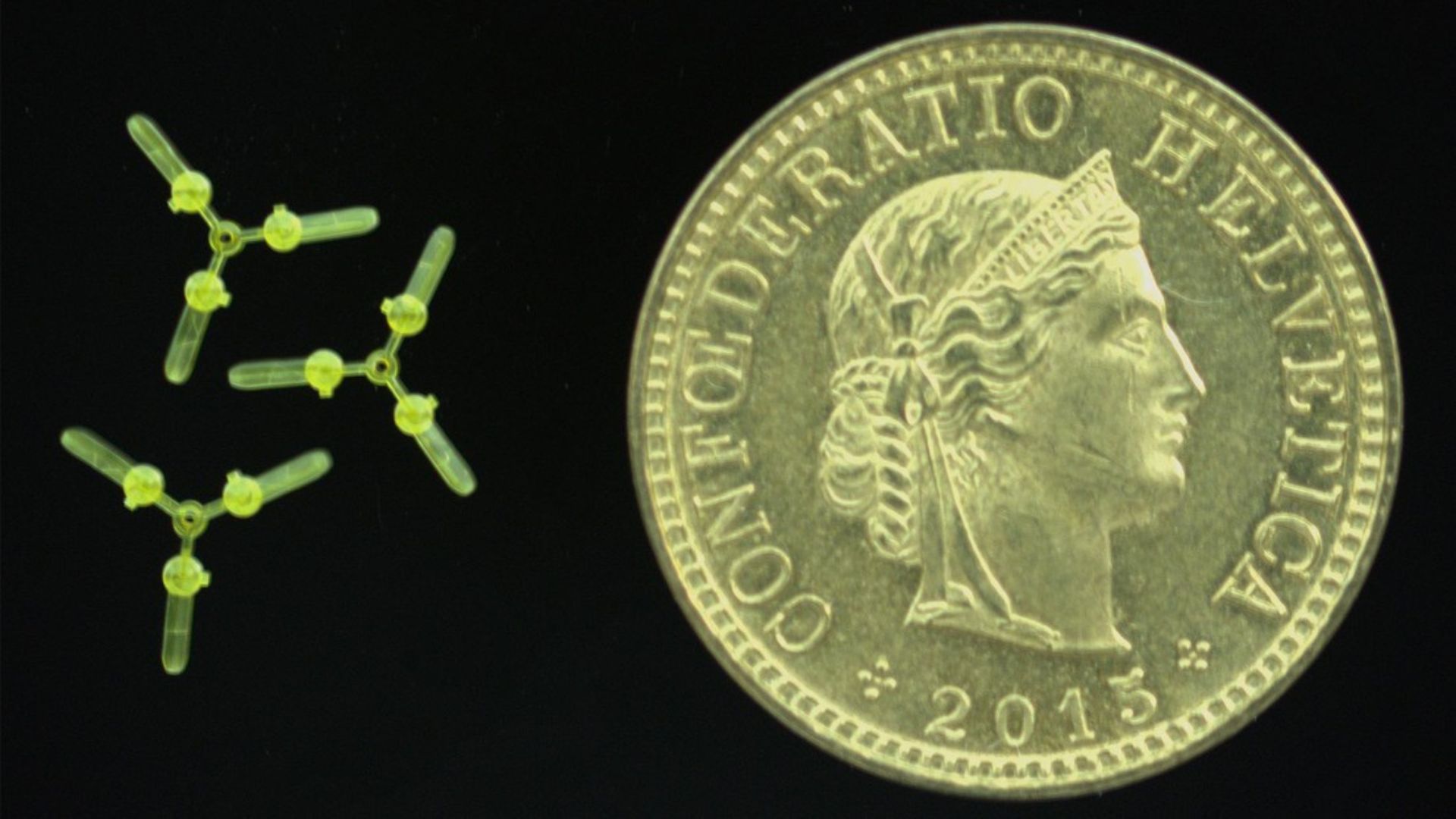
Engineers at Switzerland’s École Polytechnique Fédérale de Lausanne (EPFL) have unlocked a way to transform basic sound waves into powerful directional thrust. The technique could create functional micro-machines without onboard motors, batteries, electronics, or gears. The technology adapts the physics of Helmholtz resonance, which is the physical phenomenon behind the hum produced by blowing across a bottle neck. In this resonance, sound excites air trapped within a cavity, creating an airflow imbalance that generates propulsion. The development could propel small boats and ultralight aerial vehicles without power, just through hollow acoustic cavities. Compared with earlier acoustic levitation methods, EPFL’s technique relies on 3D-printed hollow cavities that transform sound waves into self-generating thrust by expelling concentrated air jets. “Our concept is compatible with even further miniaturization, enabling advanced designs that push the boundaries of robotics and aeronautics,” says first author and MICROBS Lab PhD student Junsun Hwang. The MICROBS Lab’s sound-powered boat. 2026 EPFL/MICROBS – CC-BY-SA 4.0 Propulsion mechanism If you have ever blown across the top of an empty glass bottle, you know the sound: a low, pleasing hum that fills the room. It feels like a simple party trick. But that identical physical phenomenon might soon change how miniature robots fly, float, and navigate complex environments. In this new work, Helmholtz resonance did the trick for turning incoming sound into self-propelling thrust. Sound waves cause air inside the spherical or bell-shaped structures to oscillate, pulling in diffuse airflow and expelling it as a concentrated, high-velocity jet. This airflow imbalance enables entirely passive materials to generate directional motion without onboard power or electronics. Rather than using acoustic force to push objects around, the EPFL team built passive materials that move on their own. “Instead of pushing devices around with sound waves, we have created acoustic resonators that are tuned to harness sound at specific frequencies to generate directional thrust and controlled motion. Our work shows the feasibility of transforming a simple, cleverly designed mechanical piece into robotic matter,” said Selman Sakar, lab head. To validate the design, researchers built prototypes at two scales: centimeter-scale mini-boats powered by audible sound frequencies and microscopic fliers propelled by high-frequency ultrasound. At the centimeter scale, researchers controlled mini-boats using audible frequencies to activate individual cavities for steering and navigation. At the microscopic scale, ultrasound-powered microfliers demonstrated impressive capabilities, with a 150-microgram micro-rocket achieving direct upward lift and another variant spinning tiny blades up to 13,000 RPM for helicopter-style flight. A microflier in flight. 2026 EPFL/MICROBS – CC-BY-SA 4.0 Future potential of the technique Removing power sources completely changes the rules of robotics design. Batteries drag down performance with extra weight, motors suffer mechanical wear and failure, and complex electronics simply break down when shrunk to microscopic scales. On the other hand, acoustic cavities can be 3D-nanoprinted using standard plastics, rubbery polymers, or glass. Future designs aim to embed multiple tuned cavities within soft, flexible materials. It could be used for sound-powered micro-robots that span medicine, environmental monitoring, and space exploration. The battery-free design may also eliminate the risk of electrical sparks or toxic leaks, so it could be used for inspect industrial pipelines and hazard zones. The study findings have been published in Science Advances. Get the latest in engineering, tech, space & science - delivered daily to your inbox.Mrigakshi is a science journalist who enjoys writing about space exploration, biology, and technological innovations. Her work has been featured in well-known publications including Nature India, Supercluster, The Weather Channel and Astronomy magazine. If you have pitches in mind, please do not hesitate to email her.
Newly unveiled sound-powered micro-robots move without motors or batteries
Full Article
Original Source
Read the full article at Interestingengineering →KhanList aggregates and links to publicly available news content. We do not host full articles from third-party sources. Always verify important information with original sources.