
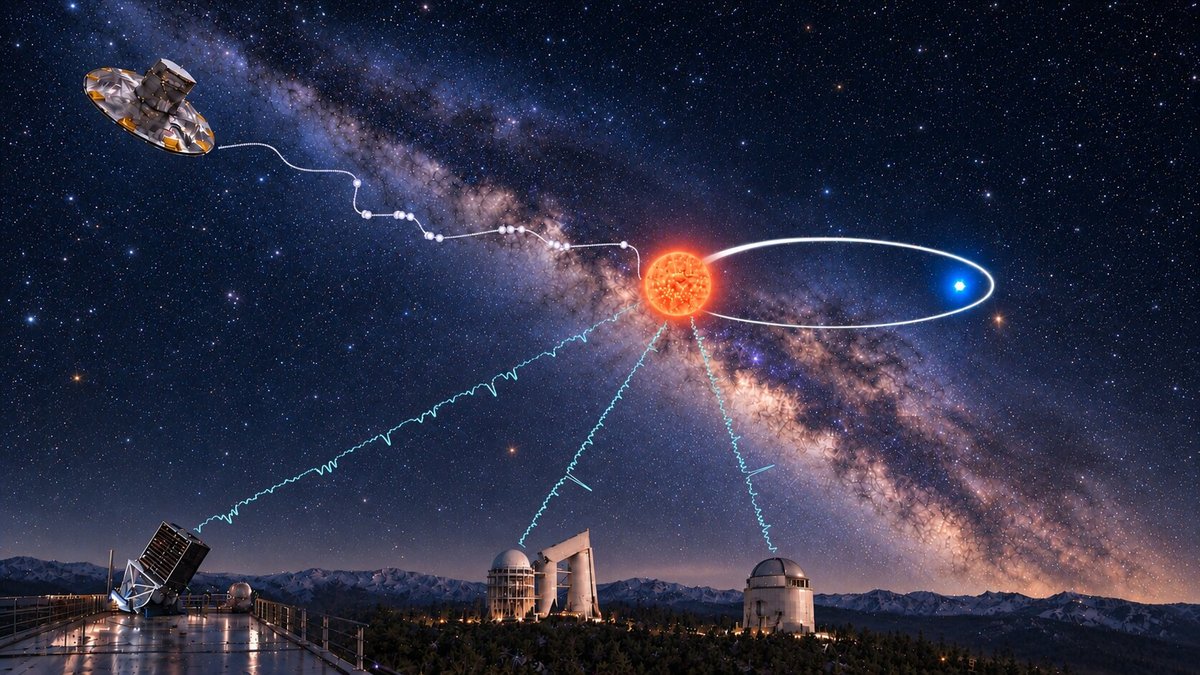
November 11, 20263 min read Add Us On GoogleAdd SciAmAstronomers saw something strange in a distant star system—or rather what’s strange is what they didn’t see. Solving the mystery could reveal new astrophysicsA schematic diagram of the binary system J0008+0128. The central red star is a visible giant star, while the blue star marks an invisible object that is most likely a supermassive neutron star. From left to right: The ground-based telescopes SDSS/APOGEE (Sloan Digital Sky Survey’s Apache Point Observatory Galactic Evolution Experiment), LAMOST (Large Sky Area Multi-Object Fiber Spectroscopic Telescope) and NOT (Nordic Optical Telescope), which were used to obtain spectra and radial velocity measurements. The satellite in the upper left is the Gaia telescope, which provided astrometric data. Xinlin Zhao/CQUWhen it comes to neutron stars, size definitely isn’t everything, but mass can go a long way.At least, that’s the case for a newly discovered neutron star candidate in a distant part of the Milky Way that has more mass than it should.In a new paper published today in Science Advances, researchers at several Chinese universities and observatories and their colleagues describe their study of a binary system located thousands of light-years away from Earth in the Pisces constellation. In it, a red giant star is being orbited by what seems to be a very small, rather overweight neutron star.On supporting science journalismIf you're enjoying this article, consider supporting our award-winning journalism by subscribing. By purchasing a subscription you are helping to ensure the future of impactful stories about the discoveries and ideas shaping our world today.Called J0008+0128, the system was picked up by analyzing data collected by China’s Large Sky Area Multi-Object Fiber Spectroscopic Telescope (LAMOST) and the Apache Point Observatory Galactic Evolution Experiment (APOGEE), as well as the European Space Agency’s now retired Gaia space observatory.The red giant appears clear as day in the data; what’s more interesting is what’s unseen—a hidden, hefty something that is gravitationally tugging on the red giant, making the star wobble to and fro.After running through and summarily ruling out an exhaustive list of possibilities, the researchers concluded this invisible object is most likely a neutron star: the ultradense remnant of another massive star that exploded as a supernova, an event that compressed the dying star’s core into a city-sized ball of neutrons. Most neutron stars weigh in at about 1.4 solar masses, or 1.4 times the mass of our sun. This one, for reasons unknown, would be somewhere between 1.8 and 2.8 solar masses, with the best estimate pegging it at 2.2 solar masses.The mystery is where that extra mass came from; solving it could help scientists better understand the complex astrophysical interactions that can create neutron stars—and the bizarre, extreme physics that occur inside them. One natural explanation for this plus-sized neutron star would be that it siphoned lots of material from its neighboring stellar companion—except that, in this system, the neutron star’s orbit around the red giant would be too wide.“Because it’s so separated, that’s how they know that it has never dumped material onto the neutron star,” says Scott Ransom, a staff astronomer at the National Radio Astronomy Observatory, who was not involved with the study.That leaves two other broad possibilities: either neutron stars can be a lot bigger than previously suspected (“that would mean we don’t understand supernova physics very well,” Ransom says) or the supernova that led to this one’s formation was the result of two smaller white dwarf stars colliding and merging together. The latter scenario isn’t impossible, but such collisions should be very rare.“It’s possible that there were two white dwarfs and the red giant, and the two white dwarves were in a really tight orbit, and they’re orbiting the red giant, and eventually those two white dwarfs collided with each other and turned into a massive neutron star,” Ransom says. Alternatively, he adds, what seems to be a single extraheavy object could, in fact, be a co-orbiting pair of run-of-the-mill neutron stars or a neutron star–white dwarf binary.There is at least one other option. The unseen object is so dense that it could actually be a very low-mass black hole, Ransom says, a possibility he thinks is more likely because of the inferred circular shape of the object’s orbit.“Astrophysically, there’s no reason why you can’t have black holes that small; it’s just that we don’t see any of them in our galaxy,” he says. “What [the orbit’s shape] probably means is that the birth of that neutron star or black hole was not especially violent.” The birth of a stellar-mass black hole is thought to be, in some respects, more sedate than that of a neutron star, with the latter imparting a heavier recoil that can “kick” the newly formed stellar remnant into a wild orbit—or off into deep space. “So the fact that the orbit is more circular might be evidence that this is a black hole and not a neutron star,” Ransom says.It may be impossible to ever truly know what this object is or how it formed. Follow-up observations with a powerful x-ray observatory to directly detect emissions from the mystery object could distinguish between the “black hole” and “neutron star” scenarios, Ransom says. But outside of that, the options are limited.“There’s no radio pulsations that any telescope in the world will find in the next decades, probably, because they’ve already looked at it with the world’s best [radio] telescopes,” he says. “That's unfortunate because that would have been an ironclad signal that it was a neutron star. But besides that, I don’t know if there’s anything else they could do, so we may never know.”
Newfound invisible object in space could be a rare supermassive neutron star
Full Article
Original Source
Read the full article at Scientificamerican →KhanList aggregates and links to publicly available news content. We do not host full articles from third-party sources. Always verify important information with original sources.