
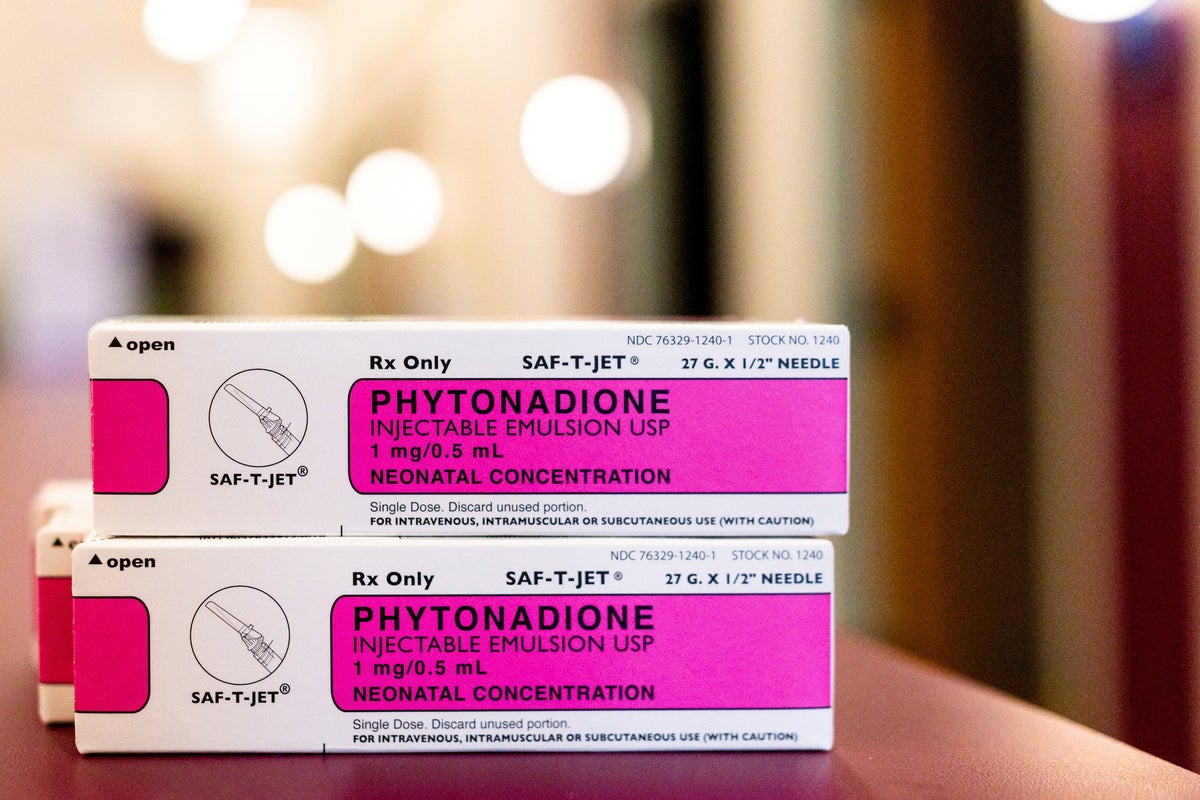
The percentage of parents and caregivers in the United States opting out of a standard vitamin K shot for infants at birth has accelerated sharply this year, according to a data analysis, placing more newborns at risk of life-threatening bleeding episodes.The findings confirm what a dozen pediatricians, neonatologists, and pediatric critical care specialists identified as a major concern: growing refusals of a protective shot amid a rising wave of mistrust toward vaccines and routine newborn interventions.For decades, Health Secretary Robert F. Kennedy Jr. has stoked that mistrust by sowing doubt about vaccines and established medicines. The acceleration in vitamin K refusals this year follows his January decision to drop recommendations for the birth dose of the hepatitis B vaccine and five other routine childhood vaccines.Health agency says it is evaluating data and surveillance related to vitamin K refusals and bleeding events (Reuters)The rate of newborns missing the vitamin K shot within a day of birth in hospitals jumped more than 57% from January through June, an analysis of health records for over 1 million births nationwide by health analytics company Truveta revealed.While vitamin K opt-outs have been rising for years, Truveta's study shows that in the first half of 2026, the non-administration rate was 2.5 times higher than the average rate recorded from 2019 to 2024. It was 1.4 times higher than in 2025.Infants are born with very low levels of vitamin K, which enables blood to clot, and remain unprotected until around six months of age, according to the Centers for Disease Control and Prevention, which continues to recommend the shot. The data confirms what a dozen pediatricians, neonatologists and pediatric critical care specialists told Reuters is a top concern: rising refusals of a life-protective shot and a growing wave of mistrust toward vaccines and other newborn interventions (Reuters)Without the injection, babies are 81 times more likely during those first six months to suffer life-threatening bleeding in the brain or gut, the CDC notes.One in five infants who suffer severe bleeding will die. Without the shot, such bleeding occurs in one out of every 59 births."It's really terrifying. It's like we're going backwards," Dr. Nia Heard-Garris, pediatric physician-scientist at Lurie Children’s Hospital, Chicago, said regarding the growing refusal rates. "We’re trying really hard to keep little babies alive."For decades, Health Secretary Robert F. Kennedy Jr. has stoked that mistrust, sowing doubt about vaccines and other established medicines (Reuters)Pediatricians like Heard-Garris are on the front lines, caring for children as families navigate changes in U.S. health policy that align with Kennedy's and President Donald Trump's views, which frequently clash with the medical community.When Kennedy removed recommendations for the six childhood immunizations, he claimed American children received too many injections and suggested a link to chronic illness, a claim unsupported by evidence.Although a court order has stalled those changes, Trump called for them again in an August 10 executive order. Experts say these mixed signals have fostered doubt among parents concerning routine newborn care, including vitamin K.President Donald Trump attends a healthcare affordability event in the Oval Office at the White House on August 31 (Getty)Asked about declining vitamin K administration relative to those policies during an April Congressional hearing, Kennedy denied any role in the trend.U.S. Department of Health and Human Services spokesperson Grace Davis Jamison said the agency and the CDC are evaluating surveillance data related to vitamin K refusal and bleeding events. The agency continues to provide parents and healthcare providers with guidance on vitamin K, she said."Concerns about vitamin K and declining trust in public health institutions predate this administration and grew during the COVID-19 pandemic amid heavy-handed mandates during the Biden administration," she said, adding that the agency is working to rebuild trust through respect for individual choice.Vitamin K refusals in hospitals have become so common that Zarminali has started stocking the shot in all primary care practices (Reuters)The percentage of U.S. infants not receiving vitamin K at birth rose to 8.1% at the end of June, up from 5.2% six months prior, according to the Truveta study, which evaluated health records from over 140 million individuals. It identified 1,026,375 infants born to 825,599 mothers between January 2019 and June 2026.Dr. Amanda Furr, chief medical officer of Zarminali Pediatrics, which operates 45 practices in 13 states, treats patients at a clinic in Rockville, Indiana, a town of 2,600 residents.Vitamin K refusals in hospitals have become so prevalent that Zarminali now stocks the shot across all primary care practices, Furr said. Two other doctors confirmed they have also begun administering the injections in outpatient clinics.Their parents believed the shot was unnecessary, and potentially toxic or carcinogenic, according to an account published by the CDC (Reuters)In 2013, when Dr. Sarah Coggins was a medical student at Vanderbilt Children’s Hospital, Nashville experienced an unusual cluster of infants presenting with severe hemorrhage from vitamin K deficiency.Their parents believed the injection was unnecessary, toxic, or carcinogenic, according to a report published by the CDC. Coggins treated one of those babies."The baby had long-term brain damage," said Coggins, now a neonatologist with Children's Hospital of Philadelphia. "I've always carried that with me. I think most pediatricians have a story like that."One out of five infants who experience serious bleeding will die (Reuters)Refusals of the injection soon began climbing nationwide, previous research showed.Coggins actively counters mistrust in her practice by requiring parents who refuse the injection to sign a form confirming they understand the risks.She and other doctors have noted a distinct difference among parents who oppose the shot but request circumcision for male infants. Many hospitals prohibit circumcision for boys who have not received vitamin K due to surgical bleeding risks.Coggins and her colleagues analyzed medical records across three hospitals affiliated with the University of Pennsylvania health system in Philadelphia and found that female infants faced twice the risk of vitamin K refusal compared to male infants.Truveta's national analysis confirms that finding, demonstrating that baby girls are disproportionately affected by rising refusal rates. In June 2026, 8.9% of girls and 7.3% of boys had not received the shot within a day of birth.That outcome raises questions over whether vitamin K deficiency and associated bleeding events will increasingly affect female infants."It's not a theoretical risk. It keeps me up at night," said Coggins, who is designing a study with colleagues to investigate the trend.The desire to circumcise male children frequently overrides parental hesitations, several pediatricians noted. Around half of U.S. boys are circumcised in hospital settings."We have an absolute hard line: no vitamin K, no circumcision," said Dr. Brad Scoggins of San Juan Health Partners' Pediatrics in Farmington, New Mexico.Scoggins aligns with research connecting increased vitamin K refusals to the rejection of other essential newborn interventions, including the hepatitis B vaccine and antibiotic eye ointment."That just gets put in the same bucket," he said.
Newborn shot refusals soar 57% as doctors fear fallout from Trump and RFK Jr. health messaging
Full Article
Original Source
Read the full article at Independent →KhanList aggregates and links to publicly available news content. We do not host full articles from third-party sources. Always verify important information with original sources.