
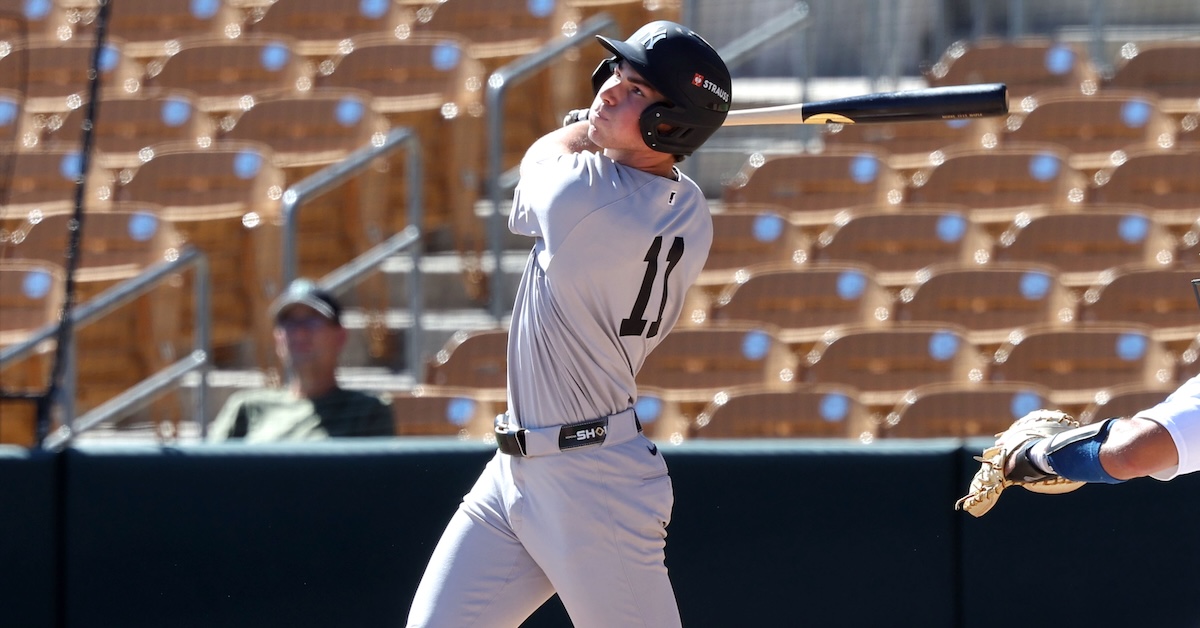
Dax Kilby Below is an analysis of the prospects in the farm system of the New York Yankees. Scouting reports were compiled with information provided by industry sources as well as my own observations. This is the seventh year we’re delineating between two anticipated relief roles, the abbreviations for which you’ll see in the position column below: MIRP for multi-inning relief pitchers, and SIRP for single-inning relief pitchers. The ETAs listed generally correspond to the year a player has to be added to the 40-man roster to avoid being made eligible for the Rule 5 draft. Manual adjustments are made where they seem appropriate, but we use that as a rule of thumb. A quick overview of what FV (Future Value) means can be found here. A much deeper overview can be found here. All of the ranked prospects below also appear on The Board, a resource the site offers featuring sortable scouting information for every organization. It has more details (and updated TrackMan data from various sources) than this article and integrates every team’s list so readers can compare prospects across farm systems. It can be found here. Other Prospects of Note Grouped by type and listed in order of preference within each category. Reliever Periphery Michael Harpster, RHP Zach Messinger, RHP Hayden Merda, RHP Carson Coleman, RHP Eric Reyzelman, RHP Xavier Rivas, LHP This group mostly includes upper-level relievers who could get a cup of coffee this coming year, but who I fear will struggle to remain on the big league roster. Harpster is the exception. He was the Yankees’ 2026 seventh-rounder out of East Tennessee State, and has a quick arm and plus-plus spin on his breaking stuff. He’s the top candidate for “Which later-round pitcher will break out in his first pro season?” Messinger sits 95-96, but it doesn’t miss bats, so he’s become a cutter-heavy Triple-A reliever who aims to induce weak contact. He doesn’t strike many guys out, nor does he avoid walks especially well, but opponents hit .177 against him in 2026. Was this a one-year anomaly, or could his cutter/sinker attack work like this against big league hitters? Injuries will likely give us the opportunity to find out in 2027. Merda sits 96 and has a killer cutter/slider, but fatal, 20-grade control. Coleman was striking out 36-38% of hitters in 2021-2022 thanks entirely to an uphill mid-90s fastball, which he’s always thrown 75-90% of the time. Injuries began to plague him in 2023, and the 17 innings he threw in 2025 were his first in nearly three years. He struggled at Triple-A in 2026 and has never been able to find a second good pitch, though he’s still throwing hard. Reyzelman looked like he was in the express lane to the back of the Yankees bullpen in 2024, as his fastball and slider played like elite pitches and he K’d 14.27 per nine at Double-A. In 2025, he had to be hospitalized during spring training due to a reaction to a peanut allergy, and then his fastball was down three ticks during the season. He had an up-and-down 2026, with a dominant first two months and then a walk-prone second half after returning from the IL. Rivas is a very walk-prone smoke-and-mirrors relief lefty whose fastball sits 90 mph. But his slider and changeup are nasty, and he has struck out more than a batter per inning since college. Power Hitters Jackson Lovich, 3B Garrett Martin, OF Jace Avina, OF Kyle West, 1B Queni Pineda, C Lovich, 22, is a big-framed, 6-foot-3 infielder from Missouri with plus projected power. He was able to get to enough of it to produce an above-average line in Tampa despite a ton of chase, but a former SEC hitter should be crushing Low-A like this, so his surface performance doesn’t move the needle a ton. He does have the best defensive fit and long-term body projection of this player cluster, however. Martin was added to the 40-man roster this week after hitting 24 homers in 71 games, mostly as a 26-year-old in his second stint at Double-A. He’s a pull-and-lift maven, averaging 20 degrees of launch and posting 70-grade peak exit velos. But visually, his feel to hit is pretty bad, and he gives up a ton of the plate on the outer half trying to pull everything. I get why the Yankees added him to their roster but don’t agree, as I’m skeptical that he’ll hit enough to matter. Avina, acquired from Milwaukee for Jake Bauers a couple years ago, is a righty-hitting outfielder geared for extreme launch. The 23-year-old hit 21 homers at Somerset this year. West, a 2025 13th-rounder out of West Virginia, has plus-plus low-ball power, but he’s K’d at roughly a 30% clip in A-ball and posted just an 81 wRC+ in 2026 despite netting 20 homers and steals. Pineda is a 19-year-old complex-level catcher with a one-note, pull-heavy approach. He has roughly average power, but his contact rate tanked (from 74% in 2025 to 69% in 2026) to non-prospect levels facing FCL arms. Cambios Buenos Sean Paul Liñan, RHP Luis Serna, RHP Jose M. Rodriguez, RHP Pico Kohn, LHP Originally a Dodger, then a National (Alex Call trade) and now a Yankee (Jorbit Vivas trade), Liñan is a changeup artist with an 89-mph fastball. The quality of his changeup was too much for Low-A hitters to deal with when Liñan broke out in 2024-2025, but a lack of velocity or a quality breaking ball had consequences for him at High-A in 2026. He’s still in the depth starter mix, because it is quite the changeup he’s got. Serna flew onto the prospect radar as a precocious 16-year-old DSL pitcher back in 2021, more advanced than he was projectable. In part because he was injured for much of 2023 and 2025, it took him until 2026 to exit Low-A, which would have been unthinkable during his efficient first two seasons. Serna pitched well enough at Hudson Valley in 2026 to be mentioned again in this section, but he remains an undersized righty who sits 91-92 and needs to lean on his changeup more than any other pitch just to get by. Rodriguez is a 22-year-old High-A reliever who sits 95 and has a nasty, tailing changeup, but he’ been a 20-grade control guy for a while now. I decided to put Kohn, New York’s fourth-rounder in 2025, in this group even though he’s a slider guy because he doesn’t fit in any of the other buckets. He was injured in his first start of 2026 (stress reaction in his leg) and returned in August, striking out 23 and walking 10 in his final 17 innings. He sits 91 and has an above-average slider with extra depth created by his high arm slot. He could be a lefty specialist. Young Arm Strength, No Strikes Edinzo Marquez, RHP Enixon Sanchez, RHP Manuel Cruz, RHP This group of pitchers was in the FCL this year. Each of them touched at least 97, but has strike-throwing issues severe enough to keep them off the main list. Marquez, 21, pitched the best of this cluster and was promoted to Tampa in the middle of the year, after which his velo started to dip some. His walk rate wasn’t awful, but a visual assessment of his delivery makes me wonder if that will continue. Sanchez is the youngest at age 19, with Cruz a touch older at 20; they each walked 15-20% of the batters they faced. Undrafted Free Agents Zach Johnston, LHP J.T. Etheridge, RHP Easton Talt, OF Eric Genther, C Maika Niu, OF Chris Veach, RHP Josh Moylan, 1B/LF Jorsixt Jimenez, OF Trent Sellers, RHP Matthew Tippie, RHP The Yankees traffic in a lot of undrafted free agents, either pitchers they think they can develop or position players they need to fill out a system thin on hitters. Johnston is a sidearm southpaw with a good curveball who was signed out of Wake Forest in 2026. He has a lefty specialist look. A 2024 signing out of Louisiana-Lafayette, Etheridge is a 6-foot-6 lower-slot slinger who has been a fairly walk-prone, old-for-A-ball starter. His delivery is really tough on righties and there are glimpses of a good changeup here. Talt is the best contact hitter in this group, a former Arizona high schooler and Oregon State outfielder who is compact but still rotates hard when he swings. Genther, 24, does not throw well enough to catch, but the big-framed 24-year-old does have the hit/power combination to have put himself on the radar, even though his big 2026 offensive performance came as an elder A-ball hitter. Niu was originally at the University of New Orleans, then Marshall, then he really hit for power on Cape Cod before a K-prone senior season at Arkansas. Veach, 24, has a goofy changeup with crazy tailing action, but below-average other stuff as well as command. He spent the second half of 2026 at Somerset. Moylan hit 29 homers in a 2026 split between Hudson Valley and Somerset, but his underlying swing-and-miss is much more severe than Genther’s to this point. The 24-year-old was signed out of East Carolina in 2023. Jimenez, 23, was signed out of Tennessee Tech this year and has pretty serious power, but his swing is totally unusable and needs an overhaul. Sellers (signed in 2023) pitched at several different colleges in the Northwest and spent 2026 at Double-A. The 27-year-old has a hoppy, 92-mph fastball that punches above its weight, as well as a funky, tailing changeup he can throw for strikes. Tippie signed out of Texas State in 2025, and his slider dominated Low-A hitters in a relief role this year. If you’re trying to back into some of the Yankees’ development techniques, this is the group to start monitoring now to see what they change. Formerly Well-Regarded Arms Brock Selvidge, LHP Sabier Marte, RHP Chalniel Arias, RHP It has been a couple of years since Selvidge was both productive and healthy, missing chunks of the last several seasons recovering from pinched nerve surgery and, more recently, an internal brace on his elbow. He was throwing three ticks harder during 2026 spring training than he had been for a while, and if that’s still true when he returns in 2027, he’ll be back in the mix for the main section of the list. Marte, 22, is a super projectable 6-foot-5 righty who finally left rookie ball in 2026 after missing all of 2025 recovering from surgery. He didn’t pitch well, but there are still raw ingredients here (up to 97, the occasional good slider and changeup) to care about in concert with Marte’s age and lanky frame. Arias stood out among his DSL peers a few years ago because of his projectable 6-foot-3 frame and early-career strikeout totals, but he hasn’t been healthy for much of the past three seasons, including in 2026, when he returned from surgery, made just two starts, and sat in the 92-94 mph range. Budding Arms Chien-Fan Lai, RHP Hector Moreno, RHP Osveiker Chirino, RHP Cesar Acosta, RHP Jhon Beltre, RHP After voiding their handshake international deals upon the dismissal of former international scouting director Donny Rowland, the Yankees had late-market bonus money to play with throughout 2026 and spent nearly $900,000 of it on Lai. An athletic, if small-framed righty, Lai sat 90 and touched 93 with Taiwan’s U18 National Team late in 2025. He has a snappy mid-70s curveball and nascent changeup, but is a bit less projectable and talented than most million dollar international arms, as his bonus was more a product of timing and the Yankees’ surplus after nixing their other deals. Moreno is a 6-foot-6 righty with a plus-flashing slider who sits 94-96 and touches 98, but he’s coming off his second straight season with more than a walk per inning. He turns 19 in December. Chirino was another international amateur who signed a bit later in the 2026 calendar than most of his peers, toward the end of May. The 6-foot-3 17-year-old ended up touching 95 in three innings of DSL work later in the summer, albeit without strikes. Acosta, who turned 20 in late August, is a quick-armed, 5-foot-11 righty. He’s up to 96 with an above-average gyro slider, and improved as a strike-thrower in his second DSL season. Beltre turned 18 just a few days before list publication. He’s a 6-foot-1 DSL righty who was up to 96 and flashed a good breaking ball in his debut season, but he’s currently too wild for the main section of the list. He should be monitored for a strike-throwing improvement in 2027. Up-The-Middle Sleeper Bats Bear Harrison, C Luis Cruz, OF Luis Escudero, 2B Poly Ojeda, C/1B Juan Torres, 2B Harrison, Kyle’s brother, can throw well and had a breakout junior year at the plate. The fifth-rounder out of Texas A&M needs to improve his framing and show that his swing isn’t too long to time upper-level fastballs. Cruz is a super skinny 6-foot-1 teenage outfielder who was walking twice as often as he struck out in the DSL when he became part of the Camilo Doval trade. His measurable power somehow regressed in his second pro season (he had just a 9% hard-hit rate), but he’s projectable and can put the bat on the ball. He’s a long-term dev project who needs the right strength program. Escudero is a husky little 2B/3B who had a good year in Tampa. The pull-heavy Panamanian has very modest physical tools. Ojeda is a little 18-year-old first baseman and catcher who slashed .313/.466/.536 in his pro debut, though he doesn’t have anything close to the kind of power his statline indicates. He does have pretty good feel for contact, however, and walked a good bit more than he struck out in 2026. Torres is a 19-year-old second baseman who has had two excellent DSL seasons (he’s a career .374/.444/.590 hitter), but there are elements of his swing that I’m skeptical will continue to play like they have, and his underlying data took basically no step forward in 2026 as he repeated the level. System Overview This is a below-average system that is especially thin on position players. That’s for a couple of reasons, not all of which are bad. For one, Spencer Jones and George Lombard Jr. graduating are organizational positives. The Yankees also trade away a lot of prospects. There are 19 players we have graded as prospects in other systems who the Yankees originally drafted or signed, and eight of them are position players. Not all of the Yankees’ deals are screaming successes, but the fact that they’re able to flip players like Parks Harber and Dillon Lewis in big deals, or turn around later-round pitchers within a year of drafting them like they did in this summer’s Luis García Jr. trade, is a good sign for the health of the org. How the Yankees System Stacks Up – NYY MLB Average Standard Dev Prospects 37 42.9 8.3 Pitchers 23 22.6 5.1 Hitters 14 20.3 5.9 High Upside 8 16.5 4.3 Homegrown 31 34.9 6.2 Traded For 6 8 5 Traded Away 19 8 5.1 MLB averages determined using the last two list cycles. “High Upside” includes 40+ FV prospects and above. That said, the Yankees’ approach to international scouting, where they’d give a huge portion of their bonus pool to one player, has not been good for their depth. Putting all of your bonus eggs in one risky basket, especially when you’re good at development and theoretically want to apply that dev to as many players as possible, is not a good strategy. Even if they had hit on some of the Roderick Arias/Mani Cedeno types, their classes would still be limited because of their approach. Whiffing on basically every one of their high-profile signees from a market that gives baseball a lot of its star hitters has been bad for the health of this system. We’re still waiting to see how New York’s international approach and effectiveness will change under new leadership. Because of how that market works — players agree to verbal deals sometimes a couple of years in advance, and then can take a bit of time to develop — it could be a while before we have a good idea. Of course, the Yankees remain excellent at developing pitchers. In addition to providing them with trade pieces (Ben Grable is a name to watch in Washington’s system next season), the team produced this year’s AL Cy Young winner, as well as Will Warren, via these processes. They’ve helped turn later draft picks and an incredible number of undrafted pitchers into actual prospects. Because they’re the Yankees and not only don’t receive comp picks, but sometimes lose one for signing a qualified free agent, they have fewer opportunities to use high picks on position players. When they do (recently just Lombard and Kilby), they’ve seemingly done well, and one could argue they’ve used too many high picks on pitchers who end up being about as good as the ones they draft later and then develop.
New York Yankees Top 37 Prospects
Full Article
Original Source
Read the full article at Blogs →KhanList aggregates and links to publicly available news content. We do not host full articles from third-party sources. Always verify important information with original sources.