
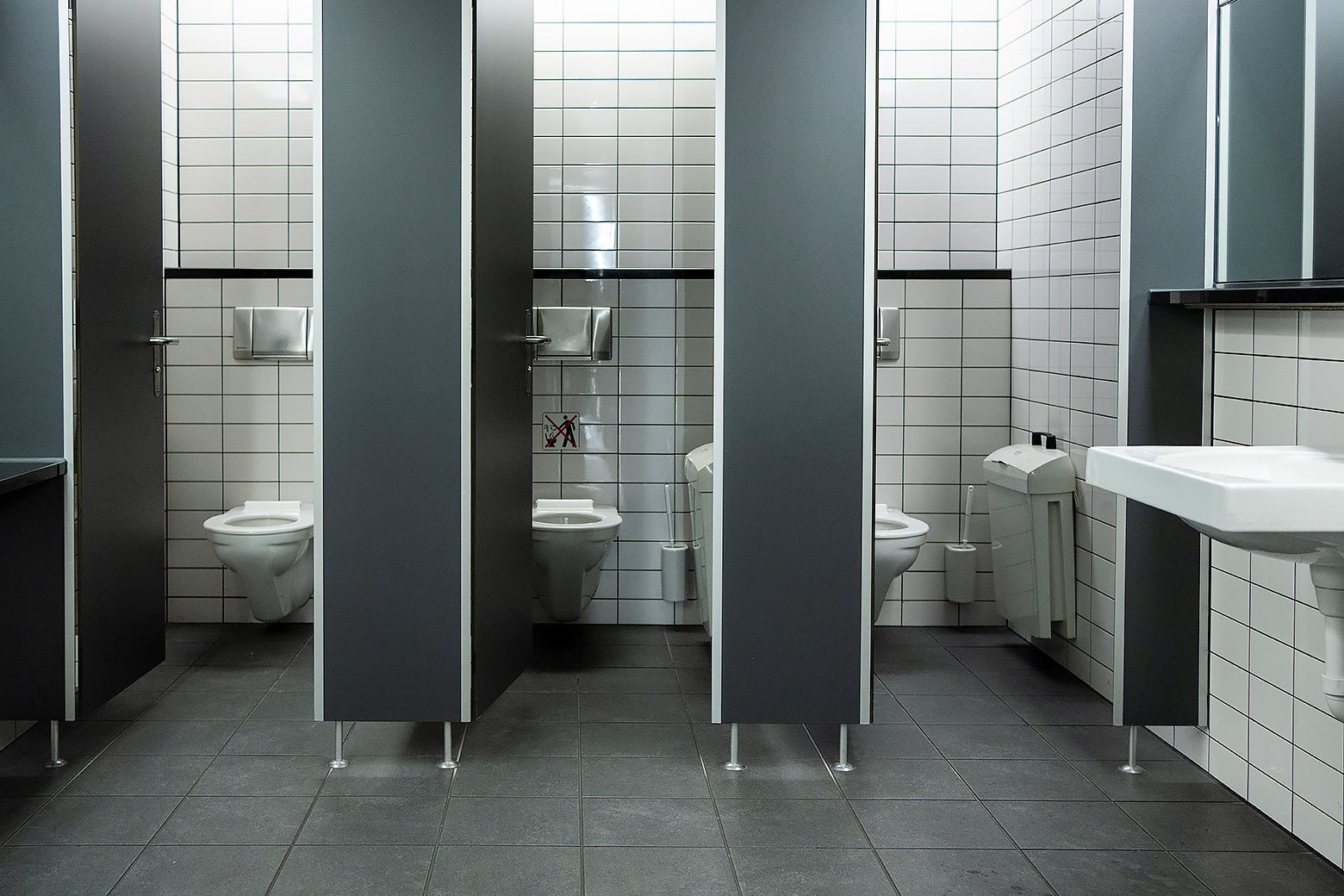
Downtime Mayor Mamdani is touting fancy new restrooms for a city that badly needs to pee. But solving urban sanitation may not be as simple as filling potholes. By Enter your email to receive alerts for this author. Sign in or create an account to better manage your email preferences. Unsubscribe from email alerts Are you sure you want to unsubscribe from email alerts for Christina Cauterucci? Sept 24, 20262:35 PM NickyLloyd/iStock/Getty Images Plus Sign up for the Slatest to get the most insightful analysis, criticism, and advice out there, delivered to your inbox daily. With the unveiling of 17 high-tech public toilets this month, New York is joining a new era of restroom experimentation. The self-contained bathrooms, built and maintained by a company called Throne, feature 21 sensors to detect messes in need of cleanup, a 10-minute time limit per visit (with, thoughtfully, a few warnings before the door pops open), and a system of record that stands to ban users who leave the place untidy. With no need to connect to power, water, or sewage lines, the units can be placed in any public space and moved as needed. The Thrones, which are also up and running in several other U.S. cities, represent an attempted 21st-century solution to a generations-old problem. Since the advent of public restrooms, these spaces have been subject to waves of disinvestment, closures, and deliberate disrepair, leaving on-the-go Americans without adequate opportunities to relieve themselves. In For Customers Only: Public Bathrooms and the Making of American Inequality, a new history of the communal toilet, Temple University professor Bryant Simon writes, “It is much easier to find accounts of public bathrooms from the past than it is to find an actual public bathroom today.” As he examines the last 150 years of American history through the lens of the toilet, Simon depicts the public restroom as a mirror reflecting our deepest anxieties, cruelest impulses, and yearning for a clear social hierarchy. In a phone conversation, we spoke about how our cities came to be toilet-less and what it would take for communal bathrooms to live up to their promise. Our conversation has been edited for length and clarity. Christina Cauterucci: People clearly have a lot of feelings about public bathrooms. As you write in the book, they’ve been the sites of policing, violence, and all kinds of passionate public debate. What is it about bathrooms that ignites such intense reactions in us? Bryant Simon: Bodies, right? And fear and shame. I mean, where else do we pull our pants down or lift up our dresses and find ourselves in that kind of vulnerability? And the other thing is that there’s nothing more American than apple pie, but second might be apprehension about strangers. So if you take those two things together, the potential to be seen and revealed to complete strangers creates this explosive environment and a whole set of tensions that, almost from the beginning, could never be easily resolved. It’s funny—until I read this book, I hadn’t really thought about the fact that there had to be a “first” public bathroom, that it took a certain level of urbanization and industrialization for this to even become a necessity. And I was particularly fascinated by the research you did into the first wave of public restrooms, when these reformers had really big dreams for how they might be able to change society and even individual people for the better, all through the bathroom. What gave them those high hopes? Well, I think that the first thing is, rather than hope, the rise of the public restroom is a recognition of failure, a failure of the private sector. As ideas about excretion change at home and notions of privacy at home change, that meant you needed something to approximate that when you left the home. Because before that, people were more comfortable with some level of sharing bathrooms with neighbors, or not having this special cosseting space where they could go alone. Yeah, exactly. In some ways, all bathrooms at one point were “public bathrooms,” in that they were shared by everyone. And by the late 19th century and the early part of the 20th century, that has changed, and the best representation of that is the three-fixture bathroom at the top of the stairs. If that’s your norm, then that changes what you expect when you leave the house. And some places are anticipating that, like hotels, department stores, and restaurants, to a certain extent. But that private-sector network isn’t extensive enough to match this new burgeoning city and new ideas about privacy all at the same time. And so policymakers are like, “OK, the private sector has failed. We’re going to come in and do this. And along the way, we’re going to uplift the people, those strangers who we’re wary of, so we can share these spaces with them. “And from the beginning, we’re going to keep some people out and we are going to create a whole new kind of separation of bodies at the door.” Which, again, didn’t exist before that. At home, we don’t separate men and women. And in those kind of pre–public bathroom days, there’s no separation of men and women. There’s also the part where leaders felt that public bathrooms could civilize those folks who didn’t have access to such privacy or an atmosphere of cleanliness in their own homes. What made public officials believe that they could, in this kind of insulting way, change the behaviors of people who might be coming to the public bathrooms? I mean, you just described the Progressive Era, right? There’s this patronizing belief in uplift, that people can be changed. They can be changed through child labor laws. They can be changed through requirements to send them to school. And they can be changed through public baths and public bathrooms. And what’s interesting to me is not only that belief, but how quickly they lose their faith. It’s kind of crazy that by the early 1930s, that’s the first evidence I have of D.C. closing public bathrooms to keep out what they consider perverts. By the teens and 20s, very soon after the first wave of public bathrooms were constructed, some women—middle- and upper-middle-class women—are saying, “Well, these bathrooms aren’t clean enough,” and they go back to the department store. They don’t give it a whole lot of time. Slate receives a commission when you purchase items using the links on this page. Thank you for your support. So as you just alluded to, municipalities started closing their bathrooms when people realized that people were having sex in them—specifically that gay men were having gay sex. How much do we owe our current lack of public restrooms to that kind of midcentury homophobia? That was one of the real surprises that I found. That’s why I tell that story from New York about Edgar Eckert. That’s the first evidence I have where city officials are not just trying to manage the space, not just trying to criminalize the space, but are actually saying the only way to handle this “problem” and to disappear these people from open society is to close public bathrooms. This is a case in the middle of the 1930s where a man who works in Manhattan, who had lived there for 20 years, is followed into an out-of-the-way bathroom and murdered. There are kind of queer overtones to the story, and I don’t know if those are true, but I’m pretty convinced that’s the way city officials would have read it. Their response to his murder is to prosecute the murderers, but also to close those bathrooms to stop the problem. To me, that becomes the beginning of a pattern where public bathrooms are not used to expand space, not used to broaden middle-class access to the city, but used to disappear people who are seen as problems. So you’re right, the first incidence is over queer sex, and trying to eliminate male-presenting people who were interested in sex with other male-presenting people. Historiographically, that was really surprising to me. I would have thought, from what I know about American history, that it would have been over race. That does happen, but it happens later. They feel like they have race under control. Mildly and explicitly white supremacist lawmakers essentially have segregated these spaces enough that that’s not a complaint until segregation completely breaks down. The origins of a pattern of closing down public bathrooms in order to create inequality and to disappear people happens over queer sex. Is it inevitable that a public restroom, let’s say in the middle of a city park, will become a gross place that no one wants to visit, even for the people who it’s putatively put there for, just because of the way public spaces get used? No. I think that we have plenty of examples in the past and some examples now where public bathrooms can be maintained, but they can’t be maintained through indifference. If you never clean your home bathroom, it’s going to be dirty. Public bathrooms become dirty when they aren’t cleaned. They become “dirty,” and then it’s assumed that the people in them are dirty and they’re not worth public investment. And so then you don’t pay for the attendant anymore. Then you don’t fix things. Then it’s not at the top of the agenda of city councilpersons. But when we look at them, we don’t make that whole accounting, do we? We just say, “Oh, there’s some people hanging out here who don’t look like us, who maybe don’t seem like they have access to bathrooms and other spaces, and it’s their fault. They did it. Well, they’re not deserving of the support of the state.” And so we pull it back and it’s just proof of their unworthiness. It’s a circular logic. Understanding this pattern is crucial to any attempt to build public bathrooms now. If you tell me you’re investing in a public bathroom, tell me your plan to keep them sustainable, clean, and well-maintained. I definitely want to talk about this current era, with the new pod-like bathrooms that Mayor Mamdani is touting in New York City. In the past few years, we’ve seen a bunch of cities—including Washington, D.C., where I live—invest in these self-contained toilet units from a company called Throne, which are free to use, you just need an app or a free keycard to get in. I’m curious what you make of this, because it is sort of a public thing, but also a privatized thing. Plus, there’s this community narcing aspect where every user has a code and you can get banned if the person after you reports that you’ve left a mess. Is this the tide turning and hearkening a new golden era of the public toilet, or is this just more of the same and we’re going to see a similar cycle of disinvestment and decline? In some ways, public bathrooms stare back at us, right? These public bathrooms are an indication of the current moment we’re in, a moment with not a ton of capacity for state action, but also 15 years of neglect of some really vulnerable people, such that finally we had to act. So I think those two things are happening now, but there’s nothing inevitable about them not working. I don’t think we’re going to compare this to the public bathrooms of the early part of the 20th century with gold crests over their entranceways and terra-cotta floors and marble countertops. But I think it is finally a recognition that we can’t live with the dirt we’ve created. It’s not healthy for us. It’s not good for the business of cities, and it ultimately doesn’t serve the people who live in cities. The solution, the fact that it’s public-private, again, I think that’s the indicator of state capacity at this point. One of the really creative things about the Thrones is they don’t need to hook up to plumbing lines, which is one of the real costs of other public bathrooms. So there’s some technological stuff about it that is pretty interesting, like solar panels. There’s a fair amount of creativity in sanitation right now, both among activists and among manufacturers. But the thing about the Throne as a physical object is it does quote, somewhat, the Porta Potty, doesn’t it? And even though it’s single-user, which is good, it’s ADA-compliant, which is good. I think there’s something about the Porta Potty as a solution to this that perhaps reflects a fantasy that maybe the problem is temporary. We don’t need to actually build something lasting. We’ll just try this thing out that can be removed on a whim. Exactly. And I’m not blaming Throne, but there is something different about the early solidity, if you will, of the early 20th century: We’re going to be here. We are building something that is also a testament to the people of this city. The Thrones look like something that’s solving a problem as if the problem might not be permanent. Public bathrooms make problems visible. They didn’t invent queer sex, but they brought queer men seeking a space for sex—often because they couldn’t afford access to private spaces—into a kind of light where people could see them and that act could be criminalized. So at this point, public bathrooms are bringing to light 50 years of a fraying social safety net, a retreat in paying for affordable housing, a drug problem created through a multiplicity of forces. And then to expect to open them and make that disappear—I think that’s what’s happened in some places, right? Like in San Francisco—“We spent a lot of money on public bathrooms and people are still shitting outside.” Well, they still don’t have housing. I think this is going to be one of the problems moving forward with this new public bathroom building campaign. A bathroom is being asked to solve a multiplicity of problems. And maybe there’s a parallel to the past there, in that there are a lot of expectations, and when expectations aren’t met, people can turn on the program really quickly. But if you stop it, you’re still going to have the same problem. Bodies don’t go anywhere. And neither does bodily waste if people don’t have a place for it to go. Books Cities Health History Infrastructure New York City
New York City’s New Public Bathrooms Are a High-Tech Solution to an Old Problem. They May Not Work as Intended.
Full Article
Original Source
Read the full article at Slate →KhanList aggregates and links to publicly available news content. We do not host full articles from third-party sources. Always verify important information with original sources.