
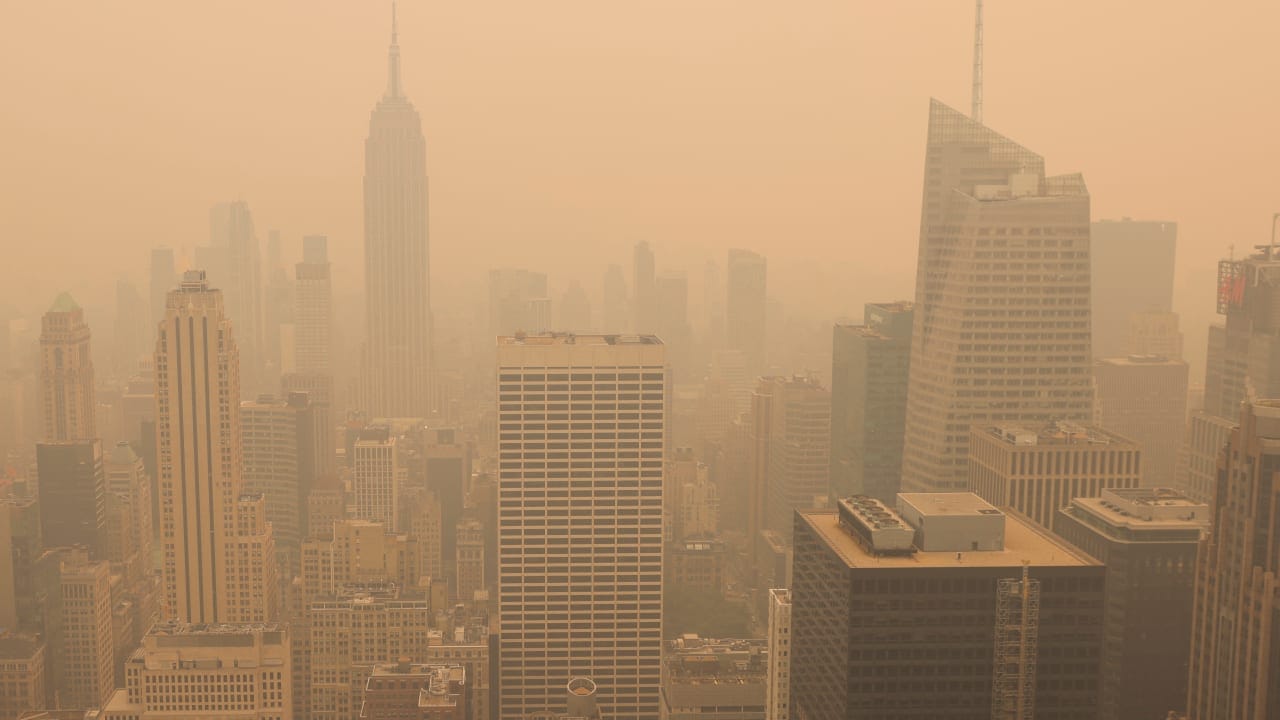
Jerusalem Post/Environment & Climate ChangeChief US District Judge Brenda Sannes in Syracuse, New York sided with 22 Republican state attorneys general, as well as industry groups including the US Chamber of Commerce.Follow us on Google A view from the top of the Rockefeller Center, as haze and smoke caused by wildfires in Canada hang over the Manhattan skyline, in New York City, New York, US, June 7, 2023. (photo credit: Andrew Kelly/Reuters)SEPTEMBER 1, 2026 03:10A federal judge ruled on Monday that New York cannot enforce a 2024 state law that sought to force fossil fuel companies to contribute $75 billion over 25 years into a fund to pay for damage caused by climate change.Chief US District Judge Brenda Sannes in Syracuse, New York sided with 22 Republican state attorneys general, as well as industry groups including the US Chamber of Commerce, in finding the state measure preempted by federal law.Sannes, an appointee of Democratic president Barack Obama, said the Clean Air Act, which gave the federal Environmental Protection Agency authority to regulate carbon-dioxide emissions, did not authorize states to adopt emissions compensation schemes such as New York's.She said enforcing New York's Climate Change Superfund Act risked upsetting the balance between preventing global warming, "a project that necessarily requires national standards and global participation," and promoting economic growth, energy production, foreign policy interests and national security."The Climate Act conflicts with the overriding need for a uniform rule of decision on matters influencing national energy and environmental policy, and basic interests of federalism," she wrote.The skyline of Manhattan as seen from the Empire State Building in New York City, US, March 3, 2026. (credit: JEENAH MOON/REUTERS)West Virginia Attorney General JB McCuskey, a Republican who led the states' opposition, in a statement hailed the decision, calling the state law "a money grab by the elites in New York."The office of New York Governor Kathy Hochul, a Democrat who signed the state law in December 2024, is reviewing the decision to determine possible next steps, spokesperson Ken Lovett said."Taxpayers shouldn’t have to foot the bill for damages caused by polluters," Lovett said.New York demands fossil fuel companies contribute to climate change superfundNew York was the second US state to create an industry-financed "superfund" to address climate change. Vermont was the first state, and its law also faces legal challenges.The New York law required fossil fuel companies to contribute $3 billion annually to the superfund starting in 2028, divided based on their greenhouse gas emissions between 2000 and 2018.The law applied to companies that the state's Department of Environmental Conservation considered responsible for 1 billion tons of greenhouse gas emissions during that period. Money would have gone to build roads, water systems, sewage systems, and other infrastructure to protect communities and coastlines from weather events such as extreme heat and flooding.In their February 2025 lawsuit, the Republican attorneys general called New York's law a politically motivated "overreach," which punished traditional energy companies that now comply with applicable laws. They said payouts from coal, oil and natural gas producers could wipe out thousands of jobs if the producers were forced to shut down.The US Department of Justice under Republican President Donald Trump had filed a similar lawsuit last year and supported the state attorneys general in the case before Sannes.The Environment and Climate Change portal is produced in cooperation with the Goldman Sonnenfeldt School of Sustainability and Climate Change at Ben-Gurion University of the Negev. The Jerusalem Post maintains all editorial decisions related to the content.Follow us on Google
New York cannot enforce state law demanding $75b. from fossil fuel companies, federal judge rules
Full Article
Original Source
Read the full article at Jpost →KhanList aggregates and links to publicly available news content. We do not host full articles from third-party sources. Always verify important information with original sources.