
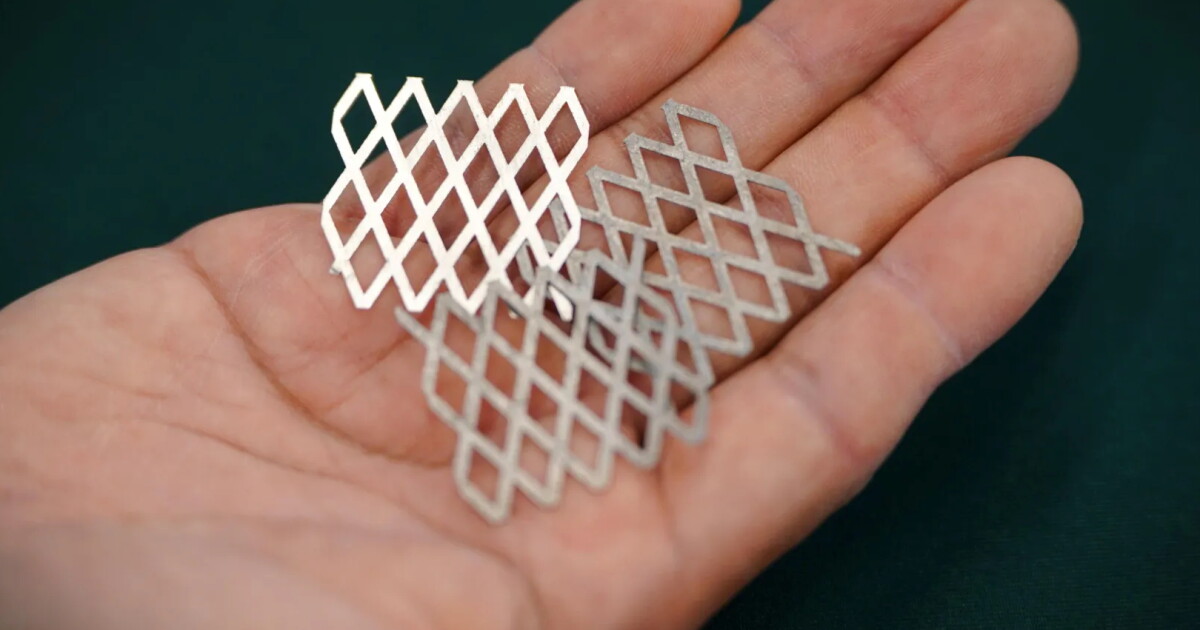
If anyone could defeat the “man of steel,” it would be a “man of stainless steel.” However, even stainless steel has its electrochemical kryptonite. Scientists have now created a new version of stainless steel that can withstand conditions only a “man of titanium” typically could, and without the cost, paving the way for more cost-effective green hydrogen production.Led by Prof. Mingxin Huang of the University of Hong Kong's Department of Mechanical Engineering, a team of researchers has developed a new alloy dubbed stainless steel for hydrogen (SS-H₂). The material is designed to survive the extremely corrosive, high-voltage conditions encountered during water electrolysis, potentially allowing cheap steel to replace some of the expensive titanium components currently used in hydrogen production systems.In tests using a 3.5% sodium chloride solution, roughly the salt concentration of seawater, SS-H₂ resisted corrosion at electrochemical potentials up to about 1,700 mV. This takes it beyond the roughly 1,600 mV potential associated with water oxidation under the researchers' test conditions, and into territory where even highly corrosion-resistant conventional stainless steels struggle, making it particularly interesting for green hydrogen production.Hydrogen can be produced by water electrolysis, in which electricity is passed through water to drive two electrochemical reactions. Hydrogen forms at the cathode, while oxygen is produced at the anode. If the electricity comes from renewable sources, the resulting hydrogen can be produced with very low operational carbon emissions, making it “green” hydrogen.Now, seawater presents an attractive potential water source because it is abundant and helps avoid using increasingly valuable freshwater supplies. However, salty water creates an especially hostile environment for the metal components in the electrolyzer. Chloride ions readily attack many alloys, while components around the oxygen-producing anode side are simultaneously subject to strongly oxidizing electrochemical potentials.Even stainless steel, known for its excellent corrosion resistance, eventually meets its match here.Stainless steel doesn't simply rust like ordinary carbon steel or iron, largely because of its chromium content. Chromium in the alloy reacts at the surface to form an extremely thin, protective oxide film, primarily composed of chromium oxide. This "passive" layer separates the underlying metal from its environment and can reform when damaged, giving stainless steel its corrosion resistance.Unfortunately, that protection has limits.At an electrochemical potential of around 1,000 mV, stable chromium oxide can itself undergo further oxidation, producing soluble Cr(VI) species. The protective layer consequently begins to break down in a process known as transpassive corrosion. This is a problem, as water oxidation occurs at around 1,600 mV under the conditions considered by the researchers. In other words, conventional stainless steel can begin to lose the very mechanism that protects it from corrosion hundreds of millivolts before reaching the expected operating range.Even 254SMO, a "super austenitic" stainless steel loaded with chromium, nickel, molybdenum, and nitrogen and renowned for its resistance to pitting in seawater, encounters this fundamental kryptonite at sufficiently high potentials.One solution is to use more resistant alternatives. Electrolyzers operating with desalinated seawater or acidic solutions typically employ titanium structural components, including titanium protected with expensive gold or platinum coatings. Titanium handles these punishing electrochemical conditions much better, but it has an obvious downside: it costs much more than steel.So Huang's team went back to stainless steel and gave its corrosion defense a second act.The experimental stainless steel for hydrogen alloy has the composition Fe-20.73Cr-20.2Co-17.7Mn-1.7Si by weight, meaning that, alongside its iron base, it contains unusually large quantities of chromium, cobalt and, crucially, manganese. The researchers cast the alloy using vacuum induction melting, forged it into a plate at 1200 °C (2192 °F), homogenized it at that temperature for 4 hours, and then quenched it in water. The result has a single face-centered cubic crystal structure, but its most important feature emerges only at high electrochemical potentials.Like ordinary stainless steel, SS-H₂ initially relies on chromium-based passivation. However, at around 720 mV, something unexpected occurs: manganese begins to form a second protective layer over the existing chromium-rich film. As the potential rises and the conventional chromium protection approaches the conditions under which it would ordinarily deteriorate, the manganese-based layer takes over the heavy lifting.The team calls the mechanism "sequential dual-passivation." It's particularly counterintuitive because manganese has traditionally been regarded as detrimental to stainless steel's corrosion resistance. “Initially, we did not believe it because the prevailing view is that Mn impairs the corrosion resistance of stainless steel,” said study first author Dr. Kaiping Yu.Atomic-scale analysis eventually convinced the researchers that the strange behavior was real. Rather than relying on a single chromium-based defense across the entire operating range, the alloy effectively changes its protective mechanism as the electrochemical potential rises.This phenomenon allowed SS-H₂ to remain protected in 3.5 wt% NaCl solution up to a breakdown potential of approximately 1,700 mV versus SCE – around 700 mV higher than the point at which conventional chromium-based passivation runs into its transpassive limitation, and importantly, above the approximately 1,600 mV water-oxidation potential highlighted by the researchers.The team also demonstrated the material in a salt-water electrolyzer, reporting performance comparable to titanium structural materials used in current hydrogen-production equipment. However, this does not by itself solve every challenge associated with direct seawater electrolysis. Seawater brings additional problems involving competing chlorine chemistry, catalysts, impurities, and deposits. What SS-H₂ does is keep structural metal alive in a salty, high-potential electrochemical environment, potentially solving a particularly expensive piece of that puzzle. Lead scientists Prof. Mingxin Huang and Dr. Kaiping YuUniversity of Hong Kong According to the HKU team, a 10-MW proton exchange membrane (PEM) electrolysis tank system costs around HK$17.8 million (about US$2.3 million), with structural components accounting for as much as 53% of that expense. Replacing expensive gold- or platinum-coated titanium components with SS-H₂ could, by the researchers' estimate, reduce the cost of the relevant structural material by roughly 40 times!Now, this does not automatically mean the hydrogen obtained suddenly becomes 40 times cheaper. Electricity, catalysts, membranes, balance-of-plant equipment, and numerous other costs remain. However, drastically reducing one of the electrolyzer's major hardware costs could help lower the capital cost of green hydrogen systems, particularly if steel eventually proves viable for equipment operating with seawater-derived feedstocks.The development is also past the early experimental stages. The researchers say they have already produced tonnes of SS-H₂-based wire in partnership with an industrial manufacturer as the project moves toward practical components. However, plenty of engineering still lies between wire and a commercially proven electrolyzer. Components such as porous meshes and foams must be manufactured at scale, incorporated into working systems, and shown to maintain their unusual corrosion resistance over long operating periods.“From experimental materials to real products, such as meshes and foams, for water electrolyzers, there are still challenging tasks at hand,” said Huang.The mechanism itself may ultimately have implications beyond this particular steel. By designing alloys in which different elements provide protection at different electrochemical potentials, the researchers believe sequential passivation could offer a new route to materials that can withstand environments conventional stainless steels simply weren't designed to endure.A paper on the research was published in Materials Today.Source: University of Hong Kong
New type of stainless steel is optimized for hydrogen electrolysis
Full Article
Original Source
Read the full article at Newatlas →KhanList aggregates and links to publicly available news content. We do not host full articles from third-party sources. Always verify important information with original sources.