
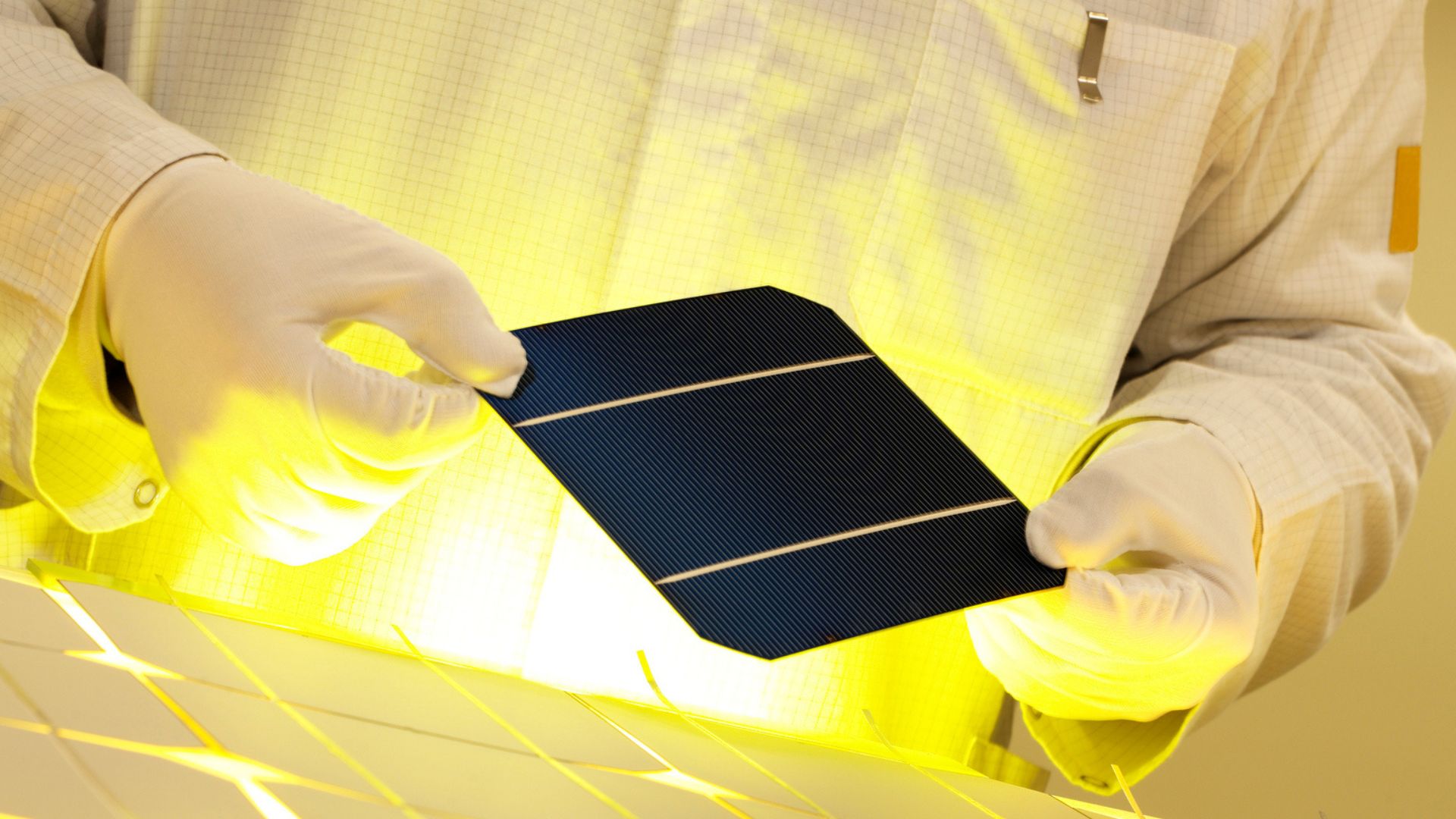
Researchers at the University of Groningen in the Netherlands found that tin-based perovskite solar cells can slow heat loss from high-energy “hot electrons.” It could push solar cell efficiency beyond the theoretical 33 percent limit. When sunlight strikes a panel, photons jump-start electrons into action. The most energetic photons create super-charged hot electrons. Theoretically, these high-voltage powerhouses should generate far more electricity. In practice, they are a fleeting tease. In fractions of a trillionth of a second, these high-energy particles rapidly cool, dumping their bonus energy as waste heat before ever leaving the solar cell. “This means that the energy is lost before the hot electron exits the solar cell material,” said Jan Anton Koster, Professor of Physics of Novel Semiconductors and Devices at the University of Groningen. Reabsorption of lost heat (hot phonon bottleneck) and occupied energy levels (Band filling) slow the loss of energy from hot electrons. | Image ACS Energy Letters Dual-action physics In collaboration with Maria Antonietta Loi, professor of Photophysics and Optoelectronics, the team created an experimental setup. Using a specialized solar cell material called tin-based perovskite, Loi’s lab performed a feat many thought impossible: she slowed the heat loss down by a factor of 1,000. Suddenly, the extra energy lingered for nanoseconds instead of vanishing in picoseconds. Skeptics were instantly dubious. Even the researchers questioned their own data. “We even started to doubt the measurements ourselves,” admits Koster. To solve the puzzle, Koster and PhD student Tim Faber built digital simulations to peel back the quantum layers. And discovered a surprising double-action mechanism at work. First, a “Hot Phonon Bottleneck” creates a heat trap. As electrons release heat, the surrounding environment warms up so fast that the electrons end up reabsorbing their own lost thermal energy. Second, the “Burstein-Moss effect” creates an atomic traffic jam. Because the lower-energy states are already crowded with excited electrons, the path down becomes blocked. Together, these two mechanisms stall the cooling process. It works. The simulations matched the exact nanosecond delay observed in the lab. Advantage of tin-based cells This study uses Ensemble Monte Carlo simulations and time-resolved photoluminescence to show that band filling, combined with the hot-phonon bottleneck effect, accounts for ultra-long hot-carrier cooling times in tin-based metal halide perovskites. Through advanced computer simulations and light-based measurements, researchers discovered why tin-based solar materials can hold onto extra energy much longer than usual. These specialized materials could be used to build a new generation of super-efficient solar cells. Tin-based metal halide perovskites are non-toxic, eco-friendly crystalline materials for high-performance solar energy conversion. These advanced semiconductors feature a specialized three-dimensional lattice structure in which tin ions pair with halogen and organic or inorganic components. The material possesses an unusually low electron mass. As a result, electric charges move quickly and retain extra thermal energy for extended periods. This combination of broad light absorption, efficient charge movement, and prolonged energy retention makes these materials prime candidates for next-generation solar panels. Commercial solar panels harvesting this lingering heat are still a ways off. “There are many other questions that still need answers, but in theory, this discovery could allow the creation of more efficient solar cells, beyond the theoretical limit of 33 percent,” the team stated.The study findings were published in the journal ACS Energy Letters. Get the latest in engineering, tech, space & science - delivered daily to your inbox.Mrigakshi is a science journalist who enjoys writing about space exploration, biology, and technological innovations. Her work has been featured in well-known publications including Nature India, Supercluster, The Weather Channel and Astronomy magazine. If you have pitches in mind, please do not hesitate to email her.
New tin-based solar cells trap heat 1000 times longer, could beat 33% limit
Full Article
Original Source
Read the full article at Interestingengineering →KhanList aggregates and links to publicly available news content. We do not host full articles from third-party sources. Always verify important information with original sources.