
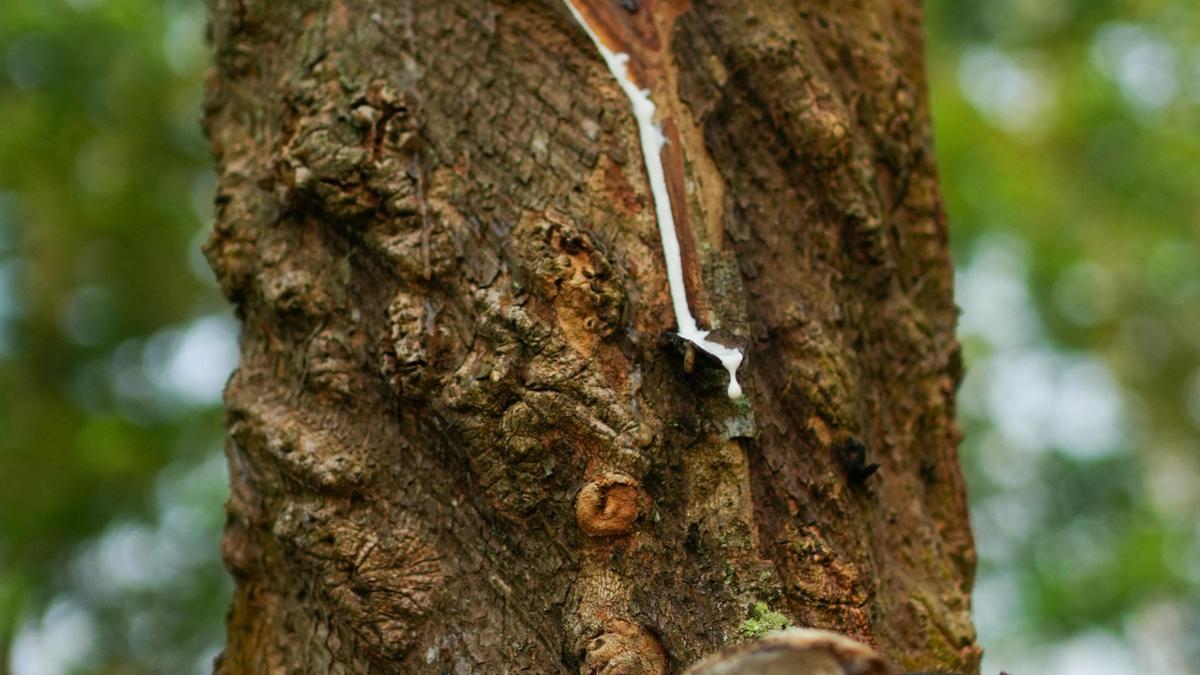
Emphasising the need to prop up Keralam’s ailing natural rubber sector, a new study has suggested reviving rubber producers’ societies (RPS), overhauling the rubber production incentive scheme (RPIS) and floating a scheme for tapping abandoned plantations.The Public Policy Research Institute (PPRI), a think tank under the Finance department which conducted the study, has submitted its report, ‘Price fall of natural rubber and its impact on Kerala economy - Study of an natural rubber-dominant grama panchayat,’ to the Kerala State Planning Board. For the purpose of the study, PPRI’s S. Mohanakumar, Vipin Kumar R. and Prem Kumar examined the impact of falling rubber prices on Chirakkadavu, a natural rubber-reliant grama panchayat in Kottayam district.When rubber prices started plummeting, many RPS quickly became defunct. Reviving them can attract farmers to the sector, for which a special scheme has to be evolved and implemented, the study said. “It will help farmers to process rubber and manufacture value-added products,” it said. The study has urged the State government to draw up a scheme for tapping abandoned plantations or plantations where the owners are absent.Buyer oligopsonyThe RPIS, which is now farmer-oriented, should be restructured to accommodate labour also, Prof. Mohan Kumar, who is the PPRI Director, said. A ‘buyer oligopsony’ where numerous small and marginal farmers with limited bargaining power are confronted by eight automotive tyre majors who control over 70% of India’s consumption is one reason for the ineffectiveness of the RPIS, he said. The study noted that Keralam’s natural rubber sector is passing through a crisis characterised by “unprecedented” volatility and fall in prices. “The price fall has manifested in rubber productivity and production while the gross area under the crop remained unchanged,” it said. While seeking measures to regulate rubber imports, the study also recommends an expansion of the World Bank-aided Kerala Climate Resilient Agri-Value Chain Modernisation (KERA) project to cover all districts and all plantations in the case of rubber. “Even though rubber has been included under the scheme, the project covers only six districts in the State,” it noted.Specialised trainingThe study further called for the promotion of rubber exports and rubber-based micro, small and medium enterprises (MSME) and specialised training for women in rubber-based, non-tyre industries.The study of the Chirakkadavu grama panchayat was based on a sample survey covering 565 rubber-reliant respondents. It found farmers increasingly leasing out rubber land for growing other crops such as pineapple or rambutan in Chirakkadavu. The “persistent fall” in rubber prices has resulted in licensed rubber dealers in the village dropping from 22 to 5 (2020-2025), input suppliers from 6 to 3 and the number of processing units from 5 to 4, the study revealed. Published - August 30, 2026 07:02 pm IST
New study suggests measures for propping up Keralam’s ailing natural rubber sector
Full Article
Original Source
Read the full article at Thehindu →KhanList aggregates and links to publicly available news content. We do not host full articles from third-party sources. Always verify important information with original sources.