
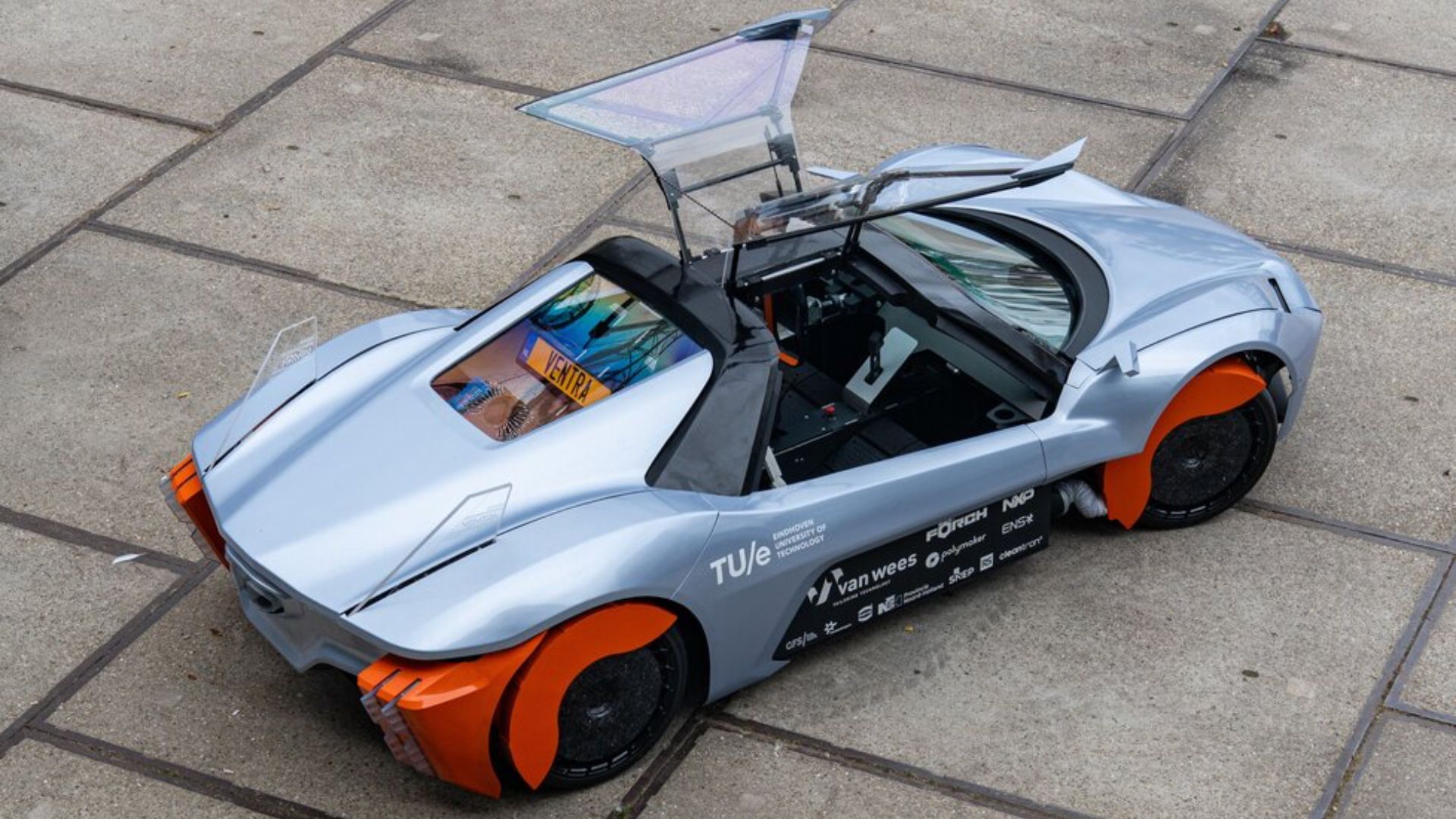
A group of students has built an electric car that tackles a rising source of pollution: particles from tires and brakes. Their team, TU/ecomotive, created VENTRA, a sustainable concept car that captures these particles while driving and uses lightweight materials to help reduce tire wear. They revealed the car to encourage the auto industry to address emissions that come from more than just the exhaust. The student team from Eindhoven University of Technology pointed out that electric cars still create particulate matter, even without tailpipe emissions. Tire and brake wear, along with particles from the road, all add to pollution near roads. “No exhaust emissions does not necessarily mean no emissions,” said team manager Tim Spencer. Electric cars can also place greater loads on tires because they are generally heavier and can deliver strong acceleration. An electric system captures particles VENTRA’s main feature is a system that collects tiny particles near the wheels. Rather than using a regular filter, it electrically charges the particles. The charged particles are then attracted toward a grounded collection surface positioned near the wheel. Once captured, they remain attached to the collection surface rather than continuing into the surrounding air. The collection system can be cleaned after driving with a vacuum cleaner or water. The students also plan to recycle the captured material. Their concept demonstrates this approach by reusing the collected particles as part of the vehicle’s interior. Computer simulations indicate that the system can collect about 24 percent of particles when the car is moving between 31 and 50 mph. At lower speeds, it could capture up to 42 percent. TU/ecomotive with VENTRA. (Image credit: Sarp Gürel) Cutting pollution through lower weight VENTRA also tackles particulate pollution by reducing the amount the vehicle generates in the first place. The team focused on the vehicle’s chassis, which can account for a significant portion of a car’s weight. Much of VENTRA’s chassis uses lightweight carbon-fiber-reinforced thermoplastic panels. This cuts almost 220 pounds from the vehicle. Lower weight means less force is placed on the tires during driving. The students noted that this can reduce tire wear and therefore decrease the amount of particulate matter released from the tires. The concept also includes the Clean Drive system, which monitors driving behavior. A dashboard display provides guidance aimed at smoother driving, including more gradual acceleration, gentler braking and less unnecessary steering. (Image credit: Sarp Gürel) Students target a wider emissions problem The team said its work highlights a pollution source that can receive less attention than exhaust emissions. Tiny particulate matter can enter deep into the lungs, while some particles can potentially reach the bloodstream depending on their size and composition. Exposure has been associated with health risks including cardiovascular disease, strokes, impaired lung development, COPD, and lung cancer. The issue is also gaining regulatory attention in Europe. From November 2026, Euro 7 rules will introduce requirements covering emissions from brake and tire wear. “With VENTRA, we want to show what solutions are possible and encourage the automotive industry to look beyond the exhaust pipe when it comes to emissions,” Spencer added. Get the latest in engineering, tech, space & science - delivered daily to your inbox.A versatile writer, Sujita has worked with Mashable Middle East and News Daily 24. When she isn't writing, you can find her glued to the latest web series and movies.
New student-built electric car concept captures pollution even while driving
Full Article
Original Source
Read the full article at Interestingengineering →KhanList aggregates and links to publicly available news content. We do not host full articles from third-party sources. Always verify important information with original sources.