
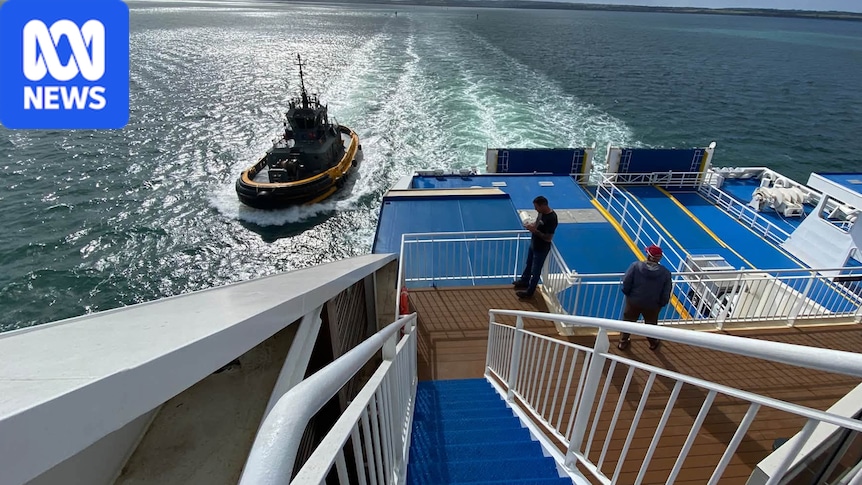
One of the new Spirit of Tasmania ferries, Spirit IV, has arrived in Geelong four hours late after making several unusual turns and being escorted by a tug boat into Port Philip Bay.It comes as the Australian Transport Safety Bureau (ATSB) investigates a "steering issue" on TT-Line's other new ferry, Spirit V, late last month.Spirit IV, which embarked on its first passenger voyage with much fanfare on Saturday, left Devonport last night and was due to dock at Geelong at 6am.However, passengers were told early in the morning that the ferry would be arriving late due to an as-yet undisclosed reason."The person came on the PA and announced the arrival would be delayed till about 8 o'clock [this morning]," passenger Mitchell Bruce, who runs the Ferries of Tasmania Facebook group, said.Spirit of Tasmania IV arrives at Geelong with a tugboat following behind. (ABC News: Harrison Tippet)"And then about five minutes later, the captain came on and said that the harbour had delayed the arrival of the ship entering, preventing them from entering the harbour until about 10:30am."The ferry ended up docking at Geelong about 10am.A track map shows Spirit IV made several turns outside Point Lonsdale before entering Port Phillip Bay.Spirit of Tasmania IV's location was tracked on a marine traffic website. (Supplied: MarineTraffic)Spirit of Tasmania IV made erratic turns in Port Phillip Bay on Thursday morning.It then made more turns inside the bay.A tugboat shadowed the ferry as it made its way to the terminal.The ABC has contacted the ship's operator TT-Line for comment.Spirit V autopilot settings investigatedSeparately, the ATSB is investigating a steering incident involving Spirit V that occurred off Point Henry, in Port Phillip Bay, during a trial voyage on October 26.At the time, 94 crew and 20 passengers were onboard, as well as a cargo of freight vehicles."At about 2030 [8:30pm], the ship was being controlled using its autopilot when it reached the junction between the Hopetoun Channel and Wilson Spit Channel to the north-east of Point Henry," the ATSB said."The required starboard turn was initiated, but the autopilot responded slowly, causing a wider-than-expected turn."The ATSB said after adjusting the settings, the ship's "rate of turn" increased, with the autopilot subsequently "unable to arrest the turn"."Steering control was then switched to manual, and port rudder applied to stop the turn," it said."Subsequent attempts to control the ship's heading resulted in increasing heading oscillations from port to starboard, resulting in the ship briefly moving outside the charted shipping channel's southern and northern limits."In order to regain control of the ship's movement, it was then brought to a stop in the Wilson Spit passing channel to the south of the shipping channel's limit before resuming its outbound voyage."A final report on the incident is expected to be published in the second quarter of next year.Ferry replacement beset by problemsSpirit IV and its sister ship Spirit V have now replaced the two older ships in TT-Line's fleet.One of those older ships, Spirit I, suffered a navigational issue as it was about to enter Port Phillip Bay last month, triggering an internal investigation.The Tasmanian government's ferry replacement program has been plagued with cost overruns and infrastructure delays.The issue happened during the ship's fifth official sailing. (ABC News: Mackenzie Heard)A parliamentary inquiry in May heard the capital program had cost $717 million more than originally expected.The figure did not include costs associated with berthing both newly completed vessels for many months in Scotland and Victoria while their Devonport facility was still being constructed.TT-Line is currently trying to sell the two older ferries.
New Spirit ferry escorted by tugboat as ATSB probes 'steering issue' on other ferry
Full Article
Original Source
Read the full article at Abc →KhanList aggregates and links to publicly available news content. We do not host full articles from third-party sources. Always verify important information with original sources.