
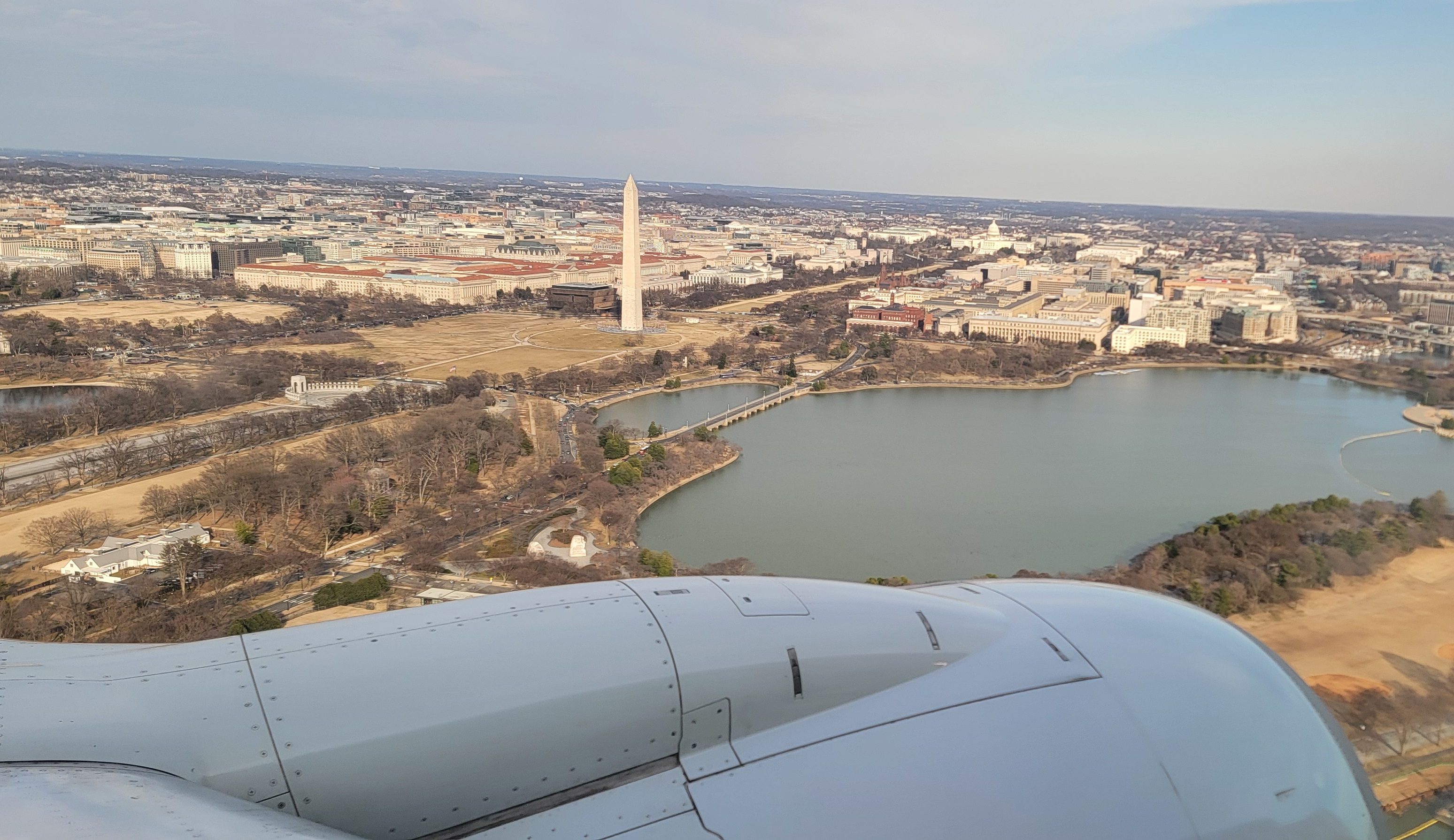
Washington’s National airport doesn’t allow flights longer than 1,250 miles, unless there’s an exemption written into law that gets handed out by the Department of Transportation. Virginia Senators Tim Kaine and Mark Warner have a new proposal to permanently eliminate 30 daily flight slots at Washington National airport, and at least 26 of those would have to be taken from those ‘beyond perimeter’ flights, removing at least half the airport’s long-distance domestic flying. They call their proposal the DCA Air Safety Act even though most of it has nothing to do with safety. In fact, the bill requires the cuts to proceed even if the FAA finds that eliminating a particular flight would produce no safety improvement. Safety is being used here as a fig leaf for a longstanding effort to restrict competition – especially competition at National that goes up against United’s Dulles hub. There are real safety challenges at National airport, and they deserve a remedy tied to what’s actually wrong. What The Legislation Actually Does Last week’s announcement and nine-page draft lays out: FAA must reduce the airport’s arrival rate to no more than 28 per hour within 90 days of enactment. Introduce binding half-hour flight caps within 180 days, distributing arrivals and departures evenly and prohibit clustering within an hour. Thirty slot exemptions must disappear permanently, at least 26 of those have to be beyond-perimeter slots. A slot is one takeoff or landing, not a round trip. The bill calls for six eliminations a year from 2028 through 2032. The proposed list of cuts would be due within 180 days, followed by a 60-day comment period, with a final list due within 120 days after comments close. The safety rational is difficult to take at face value. The legislation says that for four years, the FAA can find that a particular elimination wouldn’t provide a safety benefit. The Transportation Secretary can then delay that cut by up to a year, following notice and another 60-day comment period. However all 30 eliminations must still be completed by December 31, 2032 even if the FAA determines no safety benefit in doing so. The draft also expressly bars judicial review of FAA’s decisions to eliminate exemptions or delay their elimination. It requires the FAA to consult the Transportation Secretary and the Metropolitan Washington Airports Authority, which operates both National and Dulles and opposes beyond-perimeter flying. A permanent commission gets representatives from the airports authority, FAA, Defense Department (!), Virginia, Maryland and D.C., i.e. it’s stacked with local government representatives and the military against commercial flying. (There’s no representation of passengers or communities losing air service.) It’s charged with producing reports every two years starting in 2028. However the result of these reports gets pre-written into law. A Small Share Of The Airport Bears Nearly All The Cuts National’s beyond-perimeter authorizations total 50 takeoff and landing rights, supporting 25 daily round trips. That includes 42 additional exemptions and eight created by converting existing within-perimeter slots. Eliminating at least 26 of 50 means removing at least 52% of beyond-perimeter flying (all 30 could come from that category, taking the reduction to 60%). Compare that with who holds rights at the airport overall. This represents slotholdings, some of which may be leased to other carriers. Airline All held rights Share overall Beyond perimeter American 506 56.7% 14 Delta 108 12.1% 6 Southwest 92 10.3% 4 United 84 9.4% 6 JetBlue 60 6.7% 2 Air Canada 16 1.8% 0 Alaska 12 1.3% 12 Republic 8 0.9% 0 Frontier 6 0.7% 6 Total 892 100% 50 Beyond-perimeter rights are just 5.6% of slots, yet they must account for at least 86.7% of the eliminations. American holds most of the airport’s rights, but just 2.8% of its holdings are beyond-perimeter. The bill leaves the ordinary slot pool alone and takes the cuts from exemptions. Every Alaska Airlines and Frontier flight are in the category targeted for elimination. Together they have about 2% of overall holdings but 36% of the beyond-perimeter pool. The bill could therefore wipe out Alaska’s presence and eliminate ultra-low cost carrier Frontier from National. United Has Been Trying To Protect Dulles This Way For Years In 2016, I covered United taking credit for stopping an expansion of National’s perimeter from 1,250 to 1,475 miles. Its employee newsletter explained the concern about longer flights from National: “drawing traffic away from United’s Dulles hub.” If long distance flights aren’t allowed to compete out of National, then United’s Dulles flights benefit. United fought hard against adding beyond-perimeter flights in the 2024 FAA reauthorization. Delta pushed for more access. They even got the airports authority to push a new lease provision charging an airline $1 million annually for using a new beyond-perimeter authorization, with the money supporting… Dulles. Senator Ted Cruz demanded records of airport authority communications with United over this. National’s Main Runway Is Busy But It Isn’t Alone Runway 1/19 at National airport is one of the busiest in the country, though use is down about 15% compared to two years ago. And it’s not inherently a problem. LAX’s busiest runway sees the same amount of traffic, and the airport has twice as many departures. It wouldn’t be possible to double National airport’s departures, because it lacks the same parallel runway capacity. But a single heavily used runway is far from unprecedented, and nobody is proposing a ban on cross-country flying from LAX. Flight distance isn’t a measure of air controller workload. Aircraft type, wake separation, runway occupancy, weather, conflicting helicopter traffic and the arrival sequence are relevant. National airport doesn’t have the large aircraft requiring greater separation that many larger facilities do. When slots were initially distributed at National airport, 10% were reserved for general aviation, and virtually none of those have been in use sicne 9/11. Fix The Failures That Put Aircraft In Conflict The NTSB’s findings on the January 29, 2025 American Airlines 5342 tragedy highlight arrival rates and controller workload as factors, along with helicopter routes overlapping airline approaches, reliance on visual separation, failures to act on warning signs, Army altimetry problems and controller position decisions. In February testimony, NTSB Chair Jennifer Homendy described tower controllers requesting four mile arrival spacing but getting less than that about 40% of the time. On the accident night, enough controllers were available to staff positions separately, but airplane and helicopter duties were combined. Hiring more people alone isn’t the full answer, since it needs to be accompanied by training, supervision and rules that keep critical positions separately staffed when conditions require it – as well as by investments in technology. And the FAA already reduced the arrival rate and changed helicopter operations. Its January update reduced from 36 arrivals an hour before the accident to 26 afterward, and then back to 30. The senators propose 28 as a tool to get rid of beyond-perimeter slots. It should be a higher priority to: Keep helicopter routes clear of airline approaches and require reliable altitude reporting and surveillance. Adopt technology that controls the arrival sequence before aircraft reach the tower. Properly implemented metering and tower approach coordination should deliver the spacing controllers need, rather than forcing them to improvise with intersecting runways. Improve staffing, training and accountability. Have enough qualified controllers, use them in the required positions, train for the airport’s mixed traffic and runway configurations, and act on repeated close calls before a collision. Build rules around data, not agendas. Operating limits should be tied to evidence. If safe separation and available staffing require smoothing of peaks and reduction in peak flights, that should be based on analysis and not a legislated outcome required regardless of what the data shows for safety. Once FAA determines how much traffic can safely operate, there’s a separate question of who gets to use that capacity. I’ve argued for congestion pricing and competition over permanent gifts of slots. Within a hard safety ceiling, prices can encourage larger aircraft, fewer duplicative peak frequencies and more flying at quieter times. The flight involved in the 2025 collision was arriving from Wichita, inside National’s perimeter. The failures that put it in conflict with a helicopter needed fixing regardless of where the next aircraft came from. Senators Warner and Kaine should be ashamed of themselves. Topics on this page
New “Safety” Bill Requires Cutting Half Of Washington National Airport’s Long-Distance Flights—Even If It Won’t Make Flying Safer
Full Article
Original Source
Read the full article at Viewfromthewing →KhanList aggregates and links to publicly available news content. We do not host full articles from third-party sources. Always verify important information with original sources.