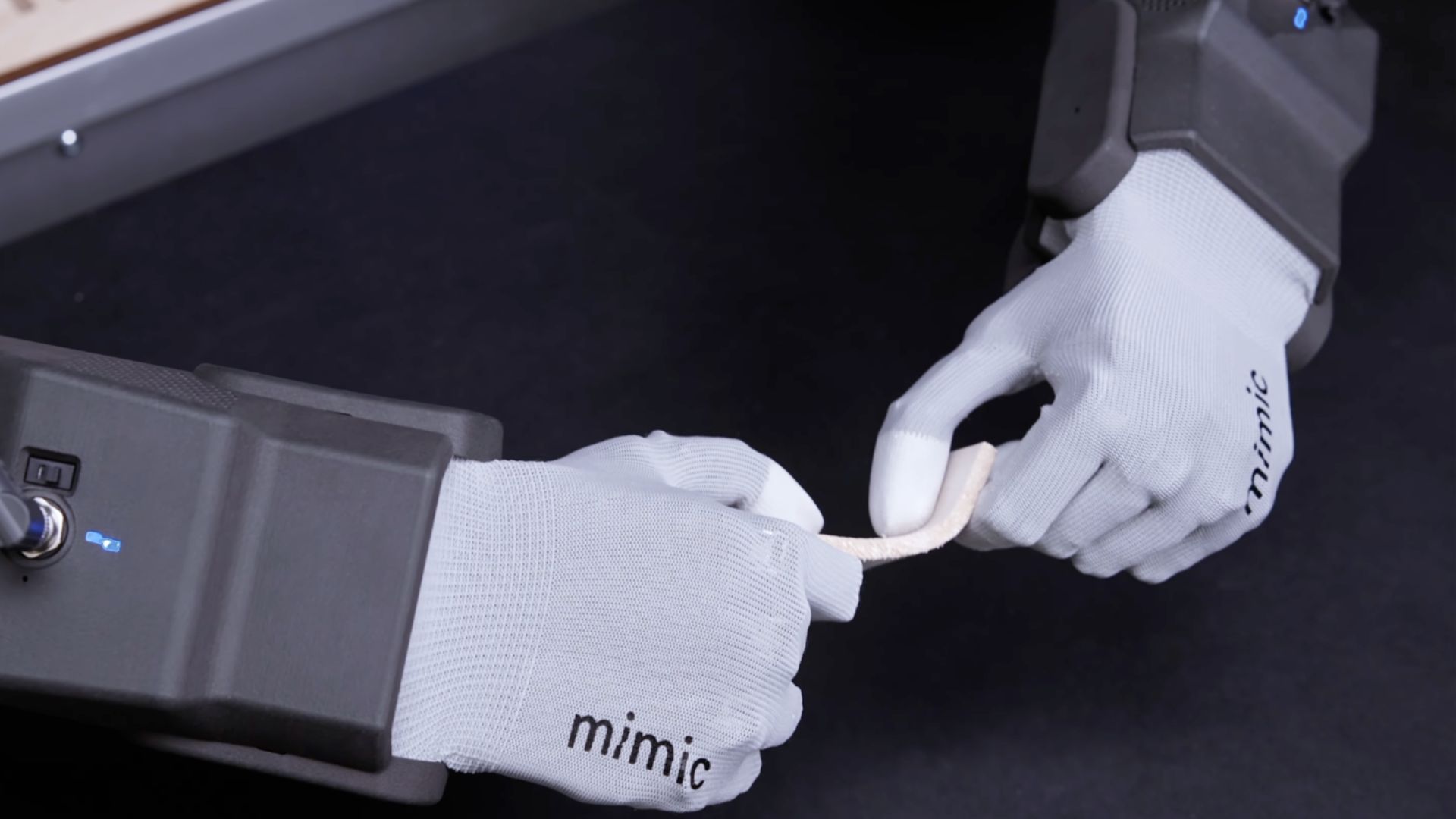
The M1 is designed AI-first: every feature exists to maximize the performance of learned manipulation policies in the real world.Mimic/YouTube Swiss robotics startup Mimic Robotics has unveiled the Mimic Hand M1, a dexterous robotic hand designed to replicate human hand movements for factory automation. The tendon-driven hand houses its actuators in the forearm, enabling a compact design while delivering enough strength to handle significant payloads. The hand also combines high-resolution force sensing with pressure-sensitive fingertips that detect normal and lateral forces, as well as contact location, enabling it to manipulate both delicate and heavy objects with precision in industrial applications. Recently, Norwegian robotics firm 1X unveiled 25-DOF tendon-driven hands for NEO, boosting precision, strength, safety, reliability, and human-like dexterity. Humanlike robotic dexterity The Mimic Hand M1 is a dexterous robotic hand engineered to match the versatility, strength, and precision of the human hand for industrial automation. Designed and manufactured in Switzerland, the M1 forms the core of the company’s strategy to solve one of robotics’ biggest challenges—general-purpose dexterous manipulation. Rather than relying on conventional two-finger grippers, Mimic believes a human-like robotic hand is essential for transferring skills learned from human demonstrations directly to robots, enabling AI systems to perform a far wider range of real-world tasks. Built around an AI-first architecture, the Mimic Hand M1 closely mirrors the functional movement of the human hand while maintaining the durability required for factory environments. It features 15 active degrees of freedom across 21 joints, including finger abduction and an opposable thumb, allowing it to perform both delicate precision tasks and powerful gripping motions. The joint configuration was selected based on industrial task data, eliminating unnecessary complexity while improving long-term reliability. Unlike many robotic hands that integrate motors directly into the palm and fingers, the M1 uses a tendon-driven architecture inspired by human anatomy. Its actuators are housed in the forearm, where they drive the fingers through tendons routed over bearings and pulleys rather than friction-prone guide tubes. This design enables the hand to remain compact while delivering higher continuous torque, improved force sensing and greater durability. It also allows the use of larger industrial-grade actuators, making the system better suited for demanding manufacturing applications. Smarter robotic grip Despite weighing only about 4 pounds (1.8 kilograms), the Mimic Hand M1 can maintain a steady cylindrical grip on payloads exceeding 55 pounds (25 kilograms). According to Mimic Robotics, at the opposite end of the force spectrum, its highly backdrivable joints can detect forces as small as 0.1 newtons, equivalent to sensing objects weighing around 50 grams through motor current alone. The combination of low-friction actuation, dual joint encoders and minimal backlash enables highly accurate motion control while providing continuous force feedback during manipulation. The fingertips add another layer of intelligence through tactile sensors that detect normal force, tangential shear force, and the precise location of contact. This rich sensory information allows the robotic hand to manipulate fragile components, adjust grip in real time and safely interact with unfamiliar objects—capabilities that are difficult to achieve with vision systems alone. Mimic Robotics says the M1 is designed not merely as an end effector but as a sensor-rich platform for Physical AI. By maintaining the same human-like hand morphology across data collection, AI training, and deployment, the company aims to eliminate the “cross-embodiment gap” that occurs when robots learn from human demonstrations but operate using fundamentally different grippers. This approach is intended to improve how AI models transfer human skills to robots.The Mimic Hand M1 is part of a broader full-stack robotics platform that also includes the wearable U1 exoskeleton for collecting human demonstration data and proprietary software infrastructure for real-time robot control. Together, the company believes these technologies can accelerate the development of general-purpose robotic systems capable of performing a much wider range of industrial tasks with human-like dexterity.Recommended ArticlesGet the latest in engineering, tech, space & science - delivered daily to your inbox.Jijo is an automotive and business journalist based in India. Armed with a BA in History (Honors) from St. Stephen's College, Delhi University, and a PG diploma in Journalism from the Indian Institute of Mass Communication, Delhi, he has worked for news agencies, national newspapers, and automotive magazines. In his spare time, he likes to go off-roading, engage in political discourse, travel, and teach languages.
New robotic hand lifts 55 pounds while handling fragile items with human-like skill
Full Article
Original Source
Read the full article at Interestingengineering →KhanList aggregates and links to publicly available news content. We do not host full articles from third-party sources. Always verify important information with original sources.