
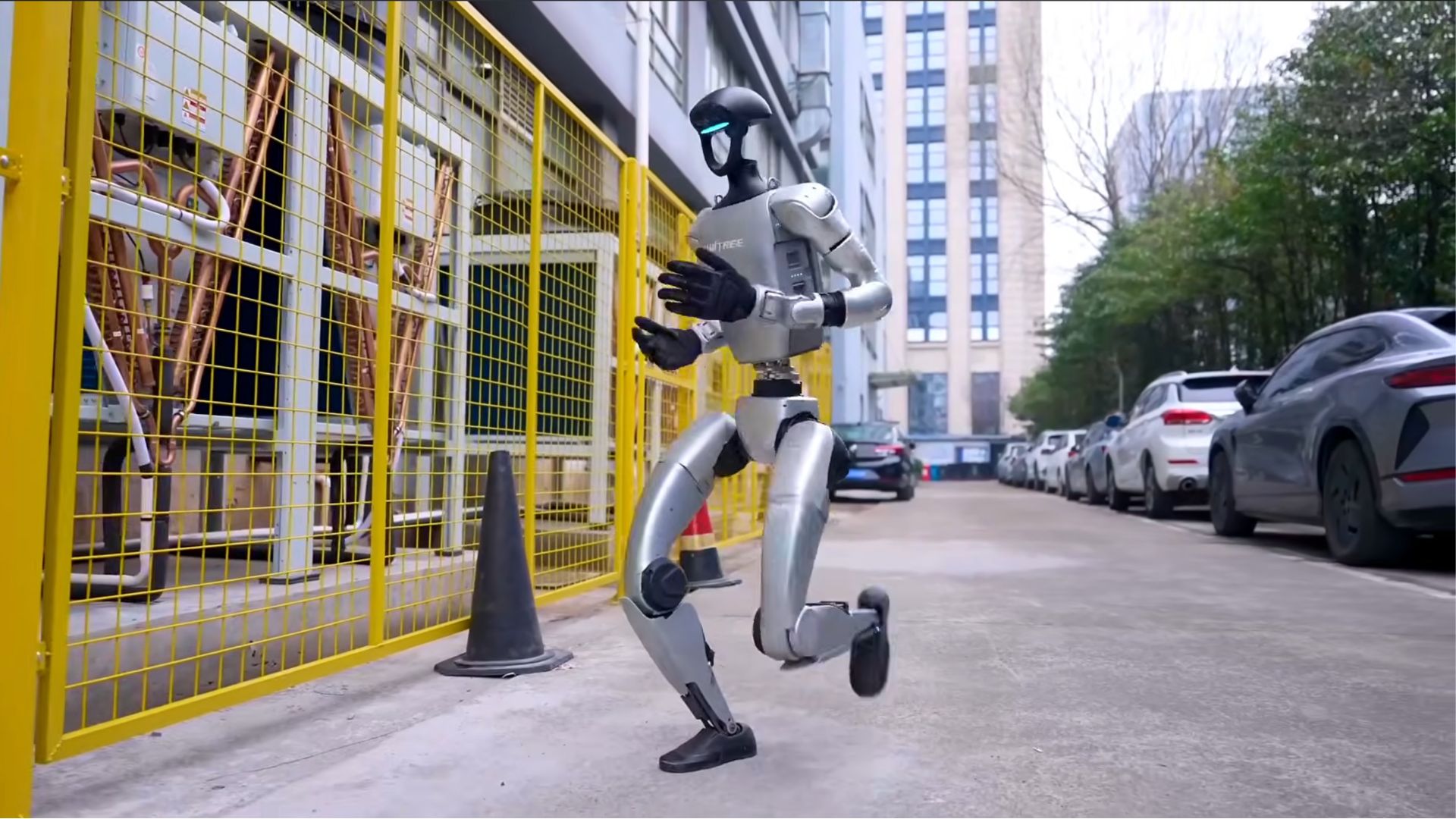
Researchers have developed a new framework that enables humanoid robots to perform agile, humanlike movements and transition smoothly between different skills. The system allows robots to execute complex maneuvers, including cartwheels, spin kicks, sports movements, and acrobatics, without requiring separate training for each task. Called BeyondMimic, the framework learns from human motion data and can adapt its movements to new tasks and environments. The researchers say the approach could help overcome limitations of existing humanoid control systems, which often require extensive fine-tuning or produce rigid, unnatural movements. Robots learn human agility The BeyondMimic model enables humanoid robots to learn agile, humanlike movements from human demonstrations and then combine those skills to perform tasks they were never explicitly trained for. The system addresses a major challenge in humanoid robotics: robots can be taught individual movements such as walking, jumping, or kicking, but making them perform naturally while switching between different skills remains difficult. Existing approaches often require motion-specific reward functions, extensive tuning, or separate training for each task. BeyondMimic uses a two-stage learning framework to overcome these limitations. In the first stage, reinforcement learning (RL) is used to teach the robot to track a wide range of human motions. Crucially, the researchers use a single motion-tracking formulation, shared reward structure, and common hyperparameters rather than tuning the system separately for every movement. The researchers trained the system using about 2.5 hours of diverse human motion data. It learned hundreds of skills, ranging from ordinary walking and running to single-leg balancing, jumps, dance movements, martial-arts-inspired actions, spin kicks, and cartwheels. Twenty-one representative motion clips were subsequently deployed on a physical humanoid robot, demonstrating reliable transfer from simulation to hardware. Making robots skillful The second stage introduces a latent diffusion model, which gives BeyondMimic its ability to generate and combine movements. Instead of simply replaying learned motion sequences, the model learns the underlying distribution of coordinated state-action trajectories. A variational autoencoder first compresses these movements into a smoother latent representation, after which a diffusion model learns how those representations evolve, according to the team. The researchers then use classifier guidance at inference time to steer the diffusion model toward objectives that were not included during training. This allows the robot to adapt its existing skills without retraining or fine-tuning the underlying policy. For example, the system can receive a joystick command and generate appropriate walking or running behavior. It can also navigate toward waypoints, avoid obstacles, or use sparse future keyframes to generate a complete movement between them. In one demonstration, the robot smoothly transitioned from walking into a cartwheel and then returned to walking. It also performed sequences combining four cartwheels with walking and running. The approach can additionally combine multiple objectives. By integrating waypoint tracking with an obstacle-avoidance cost, the robot could detour around an obstacle while continuing toward its destination. The same framework could combine joystick control with collision avoidance. The physical robot demonstrated highly dynamic movements, including aerial cartwheels, spin kicks, and flip kicks. During an aerial cartwheel, it reached a peak acceleration of 31 m/s² and pelvic angular velocities of up to 15.7 rad/s, comparable to reported values for skilled human aerial movements. Beyond agility, the researchers found that the generated walking and running motions appeared more natural to human observers. In a study involving 77 participants, BeyondMimic’s motions were preferred over the robot’s native controller as more humanlike and natural in 70.8 percent of choices, compared with 29.2 percent. The researchers say the key advance is not a single new component but the integration of scalable motion tracking with latent diffusion and inference-time guidance. By separating skill acquisition from task specification, BeyondMimic provides a route toward humanoid robots that can learn large repertoires of human movement and recombine those skills to handle new situations without task-specific retraining.Get the latest in engineering, tech, space & science - delivered daily to your inbox.Jijo is an automotive and business journalist based in India. Armed with a BA in History (Honors) from St. Stephen's College, Delhi University, and a PG diploma in Journalism from the Indian Institute of Mass Communication, Delhi, he has worked for news agencies, national newspapers, and automotive magazines. In his spare time, he likes to go off-roading, engage in political discourse, travel, and teach languages.
New robot system helps humanoids master acrobatics without training each move
Full Article
Original Source
Read the full article at Interestingengineering →KhanList aggregates and links to publicly available news content. We do not host full articles from third-party sources. Always verify important information with original sources.