
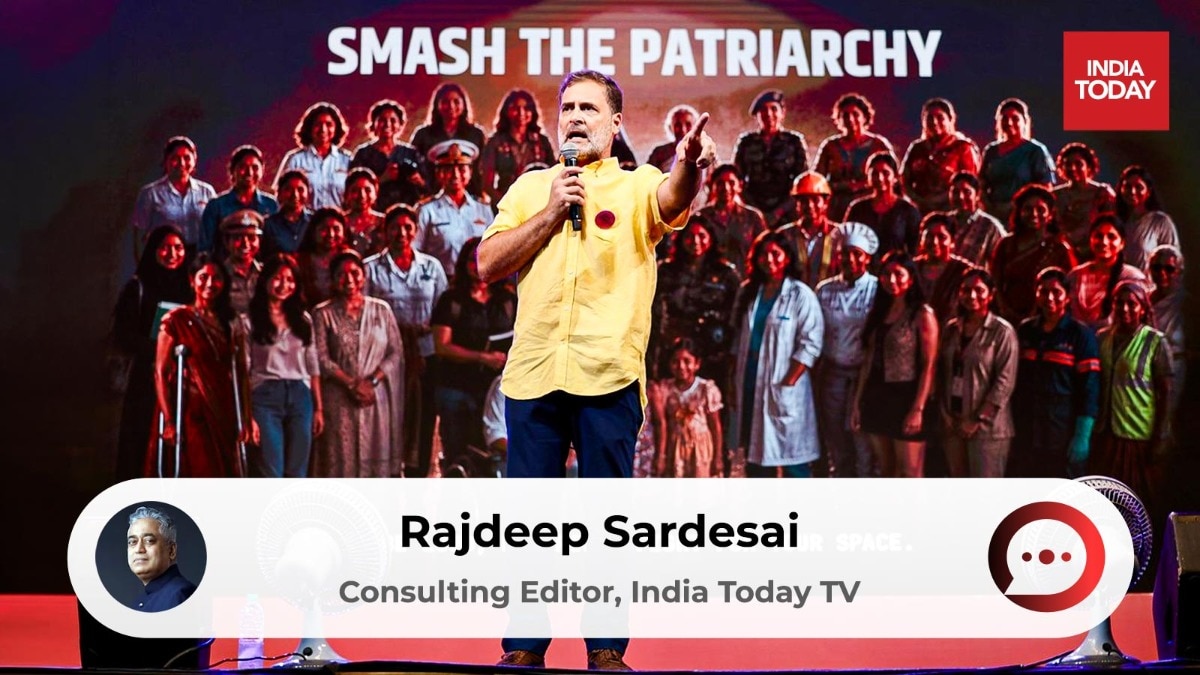
Rahul Gandhi's pitch for young women at a Pune event is admirable but stands in contrast with the Congress's reality of faction-ridden, male-dominated politics.Rahul Gandhi's speech at a Pune event that was targetted primarily at young women was strikingly different from the standard vocabulary of Indian politics.A fortnight ago, I was in Pune. And something rather unusual caught my eye. From hoardings to lampposts, from signboards to banners, one political face seemed to be staring at me everywhere I went: Rahul Gandhi.For a moment, I had to rub my eyes and look again. Rahul Gandhi dominating the political skyline of a BJP-ruled state? And not just any BJP-ruled state, but Maharashtra, where the BJP is firmly on top and the Congress organisation has shown precious little sign of revival in recent times?The occasion was Rahul Gandhi's Chhatron Ki Goonj event, and the local Congress unit had clearly pulled out all the stops to publicise it. Interestingly, the event was targeted particularly at young women - the Gen Z cohort that every political party claims it wants to reach but very few seem to understand.And Rahul Gandhi's speech was, in many ways, strikingly different from the standard vocabulary of Indian politics. Speaking to an audience of young women, he argued that women should not be defined by their relationships with men: they belong to themselves. He spoke about violence against women, but expanded the definition beyond physical violence to include what he called the "violence of denied opportunities" and the many forms of control women face in their everyday lives. The message could be summed up in his three catchy words: smash the patriarchy. Now, you may agree with Rahul Gandhi's politics or disagree with it. You may support the Congress or oppose it. But surely we can acknowledge one thing: this is not the usual language of Indian political rallies. And the response from the young women who attended was overwhelmingly positive.And yet here is the big question: How many of those young women will actually vote for the Congress in the 2029 Lok Sabha or Maharashtra election? The honest answer: we simply don't know. Because there is a huge difference between winning an audience and winning an election. Rahul Gandhi's positioning may be up. But the Congress's isn't. Not yet.And I'll tell you why. Just a few days after Pune, I was in Goa - another BJP-ruled state which will go to the polls early next year. And once again, I saw the familiar Congress problem. A party fighting itself rather than its principal opponent. Factionalism. Leadership rivalries. An inability to build the broader political alliance that may be essential if it is serious about defeating the BJP. The Congress talks about unity nationally. But in state after state, it struggles to practise unity organisationally.And then there is Karnataka, one of the few remaining major states where the Congress is in power and has a robust ground presence. Deputy Chief Minister DK Shivakumar has undoubtedly brought some much-needed energy and political aggression to the organisation. But look at his Cabinet. 33 members. Not one woman.The irony is stark. If Rahul Gandhi is standing before young women in Pune and speaking passionately about empowerment, opportunity and breaking structures of control, shouldn't the Congress itself reflect that message in the way it governs? Otherwise, it risks looking like political tokenism rather than political transformation.And therein lies the Congress's biggest problem today. Its leadership is increasingly saying many of the right things. But the moth-eaten organisation is still not walking the talk.Look across the country. In Punjab, which also goes to the polls in a few months, the Congress remains badly divided. In state after state, factionalism consumes political energy that should be directed at the BJP. The party remains overwhelmingly male-dominated in many of its organisational structures. It has struggled to create genuine space for young leaders.Remember the Udaipur Chintan Shivir of 2022 and its many promises? The Congress said it would ensure greater representation for younger leaders, with a commitment that 50 per cent of organisational positions would go to those below 50. How much of that promise has actually translated into visible organisational change? The party spoke of bringing OBCs, Dalits, and Adivasis into the centre of decision-making. Has that happened at the scale promised? It spoke repeatedly of giving women a much greater role in leadership. Again, look at the organisation and ask yourself: where is the transformation?This is not merely a question of optics. It is a question of credibility. Because you cannot tell a young voter to believe in a new political India if your own party continues to function according to the habits of the old India. The Congress's principal opponent is the Modi-Shah BJP - perhaps the most electorally formidable political machine India has seen in decades. Against that machine, speeches alone will not win elections.But here is where I think Rahul Gandhi deserves some credit. Over the past few years, he has increasingly managed to capture something real: the angst, anxiety and aspirations of a younger India. Whether it is unemployment, inequality, wealth concentration, pressures of competitive examinations, the fear of a shrinking job market or the sense among many young people that the political system does not listen to them - Rahul has been far more willing than most mainstream politicians to engage with that discontent.So the obvious question is: If Rahul Gandhi can change the way he speaks to young India, why can't the Congress change the way it functions? Why is the party still several steps behind its own leader? Or is Rahul also part of the problem: a leader marching to his own beat rather than take his party along with him?Because this is the uncomfortable truth for the Congress: Rahul Gandhi may be undergoing a political reinvention, but the Congress organisation is still carrying the baggage of its past. Elections aren't won by individuals alone. They are won by a second line of leadership that is hungry, credible and not weighed down by decades of factional baggage. Above all, they are won by a robust organisation that is present 365 days a year, not just 45 days before polling day.The Congress cannot keep hoping that Rahul Gandhi will personally carry the party across the electoral finish line. He cannot be the party's message, organisation, candidate, campaigner and vote-converter all rolled into one. If Rahul Gandhi is genuinely changing, the Congress must change with him. Invest as much in rebuilding Brand Congress as they have in building Brand Rahul.Because there is a danger here. The party could have the right message but the wrong messenger network. It could have an increasingly relevant leader but an increasingly irrelevant organisation. It could win the narrative war on social media and still lose the booth war on Election Day.You cannot win New India with Old Congress. That, ultimately, is the challenge before Rahul Gandhi - and before the Congress. The leader may be rising. But unless the party walks the talk, the Congress will remain exactly where it is: talking about change, while changing far too slowly.- EndsThe writer is a senior journalist and columnist. Views are personal.Published By: Dev GoswamiPublished On: Sep 2, 2026 11:04 IST
New Rahul, Old Congress: Why the Grand Old Party needs to walk the talk
Full Article
Original Source
Read the full article at Indiatoday →KhanList aggregates and links to publicly available news content. We do not host full articles from third-party sources. Always verify important information with original sources.