
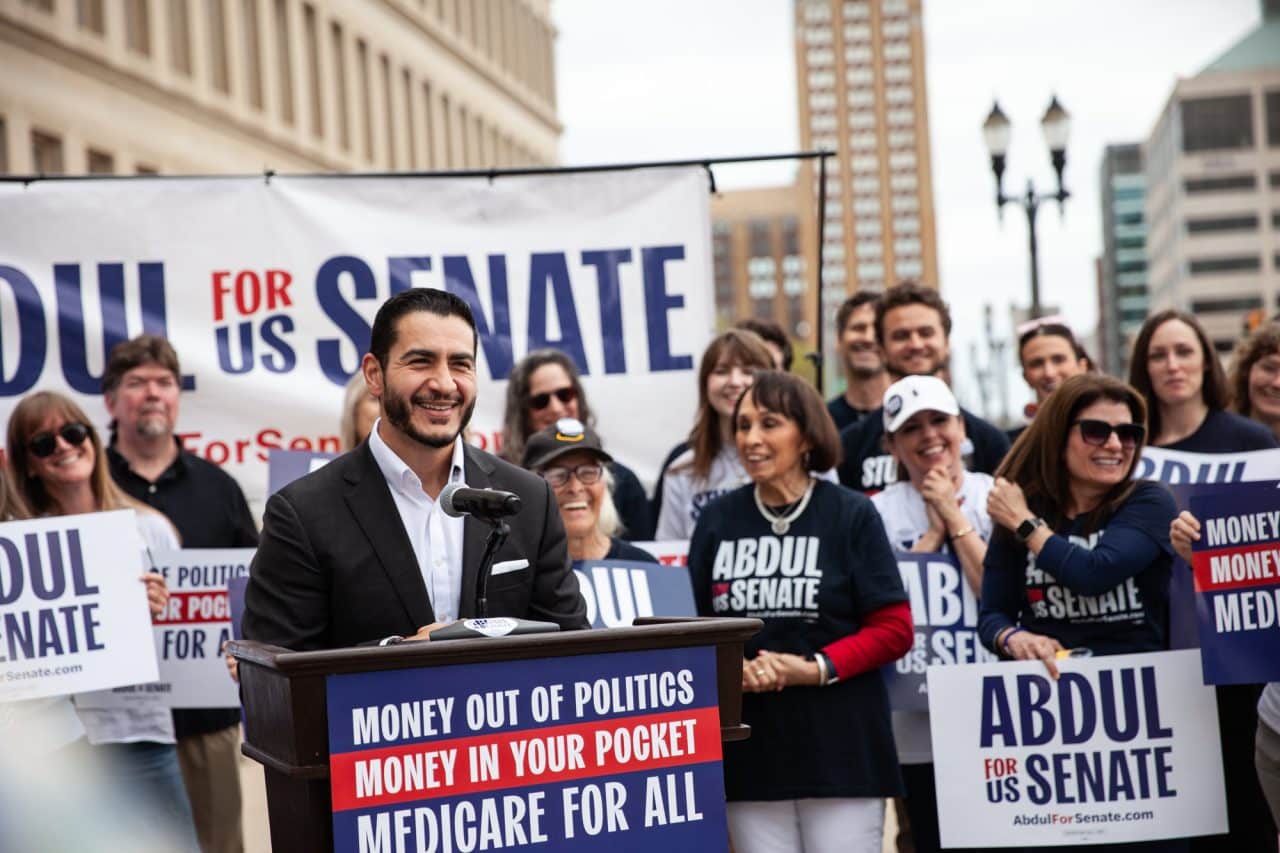
In the final televised debate for Michigan’s Senate race, GOP candidate Mike Rogers used his closing remarks to claim that Jewish Democrats were supporting him because they view his Democratic opponent, Dr. Abdul El-Sayed, as “too extreme” on the subject of Israel. “Jewish Democrats who are afraid for their children when their daughters can’t wear their Star of David walking across Michigan’s campus, these are real,” Rogers told the audience. “My opponent’s rhetoric, his vitriol, is having consequences.” The idea that El-Sayed’s criticisms of Israel have alienated Jewish Democrats is certainly not limited to propaganda from the Rogers campaign. In recent weeks, multiple articles have used this very narrative as their thesis. “Michigan Democrats at odds over Senate nominee Abdul El-Sayed as November nears,” a Quartz headline declares. “Questions about El-Sayed’s stance on Israel, accusations of antisemitism, and his campaign’s relationship with [left-wing Twitch streamer Hasan] Piker have kept the party’s attention away from its general-election opponent, Republican Mike Rogers,” insists the piece. “The divisions come as Michigan’s statehouse and governor’s races are also closely contested.” Division was also the theme of an NPR piece claiming that Democrats were trying to “unify” before the midterms. The article asserts that “healing the fractures is proving complicated” and quotes multiple Democratic voters who express reservations about the candidate over Israel. “Democrats are still struggling to unite behind El-Sayed after the primary exposed deep disagreements over Israel,” says PBS News. CNN said a “ruptured” Democratic Party is “trying” to unite around the candidate. The Detroit-based Super PAC TFM is attempting to ride this purported wave, spending nearly $6 million on ad campaigns connected to a “Democrats for Mike Rogers” effort. “We believe in the true spirit of the Democratic Party, always standing against hate and bigotry, no matter where it comes from, who it targets, or whether it is politically inconvenient or not,” reads the campaign’s website. “We believe every American deserves dignity, respect, and equal protection under the law.” This past weekend, a planned “Democrats for Mike Rogers” rally in Pontiac, Michigan, drew almost no one. The Bulwark’s Joe Perticone shared images of the event on Twitter, showing three people in an empty parking lot and one person operating a camera. “When your astroturf campaign meets actual turf,” joked the liberal social media account MeidasTouch. The low turnout probably wasn’t a surprise to anyone who read a recent Marist survey of Michigan voters. Despite the media narrative detailing a massive split among Democratic voters, 95% of Democrats say they’re voting for El-Sayed, and just 4% say they’re voting for Rogers. 3% of Michigan Republicans actually say they’re voting for El-Sayed, but this minuscule number certainly hasn’t led to a host of stories about divisions within the GOP. “The Democrats have a six-point advantage against the Republicans on the generic congressional ballot question among Michigan likely voters,” reads a write-up summarizing the poll’s findings. “That leads opens up to 10 points among registered voters, little changed from the nine-point lead the Democrats had in September. President Donald Trump’s approval rating is upside down in Michigan, and a plurality of likely voters express worry about their personal finances.” If this is reality, why do many articles on the race tell the story of a divided party, and why do they rely primarily on testimony from rare voters to convey a wider trend? Furthermore, why do so few of these pieces point out that Israel has grown deeply unpopular among Democratic voters and that El-Sayed’s positions are consistent with the vast majority of the base? An April 2026 Pew poll found that 80% of Democrats and Democratic-leaning independents held an unfavorable view of Israel, compared with 53% in 2022. This framing goes well beyond El-Sayed. The idea that the Democratic Party is divided on Israel is a consistent theme in the mainstream press, despite the fact that voters are effectively aligned on the issue. “There’s only one problem with the tensions,’ ‘divided,’ and ‘wedge issue’ framing: It is not supported by any polls,” wrote media critic Adam Johnson in The Intercept earlier this year. “The ‘divide,’ such as it is, is increasingly not among Democrats or even liberals; it is between the supermajority of Democratic Party voters and party leadership. While party leaders such as House Minority Leader Hakeem Jeffries and Senator Minority Leader Chuck Schumer, and big Democratic donors, are pro-Israel, actual Democratic voters have moved on from Israel with remarkable speed and consistency.” The pro-Israel lobbying group AIPAC recently announced that it would stop issuing endorsements or directly earmarking contributions to political candidates. The move comes less than five years after the organization began making such endorsements. The shift exposes a clear truth: voters view AIPAC as a toxic entity, and their public support is doing more to hurt candidates than help them. This was clear during Michigan’s Democratic primary, when El-Sayed highlighted opponent Haley Stevens’s connections to the group. An August Axios report showed that Mike Rogers even expressed concerns about an AIPAC endorsement, although he has since publicly welcomed their help. This all seems relevant to next week’s election or, at least, more relevant than a split that doesn’t exist.
New poll upends narrative that Democratic voters are split on El-Sayed
Full Article
Original Source
Read the full article at Mondoweiss →KhanList aggregates and links to publicly available news content. We do not host full articles from third-party sources. Always verify important information with original sources.