
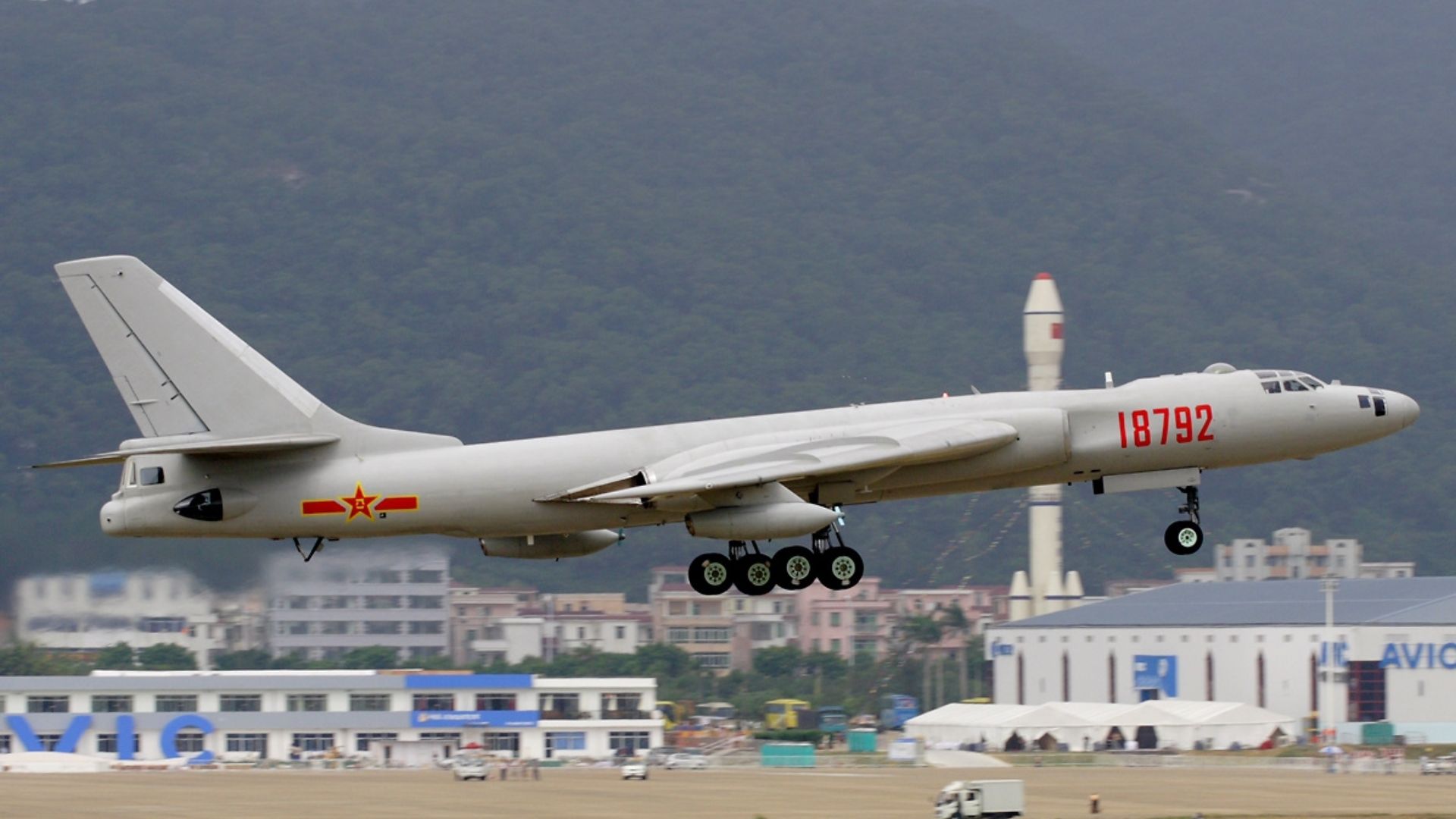
A newly released PLA documentary has offered one of the clearest public glimpses yet of China’s H-6N strategic bomber carrying a large missile beneath its fuselage during a simulated joint strike exercise, prompting renewed discussion about Beijing’s evolving long-range strike capabilities. The footage, broadcast in the final episode of the Zhisheng (Victory) documentary series aired by CCTV, shows an H-6N escorted by two J-20 stealth fighters while carrying a single large missile mounted on its centerline rather than the smaller weapons typically seen under the aircraft’s wings. Although Chinese state media did not identify the weapon, military analysts believe it could represent one of China’s most capable air-launched strike systems. A different kind of missile According to Global Times, citing Wang Yanan, editor-in-chief of Beijing-based Aerospace Knowledge magazine, the missile is likely an air-launched ballistic missile designed for either anti-ship or land-attack missions. The report notes that the weapon bears similarities to the JL-1 air-launched long-range missile, which was publicly displayed during China’s 2025 Victory Day parade. However, because the documentary only provides distant views of the missile, Wang emphasized that it is not possible to confirm its exact identity based on the available footage alone. If the weapon is indeed an air-launched ballistic missile, it would represent a different operational concept from conventional cruise missiles. Rather than flying at low altitude for most of their flight, ballistic missiles typically follow a high-speed ballistic trajectory, making interception significantly more challenging. Why launch a ballistic missile from an aircraft? The biggest advantage of an air-launched ballistic missile is flexibility. As Wang explained to Global Times, unlike land-based missile systems whose launch positions are relatively fixed, an aircraft such as the H-6N can launch from multiple locations and approach targets from different directions. This increases operational unpredictability and makes defensive planning more difficult. Launching from an aircraft can also extend the missile’s effective reach, since the bomber provides an initial boost in both altitude and speed before release. Combined with the H-6N’s long operational range, this allows strikes against distant targets without relying solely on fixed launch sites. Joint operations take center stage The missile itself was only one part of the documentary’s broader message. According to CCTV, the exercise focused on joint operations, illustrating how China’s military intends to integrate aircraft, warships, drones, and missile forces into a single networked strike system rather than relying on individual platforms operating independently. The documentary depicts a scenario involving a large hostile surface vessel formation approaching southeast of China. Multiple unmanned aerial vehicles (UAVs) provide reconnaissance while targeting information is continuously shared across the joint force. The sequence also includes footage of a Type 052D destroyer launching what the documentary identifies as a YJ-20 hypersonic missile, alongside DF-21D anti-ship ballistic missiles, before showing the H-6N carrying its large centerline weapon. The emphasis, according to the documentary, is that modern warfare increasingly depends on connected combat systems capable of sharing information in real time rather than isolated weapons platforms. The role of the J-20 escort Another notable detail is the presence of two J-20 stealth fighters accompanying the H-6N. Unlike the stealthy J-20, the H-6N bomber has a much larger radar signature and would likely require protection while operating in contested airspace. Wang told Global Times that the J-20 could provide a protective screen by engaging long-range threats before they reach the bomber. He also noted that in actual combat operations, the H-6N would likely be supported not only by escort fighters but also by naval forces, land-based missile units, and other aircraft operating as part of a larger joint combat network. Although the identity of the missile remains unconfirmed, the documentary provides another glimpse into how China is publicly showcasing the integration of long-range strike aircraft, stealth fighters, missile forces, naval assets, and unmanned systems as part of its evolving joint operations doctrine. Recommended ArticlesGet the latest in engineering, tech, space & science - delivered daily to your inbox.Kaif Shaikh is a journalist and writer passionate about turning complex information into clear, impactful stories. His writing covers technology, sustainability, geopolitics, and occasionally fiction. A graduate in Journalism and Mass Communication, his work has appeared in the Times of India and beyond. After a near-fatal experience, Kaif began seeing both stories and silences differently. Outside work, he juggles far too many projects and passions, but always makes time to read, reflect, and hold onto the thread of wonder.
New PLA footage shows H-6N bomber with suspected air-launched ballistic missile
Full Article
Original Source
Read the full article at Interestingengineering →KhanList aggregates and links to publicly available news content. We do not host full articles from third-party sources. Always verify important information with original sources.