
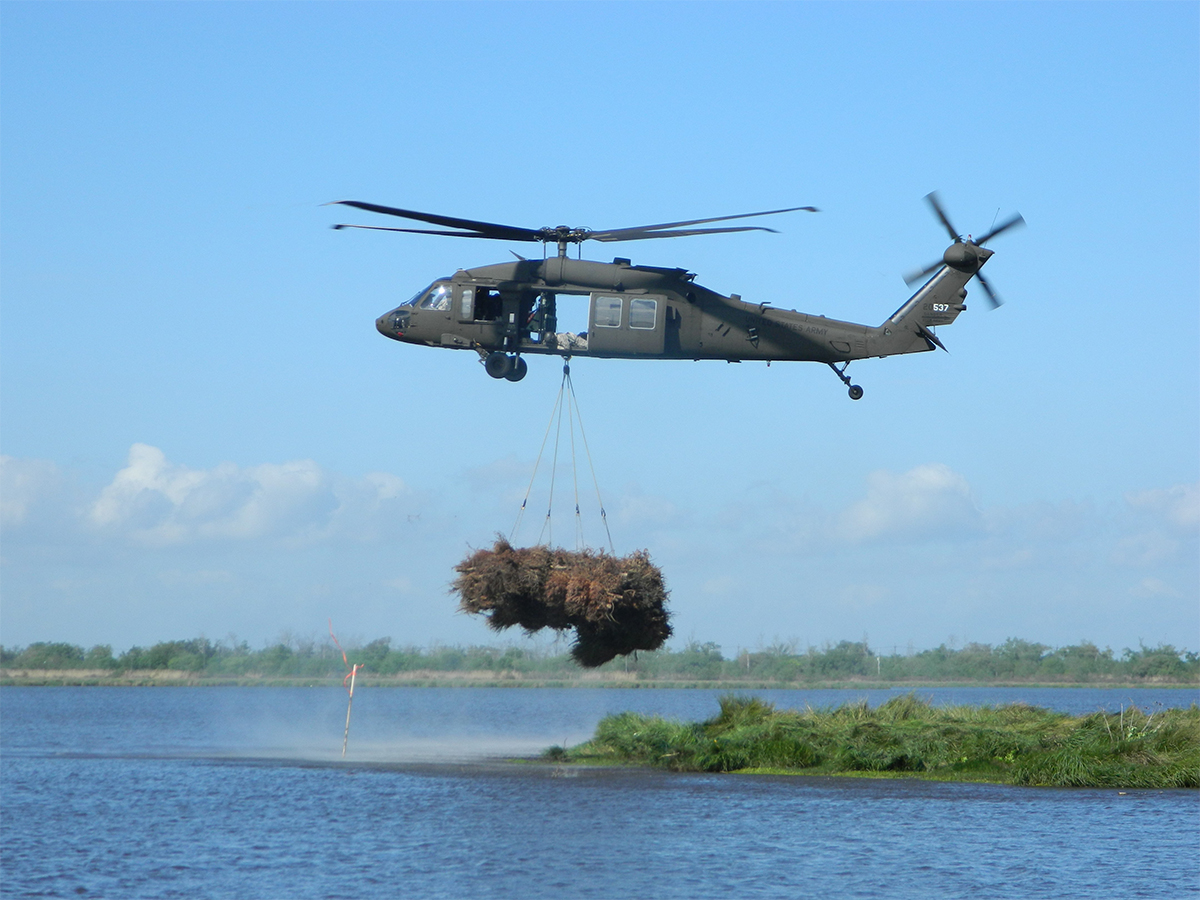
Every year, New Orleans gives thousands of discarded Christmas trees an unusual but pretty cool second life. Instead of ending up in a landfill, Louisiana National Guard helicopters fly bundled trees into the wetlands at Bayou Sauvage Urban National Wildlife Refuge. The trees support a restoration effort that helps prevent erosion, rebuild marshland, and provide habitats for local wildlife. The annual Christmas Tree Drop has been taking place for nearly three decades, bringing together New Orleans residents, local government agencies, the U.S. Fish and Wildlife Service, and the Louisiana Army National Guard. Louisiana National Guard attaches Christmas tree bundle to helicopter. Photo Credit: USFWS How Christmas trees make it from the curb to the wetlands After the holidays, New Orleans residents leave their discarded Christmas trees at the curb for collection. The trees must be bare: no lights, ornaments, tinsel, or artificial snow can be left over since they’ll eventually become part of the natural environment. Once collected, workers secure approximately 50 to 60 trees into each bundle with wire straps. Then comes the part that makes this recycling program a little different from most. Louisiana National Guard crews attach the bundles to helicopters, with each harness holding up to four bundles at a time. The helicopters then fly over the refuge and lower the trees into designated marsh areas. According to the U.S. Fish and Wildlife Service, crews carefully position the bundles in straight lines to create barriers in the marsh. Once the trees are in place, refuge workers use airboats to retrieve the harnesses. It’s a fairly elaborate system for something that was sitting in someone’s living room just a month or so earlier. Louisiana National Guard harnesses tree bundle to a helicopter. Photo Credit: Louisiana Army National Guard Discarded Christmas trees are surprisingly good for the wetlands Louisiana’s wetlands play a critical role in protecting communities from flooding and storms. But erosion and other environmental pressures damage these ecosystems. When bundles of trees are placed in shallow water, their branches help slow waves and trap sediment that would otherwise be carried away. Over time, the accumulated material supports marsh grass growth, stabilizes the shoreline, and creates new habitat for birds, shrimp, crabs, and other local wildlife. A graduate student came up with the idea after wondering whether discarded Christmas trees could help rebuild marshland. It caught on, and the project became an annual restoration effort. In 2025, the City of New Orleans reported that the program had helped restore an area of marshland roughly equivalent to 330 football fields. Bayou Sauvage Refuge using a helicopter to drop a tree bundle. Photo Credit: USFWS The National Guard gets some valuable training The Christmas tree drop also provides an unexpected benefit for the Louisiana National Guard. Originally, refuge workers transported the trees using airboats. Now, National Guard helicopters transport the bundles into the wetlands, allowing crews to practice lifting and positioning heavy loads. In a 2024 Louisiana National Guard news release, Chief Warrant Officer 4 Gabriel Ruiz explained the operation benefits to the coastal environment while “also providing valuable training hours for our pilots and crew members.” Bayou Sauvage National Wildlife Refuge staff retrieve the harnesses. Photo Credit: USFWS Christmas trees have value beyond the end of January For New Orleans residents, participating doesn’t require much beyond removing decorations and placing their tree out for collection. From there, the city and its partners handle the rest. What starts as a routine holiday cleanup becomes part of a much larger effort to protect Louisiana’s wetlands. Not a bad second act for a Christmas tree most people are done with by January.
New Orleans drops old Christmas trees into wetlands by helicopter. They’re helping rebuild the marsh.
Full Article
Original Source
Read the full article at Upworthy →KhanList aggregates and links to publicly available news content. We do not host full articles from third-party sources. Always verify important information with original sources.