
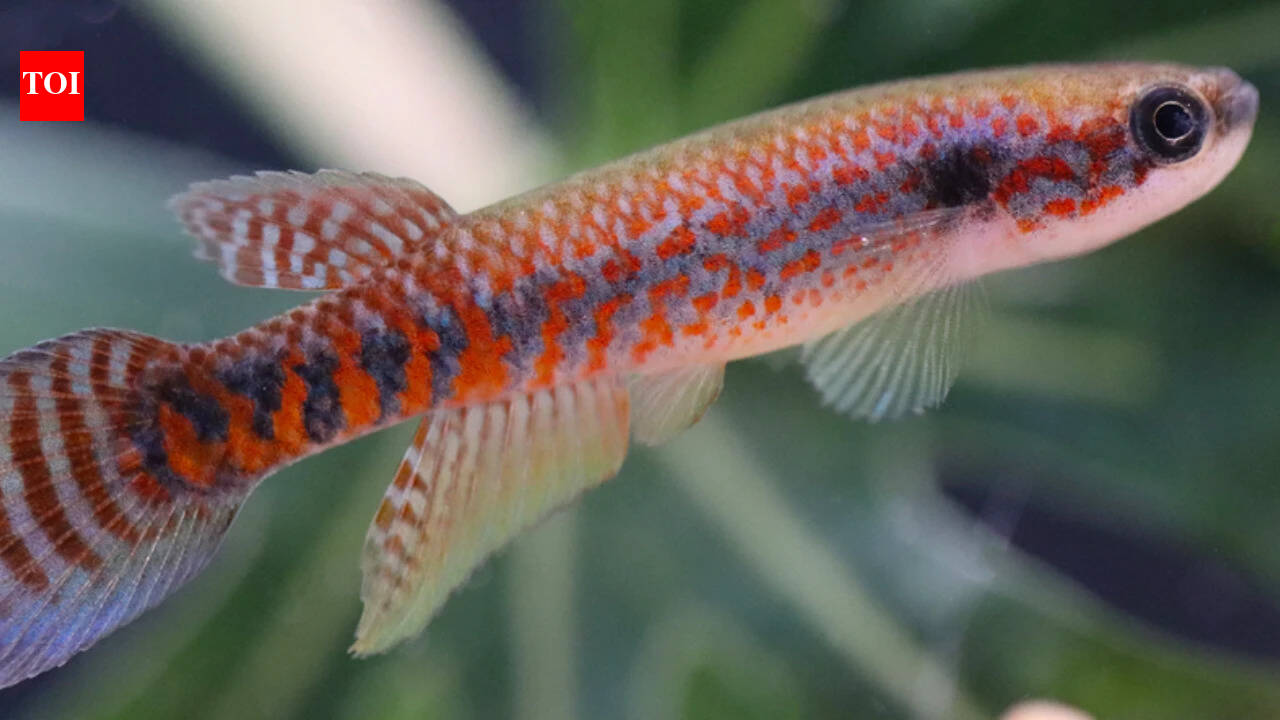
Image Courtesy: Yuri Gomes AbrantesWhat if you’re shopping for the perfect top for your night out and fall in love with this beautiful sparkly number, just to find out it is sold out in your size? What I can only imagine would be tenfolds the amount of the same disappointment; scientists have discovered a tiny fish with orange markings, only to find out that the species may already be at risk of extinction.Laimosemion laranja, a dazzling little killifish found in Brazil’s Amazon is barely three centimetres long, wears bright orange spots along its body and bold chevron-like markings near its tail. It is beautiful, unusual, and, perhaps most worryingly, found in only three small forest pools.A fish unlike any otherThe discovery was made in the Rio Cajari drainage in southern Amapá, a state in northern Brazil. Researchers from the Universidade Federal do Rio Grande do Norte, Instituto Peixe das Nuvens, Universidade Federal do Pará and the University of West Florida were surveying small rivers known locally as igarapés when they came across the fish. Its colour immediately stood out. Lead researcher Yuri Abrantes said the striking appearance of both males and females was unlike anything the team had encountered in the area before.At first, unusual colouring is not enough to declare a new species. Scientists need evidence, and plenty of it. The team examined the fish’s body proportions, counted its scales, studied skeletal features and compared it with closely related species. They also analysed mitochondrial DNA, which ultimately confirmed that this was not simply a colourful variation of a known fish, but an entirely separate species.A name rooted in placeThe name Laimosemion laranja is fitting in more ways than one. Laranja means orange in Portuguese, a nod to the fish’s vivid markings. It also honours Laranjal do Jari, the municipality in Amapá where the species was found.But the more scientists learned about where this fish lives, the less celebratory the story became. Laimosemion laranja has been recorded in just three small forest pools, and all three show signs of environmental disturbance. One pool sits near water discoloured by sediment linked to mining. Another lies within the city itself, where plastic pollution is affecting the surrounding environment. Deforestation, mining and expanding urban development are all closing in on a species whose entire known range covers only around 25 square kilometres.That is an extraordinarily small home for any animal. For a fish that may depend on very specific forest pools, it is even more precarious. A single bout of pollution, a change in water flow, further clearing of vegetation or mining activity nearby could damage or destroy one of the few places this species is known to exist. The researchers believe the fish already meets the criteria to be classified as Endangered under the International Union for Conservation of Nature’s guidelines.Why this fish mattersAnd this tiny fish is more than just a pretty face. It belongs to a group of freshwater fish called killifish, some of which have evolved remarkable ways to survive in habitats that dry out seasonally. Their embryos can pause development and remain dormant in damp mud, waiting for rains to return and refill the pools. It is an extraordinary survival strategy, and studying species like Laimosemion laranja can help scientists understand how Amazonian killifish have evolved across Brazil’s varied environments.The Amazon is often spoken about as though it is endlessly full of life, and in many ways it is. But that abundance can create a dangerous illusion: because there is so much biodiversity, it is easy to assume there will always be more to find, more species waiting to be discovered, more time to protect them. The reality is far less comforting. Many parts of the Amazon remain poorly studied, and species may disappear before we ever know they exist. In this case, researchers at least found the fish in time to describe it, name it and raise the alarm. That does not guarantee it will be saved.What needs protectingThe research team has recommended expanding the boundaries of the nearby Rio Cajari Extractive Reserve to include the areas where the fish lives. Protecting a species like this is not necessarily about building elaborate conservation projects; sometimes it begins with recognising that a small patch of forest, a few pools and the water connecting them matter enormously.There is also a broader point here about plastic pollution. Plastic waste reaches freshwater systems, including small forest pools in the Amazon. For a fish living in a habitat the size of a few puddles compared with the vastness of the Amazon, even local pollution can be devastating.Mining adds another layer of danger. Sediment can discolour water, alter habitats and disrupt the delicate conditions these fish rely on. When your entire world is a handful of pools, there is nowhere to escape to. There is no alternative population waiting elsewhere, no vast river system offering a safe retreat. The fish either survives where it is, or it does not survive at all.A future worth protectingLaimosemion laranja may be tiny, but its story is enormous. It is a reminder that conservation is about the species we may not even know of yet: the ones hiding in forest pools, under leaves, in muddy water and in places too remote or too small to attract attention. Sometimes, by the time we find them, the clock is already ticking.Scientists have given this little orange-spotted fish a name. Now the question is whether we will give it a future.
New orange-spotted Amazon fish faces mining and pollution threats
Full Article
Original Source
Read the full article at Timesofindia →KhanList aggregates and links to publicly available news content. We do not host full articles from third-party sources. Always verify important information with original sources.