
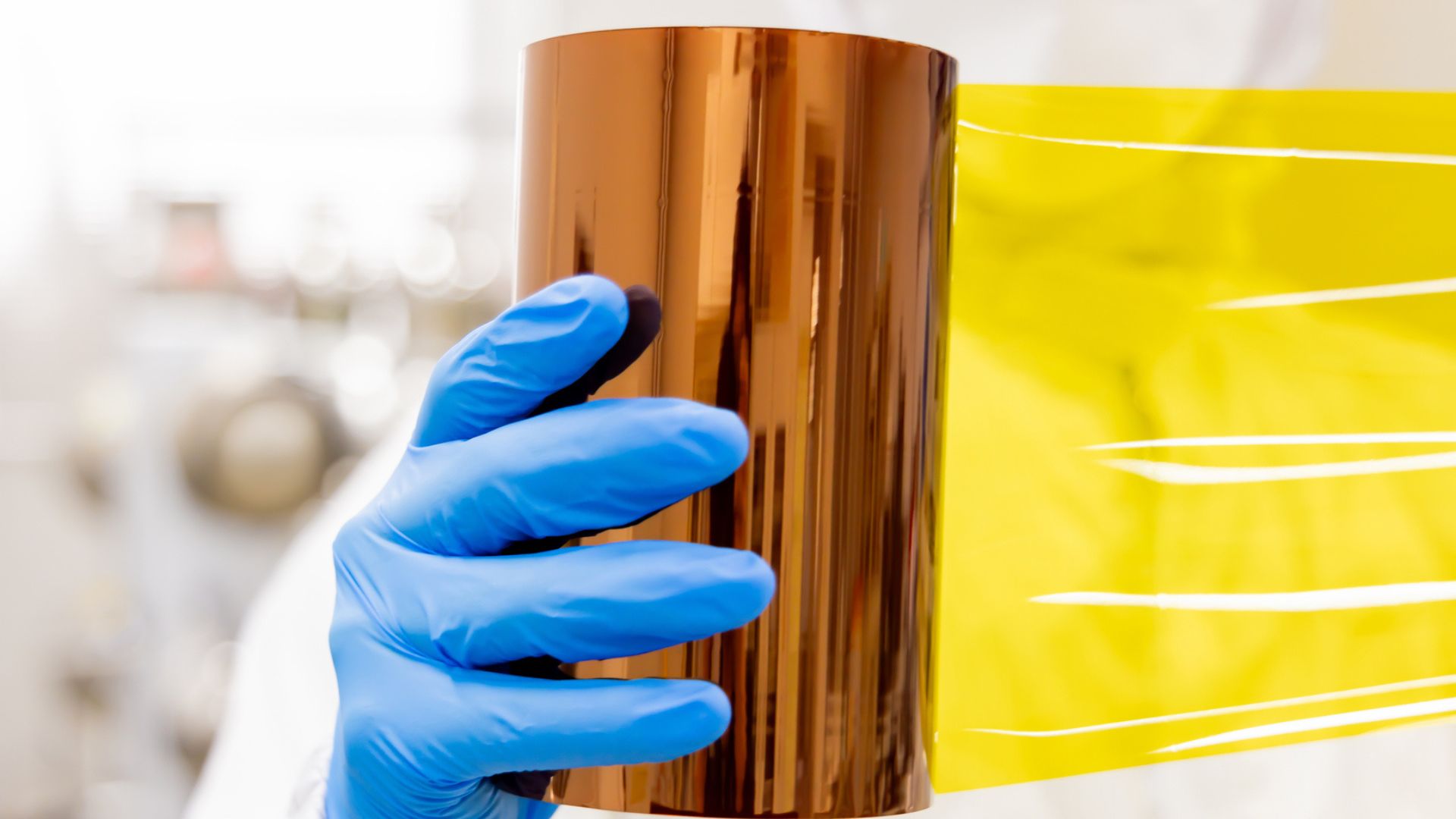
A newly designed non-porous, thin-film material combines extreme stiffness with exceptionally low thermal conductivity. It addresses a long-standing trade-off where stiff materials usually conduct heat well. Designed by researchers at North Carolina State University, the thin film has a thermal conductivity of roughly 0.04 W m⁻¹ K⁻¹ at room temperature. That makes it five times better at blocking heat than standard silicone — yet up to 10,000 times stiffer. “Stiff materials that are good thermal insulators would have substantial utility in a variety of applications, from cookware to electronic devices to space travel,” said Dali Sun, a professor of physics at North Carolina State University. “But this is a significant challenge,” the co-corresponding author added. “Because, in general, stiff materials are good at conducting heat, and materials that are not stiff are good at insulating against heat. We’ve created a material that is very stiff and is extremely good at insulating against heat. Better than any material you would find in nature.” Engineering technique Material science has long linked structural strength to heat conductivity: stiff materials transfer heat quickly, while flexible ones trap it. Metal pans heat up quickly, whereas soft rubber insulates against burns. Now, this new work breaks that paradigm with a thin-film material that combines intense structural rigidity with unmatched thermal insulation. Engineered at the molecular level, this new non-porous material remains rock-hard and even stops heat transfer five times more effectively than soft silicone. For this development, the team worked with two-dimensional hybrid organic-inorganic perovskites, arranging alternating organic and inorganic layers into precise crystalline structures. Swapping standard carbon chains for custom-tailored benzene rings tricked the material into trapping heat vibrations without sacrificing its structural backbone. Thermal performance Testing on the newly created azobenzene ethyl ammonium lead iodine thin film revealed a low room-temperature thermal conductivity of roughly 0.04 W m⁻¹ K⁻¹. For context, the rigid material blocks heat five times better than soft silicone, which sits at 0.2 W m⁻¹ K⁻¹. Silicone sets the baseline for heat resistance in everyday gear like oven mitts, so achieving that same insulating power within an unyielding coating is a major advance. “So, if we want to compare this material to silicone, the material we made is 700-10,000 times stiffer than silicone and five times better at insulating against heat,” said Jun Liu, an associate professor of mechanical and aerospace engineering at NC State. The applications are immediate and massive. Modern microchips throttle their performance due to overheating. Spacecraft burn precious fuel carrying heavy ceramic heat shields. Next-generation electronics choke under their own thermal limits. A printable, scalable thin-film coating that offers near-theoretical insulation limits could change all of that overnight. Better yet, it isn’t locked in a lab setup. According to co-corresponding author Liu, the fabrication process scales easily. It can be printed as a thin film over large surface areas or applied directly as a protective industrial coating.Besides the new material itself, another advantage is showing that molecular engineering can custom-build layered materials to combine features that used to be impossible to mix, like rock-hard strength and extreme heat insulation.Get the latest in engineering, tech, space & science - delivered daily to your inbox.Mrigakshi is a science journalist who enjoys writing about space exploration, biology, and technological innovations. Her work has been featured in well-known publications including Nature India, Supercluster, The Weather Channel and Astronomy magazine. If you have pitches in mind, please do not hesitate to email her.
New material conducts 5 times less heat than silicone, remains up to 10,000 times more stiffer
Full Article
Original Source
Read the full article at Interestingengineering →KhanList aggregates and links to publicly available news content. We do not host full articles from third-party sources. Always verify important information with original sources.