
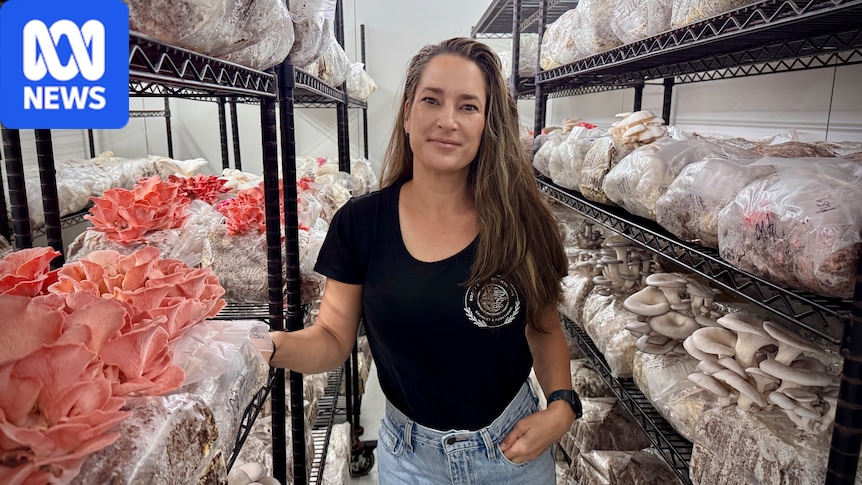
A near-death experience convinced Emma Court to ditch her four-hour commute to a corporate job in Brisbane and start farming fancy, nutrient-packed fungi."My neurosurgeon said to me, if I had left it another couple of months, I would not be standing here," Ms Court said.Nine years ago, the Sunshine Coast resident suffered through weeks of chronic fatigue, excruciating headaches, blurred vision, weak limbs, and night sweats.Refusing to accept repeatedly being told that she was "a tired, anxious, overworked woman" who needed antidepressants, Ms Court booked an eye test that triggered life-saving emergency brain surgery.Emma Court is lucky to be alive. (Supplied: Emma Court)An inflammatory mass had engulfed the pituitary gland at the base of her brain, crushed the optic nerves to her right eye, and played havoc with her hormones.Undergoing neurosurgery, immunotherapy and years of maintenance treatment, Ms Court said modern medicine saved her life.Emma Court started with the Lion's mane variety. (Supplied: Rocky Creek Mushrooms)Looking to improve her health with nutrient-packed fresh food, the mother of two began growing gourmet mushrooms.Turning her hobby into a farm that could reliably supply restaurants while keeping a low environmental footprint was a challenge.Ms Court's husband, Wayne, who once worked as an avionics engineer and a race team engineer for McLaren F1 motorsport, helped bring her designs to life for her Rocky Creek Mushrooms business.Together they built grow rooms, automated lighting and humidity controls, and a sterile laboratory to produce mushroom cultures without chemical pesticides or synthetic sprays.Wayne Court's engineering skills have been invaluable to the farm. (ABC Rural: Jennifer Nichols)Last year alone, the mother of two attended more than 90 weekend markets, made 624 restaurant deliveries, took on a wholesaler, and upskilled to obtain a food license and wholesale and commercial food supervisor qualifications.The 47-year-old took part in CSIRO's Innovate to Grow program and spent hundreds of hours mastering how to meet the specific needs of more than 30 mushroom varieties.She drew on her research and organisational skills as a product, systems and service designer; farm management studies at school; and years spent baling hay and mucking out stables as a teenager to help pay for her own horses' upkeep in the English countryside.Chefs enjoy experimenting with the mushroom varieties. (ABC Rural: Jennifer Nichols)The farm now produces around 100 kilograms of gourmet mushrooms a week to supply wholesale, retail, restaurants and farmers' markets.To minimise waste and maximise income, Ms Court makes seasonings, teas, extracts, preserves and mushroom grow bags.Her marinated forest mushrooms with smoked garlic and charred pimiento won a silver medal at the 2026 Melbourne Royal Australian Food Awards.Emma Court secured food safety licenses to value add to their farm's mushrooms. (ABC Rural: Jennifer Nichols)Jacki Hinchey from the regional Food and Agribusiness Network said that by focusing on value-adding, Ms Court has defied the national downward trend for the wider mushroom industry.The most recent figures from the Australian Horticulture Statistics Handbook for 2024/25 show mushroom production decreased by 12 per cent to 52,784 tonnes, valued at $338.3 million.Ms Hinchey said it was "notoriously difficult" for mushroom farmers to maintain a profit."You have to manage mushrooms really carefully, and it's very hard to sell everything because they're so perishable."Emma Court is proud of her farm. (ABC Rural: Jennifer Nichols)Award-winnerRocky Creek Mushrooms is a finalist in the 2026 Sunshine Coast Business Awards in both the Food and Agribusiness and Sustainability categories, to be held on November 28.The family has invested in solar and battery storage, harvests rainwater, and grows mushrooms on Australian hardwood sawdust, an agricultural by-product.Compost gets donated back to the community, and the mushroom grow bags are recycled to create new plastics.Emma Court has brainstormed ways to use spent mushroom substrate. (ABC Rural: Jennifer Nichols)The fungi farmer has also used mycelium, the root-like filaments of fungi, to grow containers, a body board and plant pots from spent substrate, which is then air-dried as an environmentally friendly alternative to plastics and foams."I guess my biggest problem is that I have so many ideas and things I want to work on that the whirlwind can at times turn into a full-blown tornado," Ms Court said."It's quite a busy life; I'm feeling busy but fulfilled. I love doing this."
New life as mushroom farmer after lifesaving neurosurgery
Full Article
Original Source
Read the full article at Abc →KhanList aggregates and links to publicly available news content. We do not host full articles from third-party sources. Always verify important information with original sources.