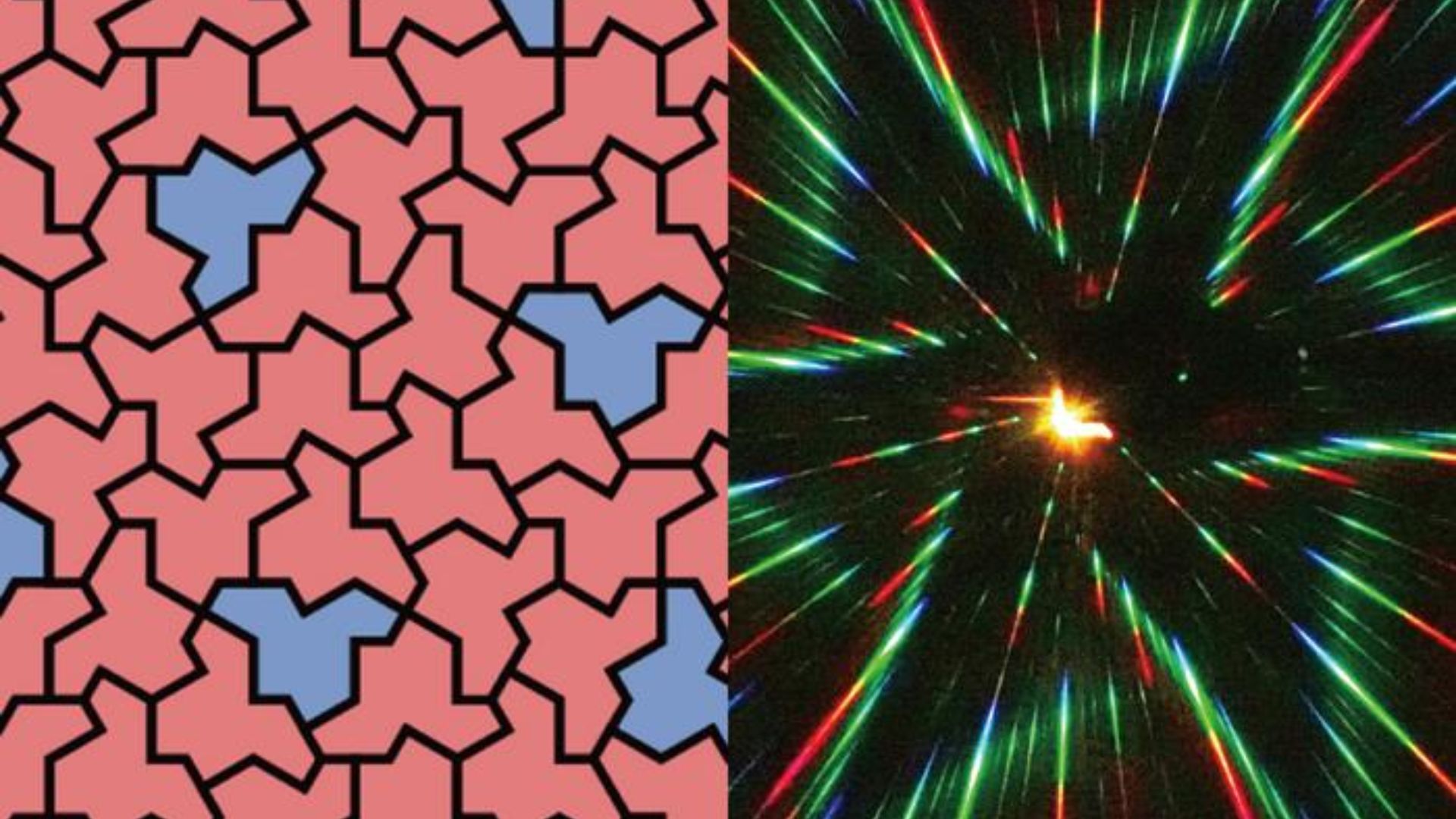
Scientists at the Institute of Industrial Science (IIS) at the University of Tokyo in Japan have come across a new twist in the decades-old mathematical puzzle, the Einstein problem, after an optical structure based on a ‘Smith hat’ showed different diffraction behaviors from those previously observed in conventional quasicrystals. The name Einstein is associated with a lot of popular terms in science. Theory of relativity, special relativity, quantum theory, black holes, gravitational waves and much more. So, it would not be surprising if the great physicist also made contributions to mathematics, which have been recognized by naming a problem after him. However, this couldn’t be farther from the truth. In reality, the so-called Einstein problem is actually Ein Stein (One Stone) problem and has no relation to the famous physicist at all. The problem has been troubling mathematicians for decades and was actually solved by a shape hobbyist in 2023. When scientists were looking for information for other associated properties with this solution, they found a new twist. What is the Ein Stein problem? We are well aware of periodic tilings such as honeycomb or checkerboard patterns that can be used to cover a surface. However, the Einstein problem asks if a single tile shape can cover a surface in a non-repeating pattern. For decades, mathematicians were certain that such a single non-repeating tile was impossible. However, in 2023, amateur shape hobbyist David Smith found out that the ‘Hat’ tile, a 13-sided polygon design, can tile a plane in an aperiodic manner. This later became known as the Smith’s Hat, which the scientific community explored with great interest. “What is especially fascinating about the hat tile is that, although the resulting pattern appears irregular at first glance, it is actually constructed from the honeycomb lattice,” explained Yuto Moritake, associate professor at IIS. “We wanted to see whether this unique shape could also produce any unexpected physical phenomena.” New twist on Ein Stein problem To further investigate the Smith’s Hat Tile, Moritake and his team used electron-beam lithography to make nanoscale patterns on silicon nitride films. When they pointed a laser at these structures, the researchers observed distinct pinwheel-like patterns, revealing the chiral nature of the structure. Chirality is the property of an object or structure of not being identical to its mirror image. A aperiodic structure like Smith’s Hat Tile is chiral because of its structure. So, the patterns seen in the laser light diffraction should not be a surprise. Yet, they were since such behavior was absent in conventional quasicrystalline materials. In their experiments, Moritake and team found that diffraction patterns change depending on the polarization and direction of incoming light. Structures that are mirrored in real space demonstrate corresponding reversals in optical behavior, showcasing a new form of symmetry-controlled optical response. “These results open a new direction of research on the fusion of quasiperiodic order and chirality,” added Moritake in a press release. “Monotile patterns provide a platform for exploring optical phenomena that emerge from the interplay of symmetry, chirality, and aperiodicity.” The researchers are hopeful that their work opens up new technologies for light manipulation, polarization control and new types of optical devices. The research findings were published in the journal Nature Communications. Recommended ArticlesGet the latest in engineering, tech, space & science - delivered daily to your inbox.Ameya is a science writer based in Hyderabad, India. A Molecular Biologist at heart, he traded the micropipette to write about science during the pandemic and does not want to go back. He likes to write about genetics, microbes, technology, and public policy.
New laser diffraction behavior unravels a different twist on Einstein problem
Full Article
Original Source
Read the full article at Interestingengineering →KhanList aggregates and links to publicly available news content. We do not host full articles from third-party sources. Always verify important information with original sources.