
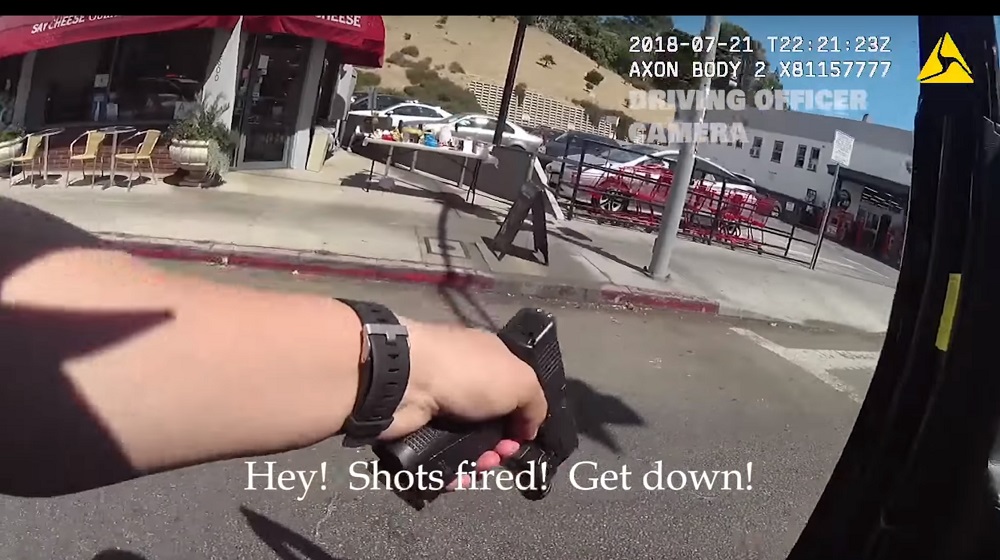
Atkins has already been convicted of attempted murder for shooting his 17-year-old girlfriend and grandmother in 2018. A previous jury deadlocked on the second-degree murder count.LOS ANGELES (CN) — The second murder trial of Gene Atkins, the man whose bloody rampage led to a fatal police shooting outside a Trader Joe’s in the Los Angeles neighborhood of Silver Lake, ended Monday with attorneys making their closing arguments to the jury.On July 21, 2018, Atkins shot both his 17-year-old girlfriend, Leah Williamson, and his grandmother. He then threw Williamson into his grandmother’s car and proceeded to drive around the city, apparently aimlessly. Police found the car and chased Atkins, exchanging gunfire with him along the way. The pursuit ended when Atkins crashed the vehicle into a utility pole outside the Trader Joe’s, squeezed off a few more shots at police and ran inside the store. Two police officers fired back. One of the stray bullets struck and killed a store employee, Melyda Corado.“Had Mr. Atkins decided, reasonably, to pull over and give up,” Deputy District Attorney Ben Schwartz said in his remarks, “Ms. Corado would still be here today. But he didn’t. He did not give a damn about anybody except himself that day.”In June, a jury convicted Atkins, now 36, of two counts of attempted murder, as well as dozens of other charges resulting from a hostage standoff inside the supermarket, but acquitted him of first-degree murder and deadlocked on the second-degree murder charge, 10-2. Although he is already likely to be sentenced to life in prison, prosecutors decided to retry Atkins for second-degree murder, upon request from Corado’s father.The second trial was shorter than the first, and omitted much of the evidence about the standoff that followed Corado’s killing, in which Atkins held dozens of customers and employees hostage. And while Atkins made a handful of court appearances during his first trial, he refused to leave his jail cell during each of the five days of his retrial.Other than that, the two trials were nearly identical. Atkins’ attorney, Errol Cook, gave no opening statement and called no witnesses. His entire case rested on his closing argument, in which he told the jury that his client was not responsible for Corado’s death.“This is unusual for a defense attorney to state,” Cook said. “Mr. Atkins was the bad guy that day. There’s no sugar coating that. He committed crimes. He created chaos. He terrified people. He put officers in an extraordinarily dangerous situation.” But, he added, “he did not kill Ms. Corado.”Unlike most trials, none of the facts about the case are in dispute. Atkins all but admitted to shooting Williamson and his grandmother, to driving recklessly, to firing at police and to taking hostages. The only thing in dispute is a legal interpretation.Prosecutors charged Atkins for murder using the theory of “implied malice,” when a defendant commits an intentional act that shows conscious disregard for human life, and the act results in someone’s death. Schwartz argued that by shooting at police while running into a crowded supermarket, Atkins knew or should have known that the police would shoot back and likely hit a bystander.“The fact that someone was killed was certainly reasonably foreseeable,” Schwartz argued. “There is nothing more dangerous than engaging in a gunfight with police officers on a busy street.”Cook argued that it was far from foreseeable. The officer whose bullet killed Corado, he said, made a “tragic mistake” — as evidenced by the fact that only two out of five cops fired at the fleeing suspect.“There were so many people that could have shot into the store, and they didn’t,” Cook said.He also pointed out that in numerous movies and television shows, police hesitate when faced with the option of firing at a suspect running through a crowd.Though the city paid the Corado family $9.5 million to settle a wrongful death claim, prosecutors concluded the two officers who shot at Atkins acted lawfully in defense of themselves and others.Initially, Atkins had pleaded not guilty by reason of insanity, telling the court in 2019, “I was sent here by Jesus” and “I’m a prophet. Sent to correct the wrong." In 2021, he was found mentally competent to stand trial. He mostly represented himself in pretrial hearings but eventually settled on a defense attorney, Cook.Williamson testified that she woke up to find Atkins staring at her.“You left me here with these people," he said, according to Williamson, who had no idea what he was talking about. Shortly thereafter, he shot her in the head, and then shot his grandmother in the chest. Both survived, though they were left with severe health problems. Atkins’ grandmother died in 2024.“It’s not rocket science to figure out something was not right with what was going on his brain,” Cook told the jury.Subscribe to our free newslettersOur weekly newsletter Closing Arguments offers the latest about ongoing trials, major litigation and rulings in courthouses around the U.S. and the world, while the monthly Under the Lights dishes the legal dirt from Hollywood, sports, Big Tech and the arts.Additional Reads
New jury gets shot at verdict in Trader Joe’s police shooting
Full Article
Original Source
Read the full article at Courthousenews →KhanList aggregates and links to publicly available news content. We do not host full articles from third-party sources. Always verify important information with original sources.