
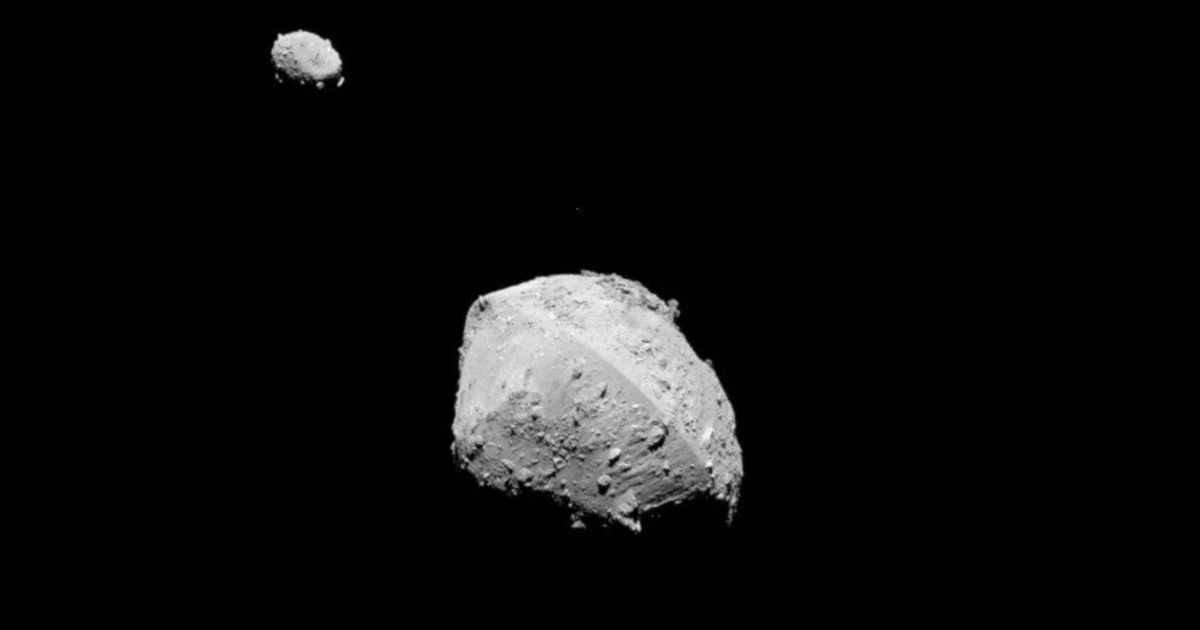
WASHINGTON – Dimorphos, the small asteroid struck by NASA’s DART spacecraft in 2022 in the first test of a planetary defence system, was left with one side flattened with a stadium-sized crater and is tumbling in space, as shown by images taken by the European Space Agency’s (ESA) Hera spacecraft released on Nov 25.DART was sent on a proof-of-principle mission for using a spacecraft to change a celestial object’s trajectory.Dimorphos, an oblong-shaped rocky object about 151m wide, orbits its companion asteroid Didymos, with a diameter of 730m, and the pair is currently about 193.5km from Earth.They are defined as near-Earth asteroids, though neither object imperils Earth.Previous data showed how DART succeeded in changing the path of Dimorphos – demonstrating that a spacecraft could alter the trajectory of an object headed towards a collision with Earth.Hera is now getting a close-up look at how DART physically changed Dimorphos.“The side impacted is now completely covered by a crater, with the visual impression that a piece of the asteroid was cut off by the impact. We do not see evidence for major changes on the site opposite to the DART impact. The combination of those two observations is surprising,” Michael Kueppers, ESA’s Hera mission scientist, told Reuters.The big crater covers nearly the whole front side of Dimorphos as it continues its orbit of Didymos.“Dimorphos is now tumbling in a chaotic way. There are hundreds of boulders floating around in the system,” Kueppers said.Hera, about the size of a small car, is presently observing Didymos and Dimorphos from a distance of about 25km to 30km.In December, Hera is slated to approach within 13km of the pair, obtaining increasingly higher-resolution images.In January 2027, Hera is due to deploy two shoebox-sized miniature satellites, called CubeSats, that will approach even closer for further study, including investigating the interior structure of the two asteroids.Hera’s mission manager unveiled the new images at a dinosaur hall in the Museum für Naturkunde Berlin as a reminder of the danger of asteroid impacts like the one 66 million years ago that caused a mass extinction on Earth and doomed the dinosaurs.The DART, short for Double Asteroid Redirection Test, spacecraft collided with Dimorphos on Sept 26, 2022, at about 22,530kmh.“We knew that the DART mission impacted Dimorphos successfully and that it changed its orbit. But we did not know what happened to Dimorphos itself.“The investigation of what the impact did to Dimorphos and the characterisation of it in general is needed to be able to apply the kinetic impactor technique to another asteroid, should we find one on a collision course with Earth,” Kueppers said. REUTERS
New images reveal crater on asteroid struck by DART spacecraft
Full Article
Original Source
Read the full article at Straitstimes →KhanList aggregates and links to publicly available news content. We do not host full articles from third-party sources. Always verify important information with original sources.