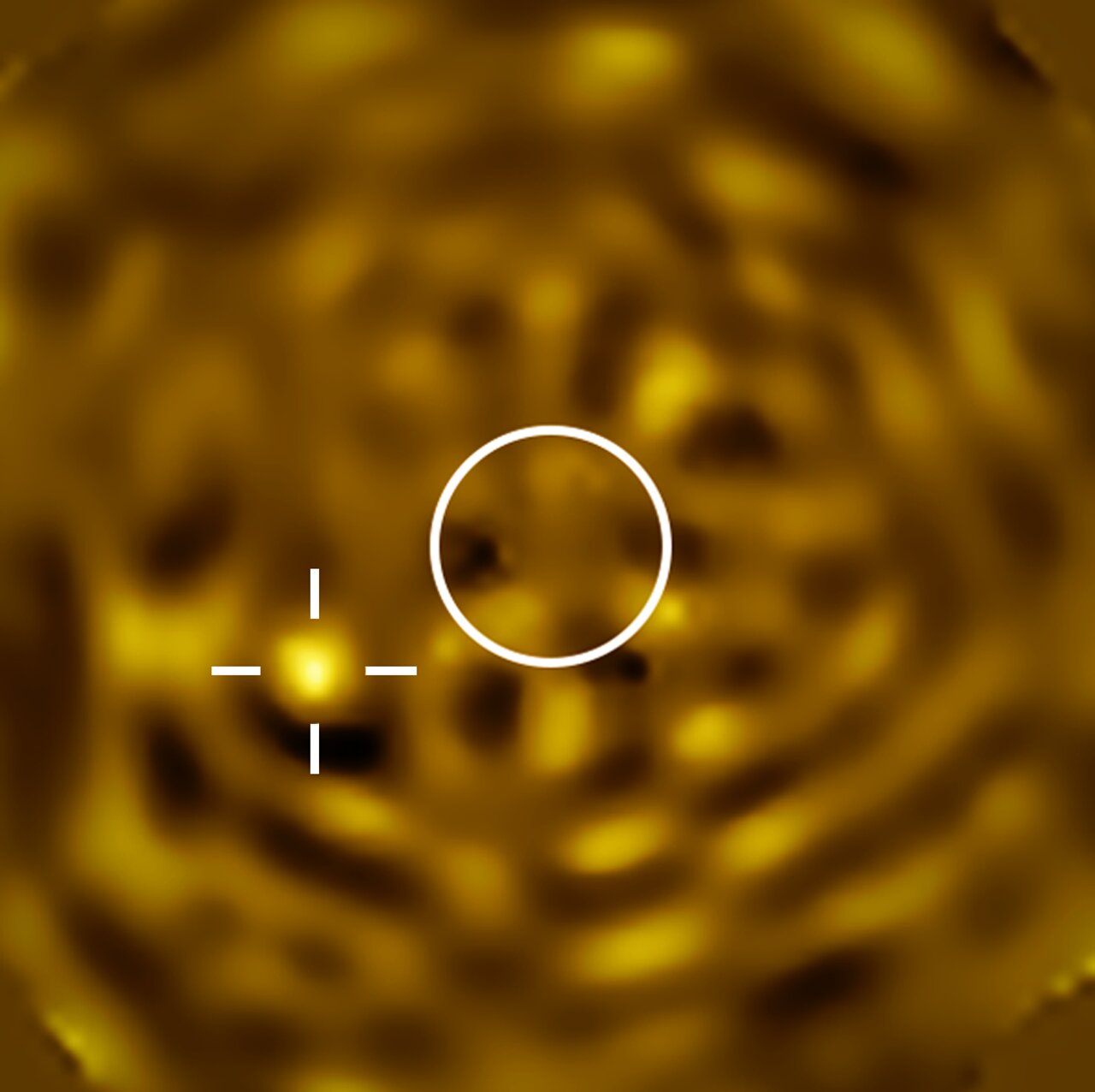
New analysis of observations taken in 2024 confirm a stellar companion for Betelgeuse in the constellation Orion. Betelgeuse is a red supergiant star in the Orion constellation. Its brightness changes periodically, and for decades astronomers had suspected that some of these variations could be due to a companion star orbiting around it. The image in the middle inset in this image was taken in January 2019 with the SPHERE instrument at ESO’s VLT, and shows Betelgeuse itself. The image in the inset on the left was taken in December 2024, when the companion was predicted to be farthest apart from Betelgeuse as seen from Earth. Betelgeuse's light has been removed from this image, revealing a source (marked with a crosshair) consistent with being Betelgeuse B.ESO / M. Montargès et al. Background: N. Rissinger (skysurvey.org) Astronomers have used the Very Large Telescope to image a companion star to Betelgeuse, almost certainly settling a long-running debate about whether the famous star flies solo through space. “This is the conclusion of a century-long quest,” says team lead Miguel Montargès (Paris Observatory, France). “I jumped from my chair when I saw the processed images.” Betelgeuse, found in the shoulder of Orion, is one of the brightest and most well-known stars in the sky. It has also been one of the most mysterious, with astronomers tracking regular brightness changes over many decades. As far back as 1908, astronomers suspected that a companion might be a big driving factor behind the star’s cycles of brightening and dimming. Then, in 2024 came measurements of Betelgeuse’s speed, brightness, and changing position, all suggesting that it is indeed being tugged around by the gravity of a companion star with a mass roughly equal to the Sun. Yet indisputable evidence remained elusive. So Montargès and his colleagues set out to directly image the companion, dubbed Betelgeuse B. The team took advantage of a window of opportunity in December 2024, when the gap between Betelgeuse and its suspected fainter neighbour would be widest. Even then the separation was only 52 milliarcseconds. “I cannot stress enough how difficult it is to make such an observation,” says René Oudmaijer (Royal Observatory of Belgium), who was not involved in the research. But it was by no means a sure thing. “Honestly, I thought we did not have the sensitivity to detect Betelgeuse B as it was predicted,” Montargès says. “Because it is more massive than predicted, we see it!” It turns out Betelgeuse B has a mass equivalent to two or three Suns, not one. The team’s results are published in Astronomy & Astrophysics. This image, taken with ESO’s Very Large Telescope (VLT), shows the clearest image ever of what likely is Betelgeuse B, a star orbiting Betelgeuse. The image was taken with the SPHERE instrument in December 2024, when the companion was predicted to be furthest apart from Betelgeuse as seen from Earth. The circle indicates the size of Betelgeuse, which has been removed. The bright source to the left, marked with a crosshair, is consistent with being Betelgeuse B. ESO / M. Montargès et al. While Montargès is confident that the long-sought companion has indeed been found, further observations confirming its orbital motion are needed to be sure. “To be certain that the companion is really there, we still need to observe it in one year on the other side of the star,” Montargès says, “but there is very little space left for doubt.” Christopher Copperwheat (Liverpool John Moores University, UK), who was not involved in the research, agrees. “What we have here is a direct-imaging result, and it’s difficult to argue with what is essentially a picture of the companion,” he says. “The position of the object in the images is also consistent with the other measurements.” Those measurements include images released a year ago by a team led by Steve Howell (NASA Ames). Howell’s team used the Gemini North telescope in Hawai‘i to identify a fuzzy smudge that looked like a companion. “What's special about [Montargès’s] paper is that the observations were carried out with a different telescope at almost the same time as Howell's and found a strong detection at the same place,” says Iain McDonald (University of Manchester, UK), who is also not part of Montargès team. “What we need for proof are reproducible observations that confirm an existing hypothesis,” he adds. “We now have that.” Understanding red supergiant stars like Betelgeuse is important work. “If Betelgeuse behaves the way it does only because it has a companion in a particular orbit, then that changes how we expect other red supergiants to behave and evolve,” says McDonald, “including our models of how energy and new elements are created and moved around the universe.” In more ways than one, the story of stars like Betelgeuse is an important part of the story of ourselves and how we came to be here.
New Images Confirm: Betelgeuse Has a Companion
Full Article
Original Source
Read the full article at Skyandtelescope →KhanList aggregates and links to publicly available news content. We do not host full articles from third-party sources. Always verify important information with original sources.