
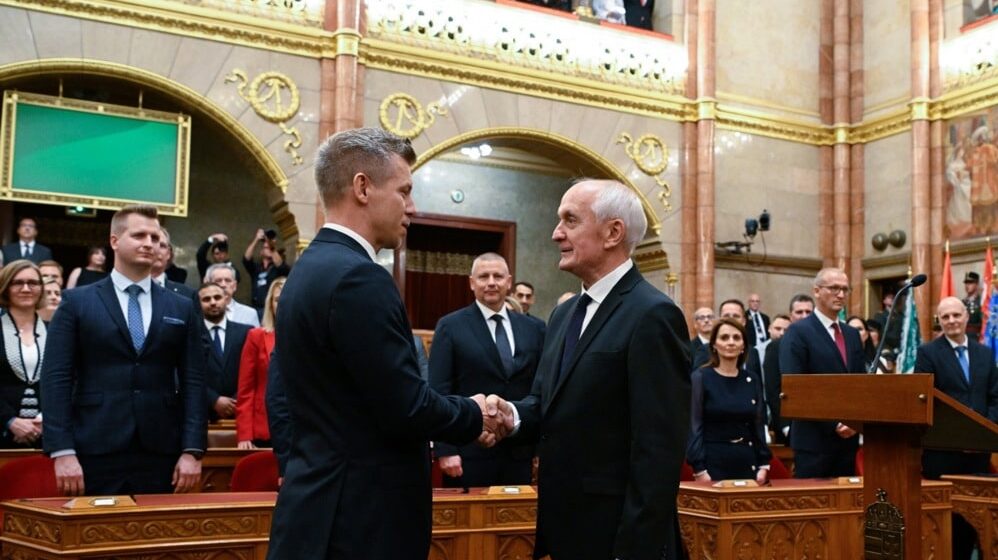
Hungary’s President-elect and former Supreme Court president Andras Baka (C-R) receives congratulations from Hungarian PM Peter Magyar (C-L) after being elected during an extraordinary plenary session of the parliament in Budapest, Hungary, 11 August 2026. EPA/SZILARD KOSZTICSAK Hungary cannot be built on “vengeance” and building a new future for it “demands both justice and self-restraint”, Hungary’s new president, Andras Baka, said after being elected by the ruling Tisza party’s 140 votes in parliament on Tuesday evening. The former governing party Fidesz boycotted the vote and called both the process and the new president illegitimate. The 73-year-old will be sworn in to the largely ceremonial post on August 19 and will remain in office until Hungary’s new constitution is adopted – a process that could take up to five years. The new constitution is expected to pave the way for the direct election of the country’s next president. According to a poll conducted by Median last year, 66 per cent of Hungarians would prefer direct presidential elections, with only Fidesz voters backing the current system by a significant majority of 61 per cent. Commentators see Baka, a former Supreme Court chief judge and two-term judge serving at the European Court of Human Rights (ECHR) in Strasbourg, as a broadly acceptable candidate for a large majority of Hungarians: an experienced, respected man with solid legal credentials. Baka was an outspoken critic of the regime of former prime minister Viktor Orban, which removed him from his position as president of the Supreme Court in 2012 after he criticised his judicial reforms, which included plans to transfer cases to more government-friendly judges. The Orban government passed tailor-made legislation that would have required previous judicial experience in Hungary to become president of the Supreme Court. It was a condition that Baka did not meet, given much of his career had been spent at the ECHR. Baka sued the Orban government and won at the Court of Justice of the European Union’s (ECJ), but was not reinstated to his position. His election by parliament puts an end to a somewhat embarrassing casting process by new Prime Minister Peter Magyar, whose first choice was Hungary’s renowned chess world champion Judit Polgar, but she politely declined the offer, partly because of controversial remarks made on social media, mostly concerning her silence on political issues. Baka is clearly a more political choice, especially considering his experience and background. But his election also suggests that Magyar has been willing to choose a figure with a strong independent streak rather than a party loyalist, unlike the previous Fidesz-appointed incumbent, Tamas Sulyok, whose resignation Magyar had made a campaign promise. “Andras Baka has had an outstanding and highly prestigious career, and he is a very autonomous person. I see his election as president as a possible sign of self-restraint on the part of Prime Minister Peter Magyar, who won a very broad mandate in the April 12 election,” Marta Pardavi, chair of the Hungarian Helsinki Committee, told BIRN. Baka is distinctly different from influencer-style politicians like Magyar or even Health Minister Zsolt Hegedus, who skyrocketed to fame with his dancing after Tisza’s election victory. Baka is a calm, principled man who believes in core values such as democracy and the rule of law. “His election can send the message that Hungary takes its highest office seriously,” Pardavi added. Baka himself has made clear that he does not intend to become a pliant partner for the government and will voice criticism when necessary. He has already been one of the leading critics of the Tisza government’s recent constitutional amendment limiting MPs’ mandates to 12 years, arguing that it infringes on passive voting rights – in other words, that it restricts voters’ choice of candidates. In his speech to parliament on Tuesday, Baka said that the nation had “wasted an entire generation”, and has fallen from being a frontrunner in 1990 to one of the countries lagging behind in the region. He described the country’s situation as critical in areas such as the rule of law, health care, education, child protection, energy and transport. But he also warned that “an election result in itself cannot restore the rule of law.” The rule of law, he argued, does not only imply that institutions work, but also that people can trust that the rules apply to everyone, without exception. Baka is also in keeping with Magyar’s conservative background, having served as an MP in Hungary’s first democratically elected parliament after 1990 as part of the Hungarian Democratic Forum (although he never formally joined the party). He used to work with Laszlo Solyom, who later became president and was the last head of state to use the office as a check on the government and openly criticise its policies.
New Hungarian President Elected; Vows to Restore the Rule of Law
Full Article
Original Source
Read the full article at Balkaninsight →KhanList aggregates and links to publicly available news content. We do not host full articles from third-party sources. Always verify important information with original sources.