
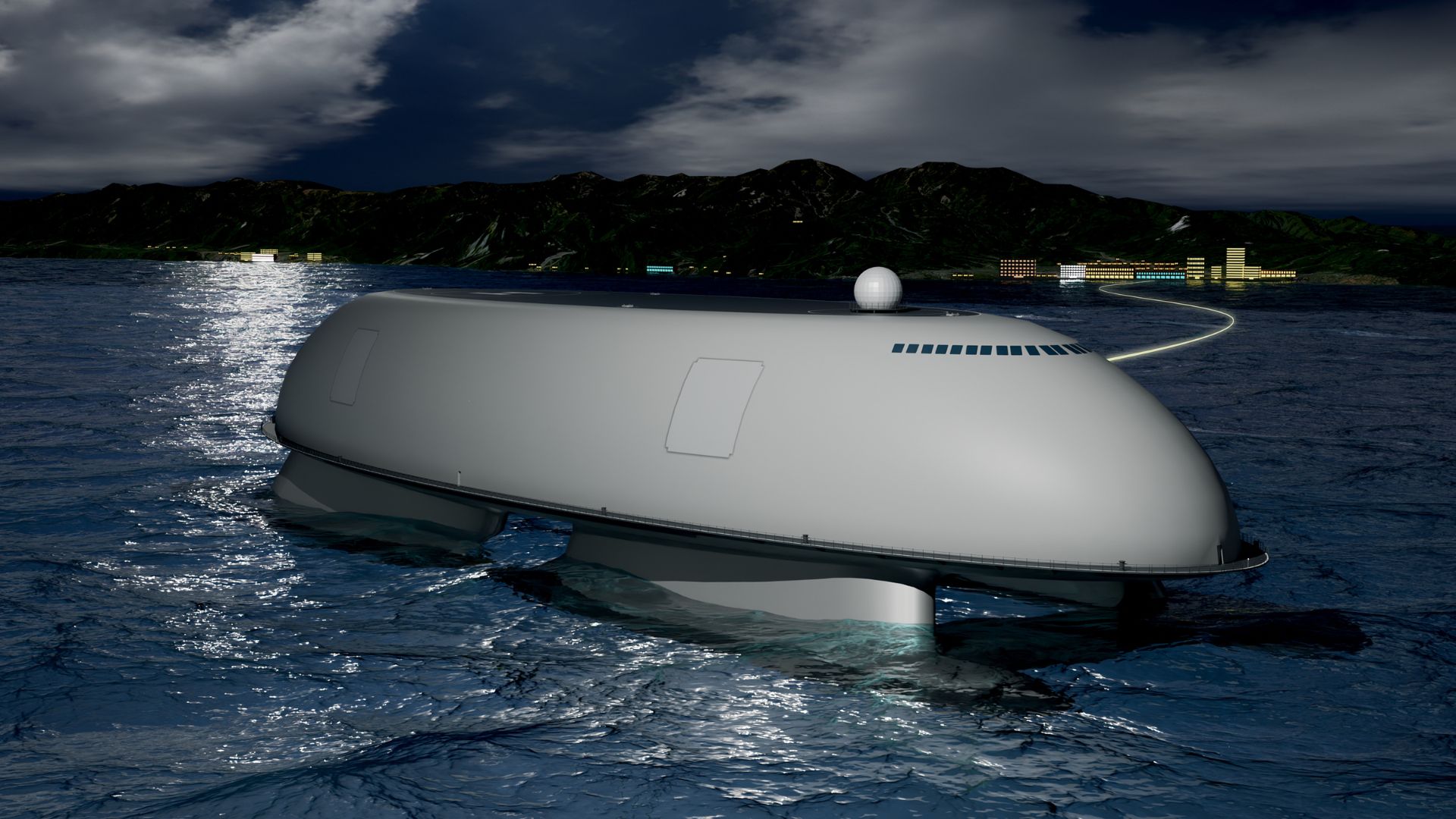
Optimal Transit, a US-based firm, has designed a multi-purpose vessel capable of powering homes, producing clean water, and hosting AI compute workloads. Known as the Blue Economy VITAL 100 MW Kraaken, this zero-emission vessel generates enough fuel-free power for 32,000 homes, supplies fresh water to 150,000 people, and hosts 60 MW of AI compute capacity. The high-tech vessel uses a proven small waterplane area twin hull (SWATH) architecture paired with a flexible mooring system for offshore stability. It could provide an immediate utility alternative in areas mostly dependent on expensive diesel self-generation (e.g., Pacific Islands, sub-Saharan Africa, South/Southeast Asia). Three-in-one vessel Just five weeks after unveiling the Kraaken as an offshore, self-powered AI data center, the developers are shifting its payload. The new configuration redirects a massive fraction of its energy away from raw compute to export continuous electricity and fresh water directly to coastal grids. When first announced in July, the Kraaken made waves as a zero-emission floating data center powered by a patented Digital Ocean Thermal (DOT) engine. The VITAL 100 MW setup asks a different question: What if coastlines need utilities more than they need large language models? “The answer is a single vessel that can serve the equivalent of a small city – indefinitely, from offshore, with no connection to the existing grid,” said Jeff Kline, President of InMar Technologies. The updated layout turns the vessel into a tri-generation utility hub, continuously exporting 40 MW of clean electricity to power roughly 32,000 homes and producing 7.9 million gallons of fresh water daily for ~150,000 people via vacuum-flash desalination. And that’s not all. It retains 60 MW of onboard power dedicated to high-performance AI compute and sovereign data needs. Scalable “Power Parks” Power, fresh water, and data compute are all delivered to shore through a specialized quick-disconnect umbilical system. This setup allows the vessel to unplug and relocate within hours if threatened by severe weather or changing operational needs, then quickly reconnect once conditions clear. Interestingly, the new vessel also offers disaster relief by deploying within days to inject emergency power and fresh water directly into damaged coastal grids without depending on destroyed land infrastructure. Furthermore, the architecture could be scaled as per requirement. For instance, clustering five vessels into an offshore “Sovereign Power Park” would generate 200 MW of power, 40 million gallons of fresh water, and 300 MW of compute capacity. Altogether, it would be enough to support an entire metropolitan area without consuming land or fuel. The VITAL 100 MW integrates these features into a single offshore asset that requires no land, fuel, or grid connection. Building equivalent infrastructure on land would require three separate projects costing between $750 million and $1.33 billion. It also avoids six-to-ten-year delays due to permitting, zoning, and grid queue backlogs that the ready-to-operate vessel avoids completely. Hence, the system holds potential to cut land-based development costs by roughly 22 to 56 percent (costing 44 to 78 percent of traditional alternatives). Notably, the tech’s economic appeal is especially strong in developing and disaster-prone regions across sub-Saharan Africa, Asia, and the Pacific, where unreliable grids force infrastructure to tap into diesel generators costing $0.40 to $0.55 per kilowatt-hour. In these markets, the vessel will be able to operate as a lucrative, stand-alone utility provider even without accounting for data center revenue.Get the latest in engineering, tech, space & science - delivered daily to your inbox.Mrigakshi is a science journalist who enjoys writing about space exploration, biology, and technological innovations. Her work has been featured in well-known publications including Nature India, Supercluster, The Weather Channel and Astronomy magazine. If you have pitches in mind, please do not hesitate to email her.
New floating vessel can power 32,000 homes and serve clean water to 150,000 people
Full Article
Original Source
Read the full article at Interestingengineering →KhanList aggregates and links to publicly available news content. We do not host full articles from third-party sources. Always verify important information with original sources.