
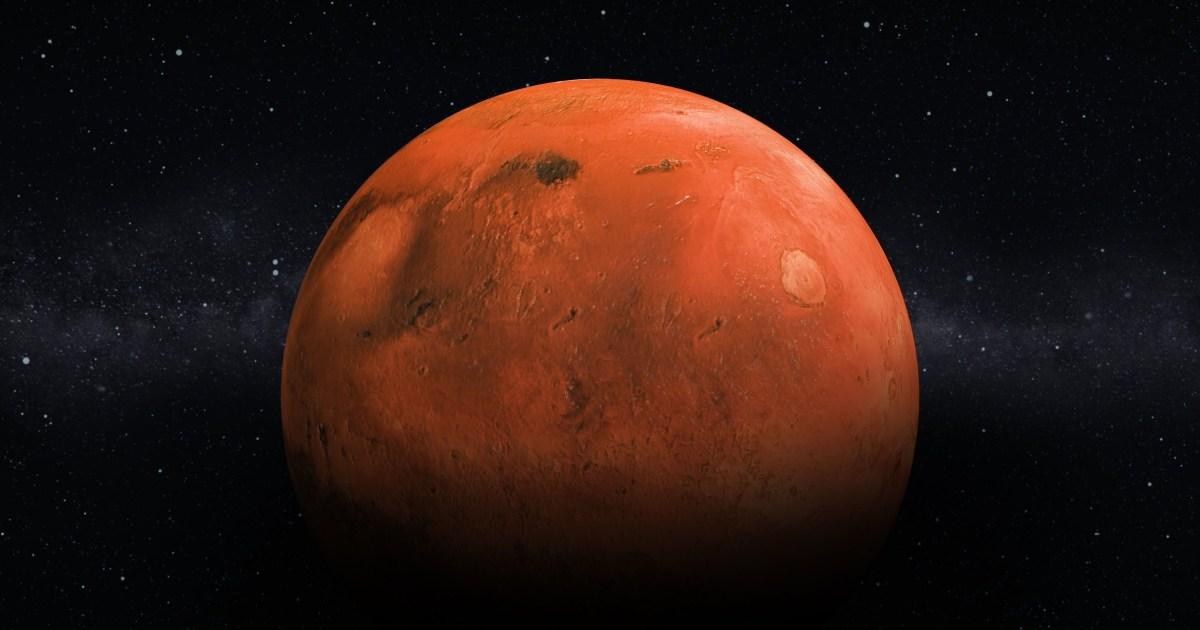
To view this video please enable JavaScript, and consider upgrading to a web browser that supports HTML5 video Mars was once home to flowing rivers and vast oceans and perhaps even life. These days, the red planet is a dry, dusty orb and, for the most part, lacking in green or grey Martians. Yet volcanic rifts belching a particular gas suggest our planetary neighbour isn’t dead inside but merely sleeping. The discovery, published today in the journal Science Advances, was detected by a European Space Agency (ESA) orbiter. ‘Hydrothermal systems are known on Earth for being the main, or one of the main environments where life emerged,’ Professor Daniel Mège, a Mars researcher at Poland’s Academy of Sciences and study’s co-author, tells Metro. ‘On Mars it could be the same.’ Hydrothermal what now? Mars was once overflowing with water (Picture: Getty Images) Mars is a very quiet place. It’s pocked with some of the largest volcanoes in the solar system that have been silent for millions of years. Still, in 2021, scientists discovered tiny traces of hydrogen chloride swirling in Mars’ atmosphere. While the gas doesn’t sound conducive to life – it corrodes and irritates human skin – it is coughed out by magmatic vents on Earth. We already know that Mars might have been warmed by the magmatic gassy burps of active volcanoes, heating and warming its atmosphere. How the hydrogen chloride is still floating around hints that molten rock is still churning within Mars, despite the planet being barren and cold. Professor Mège and his team said the gas is released in seasonal bursts. Mars might have been warmed by the gassy belches of active volcanoes (Picture: European Space Agency) A graphic shows how hydrogen chloride gas could be leaking from fissures (Picture: European Space Agency) It reaches its gassy peak during the Northern Hemisphere’s winter, which lasts 154 Martian days, or sols, and almost vanishes during the summer. For the most part, this is because of Mars’ dust and water cycles, as crusty salt from evaporated Martian oceans is whipped by the wind. Yet hydrogen chloride was consistently near volcanic fissures on the flanks of Alba Mons, a volcano in Mars’ Northern Hemisphere, in the summer. His team used a powerful camera on ExoMars Trace Gas Orbiter, called CasSSIS, to spot fresh and narrow fissures, some hundreds of metres long. Something must be generating the gas, Professor Mège says, and if magmatic gas is about, it could be a sign of hydrothermal systems. On Earth, these systems see hot fluids sloshing under the ground, revved by magmatic gas, produce chemical reactions that could make the ingredients for life. Alba Mons, a volcano in Mars’ Northern Hemisphere, still seems rather gassy (Picture: European Space Agency) It’s within these that Martian life, likely bacteria, could have once been wriggling inside. Or still is, in the case of the leaky fissures in Alba Mons. ‘The big unknown is time,’ Professor Mège says. ‘To obtain life from the existing materials, a lot of chemistry is needed, and this chemistry takes time, perhaps hundreds of thousands of years, or perhaps tens of millions of years.’ The planet’s crust – split into two or three layers – also needs to have been stable long enough to give it a chance to form. Mars doesn’t exactly scream ‘habitable’ at the moment (Picture: AFP Colin Wilson, a planetary scientist at the ESA, tells Metro that the magma could melt ice and make habitable ‘niches’. ‘If these gas emissions are occurring until the present day, perhaps Mars may have been habitable more recently than previously thought.’ Professor Mège stresses that the findings need to be double-checked with more observations. Life on Mars isn’t guaranteed. But a bucket and spade might help find it. ‘One would probably need to dig a bit,’ he adds, ‘perhaps 20cm, perhaps 100m.’ Get in touch with our news team by emailing us at webnews@metro.co.uk. For more stories like this, check our news page. Arrow MORE: A 1,500kg Nasa spaceship is about to crash into Earth – but where? Arrow MORE: This is what you dream about right before you die, according to scientists Arrow MORE: Humans are exploring the ‘Zeptoverse’ – a world 100billion times smaller than an atom News Updates Stay on top of the headlines with daily email updates.
New evidence of volcanic activity on Mars suggests possible life on the red planet
Full Article
Original Source
Read the full article at Metro →KhanList aggregates and links to publicly available news content. We do not host full articles from third-party sources. Always verify important information with original sources.