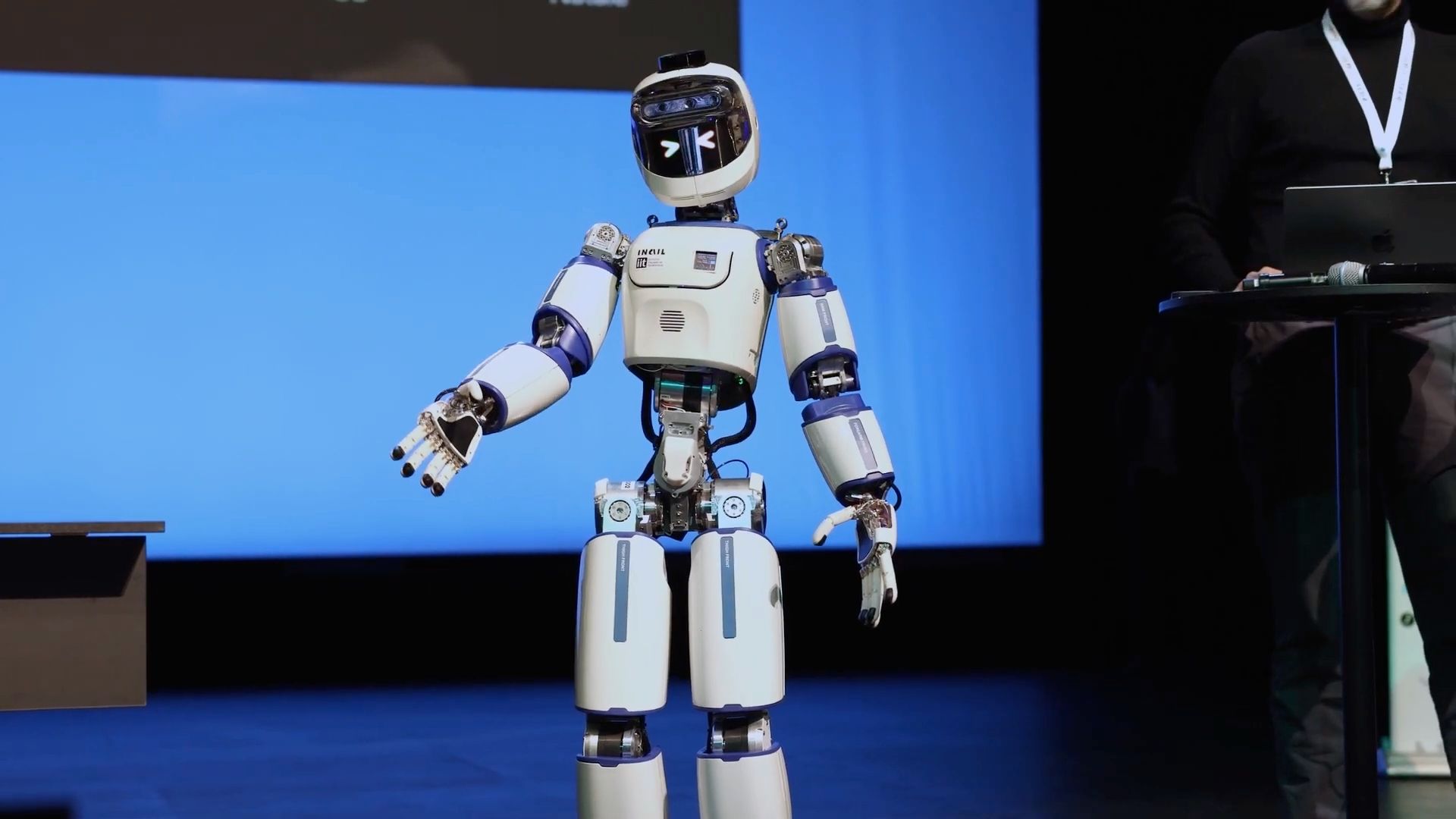
Researchers in Italy and the UK have developed a humanoid robot that can adapt to a human partner during shared lifting tasks, helping reduce physical strain and improve workplace safety. The robot, called ergoCub, was created by scientists at GenerativeBionics, the Italian Institute of Technology (IIT), and the University of Manchester using a new human-aware design framework. The research combines robot hardware and control systems to enable safer, more adaptive human-robot collaboration. The team says the approach allows robots to interpret human movements in real time and provide ergonomic assistance during physically demanding tasks. Smarter collaborative humanoids The new design framework strives to transform how humanoid robots collaborate with people. Instead of treating a robot’s body as fixed hardware controlled solely by software, the team developed a system that simultaneously optimizes a robot’s physical structure and its intelligence, enabling more natural and ergonomic human-robot teamwork. The research introduces a humanoid robot called ergoCub, designed specifically to reduce the physical strain experienced by humans during cooperative lifting and carrying tasks, reports TechXplore. ergoCub uses sensors and AI to assist human lifting, reduce strain, and improve walking performance. The core technological innovation lies in what the researchers describe as shared embodied intelligence. Conventional humanoid robots are typically designed in two separate stages: engineers first finalize the robot’s hardware, then develop software to compensate for any mechanical limitations. The new framework abandons this sequential process, instead designing the robot’s body, sensors, actuators, and control algorithms together while explicitly modeling the human partner as part of the system, according to the team’s research paper. The design process begins with optimizing the robot’s morphology, including limb lengths, joint placement, weight distribution, and overall body structure. Rather than maximizing robot performance alone, these parameters are selected to improve the combined performance of the human-robot team. Once the physical design is established, the researchers develop an intelligent whole-body control architecture. The robot continuously builds and updates an internal model of its human partner using sensor data. This allows it to predict human movements, synchronize its actions, adapt to people with different body sizes and strengths, and monitor biomechanical indicators such as lower-back loading in real time. Robots learn ergonomics The resulting humanoid, ergoCub, is based on IIT’s iCub robot but incorporates optimized hardware and software developed using this integrated framework. During collaborative lifting experiments, the robot successfully followed human movements while dynamically adjusting its assistance according to the person’s posture and motion. A key technological capability is the robot’s ability to estimate the torque acting on a person’s lumbosacral joint—the region of the lower back most vulnerable to strain during lifting. By adjusting its own force and movement, ergoCub significantly reduced the estimated biomechanical load compared with a person performing the same lifting task without robotic assistance, reports TechXplore. The optimization process also improved the robot itself. Compared with its predecessor, ergoCub demonstrated faster walking speeds and more energy-efficient locomotion, showing that integrating hardware and intelligence benefits both collaborative and standalone robot performance. The framework treats hardware as an active contributor to intelligence rather than simply a platform executing software instructions. Sensors, actuators, mechanical design, and control algorithms operate as an integrated system that continuously adapts to both the environment and the human partner. The researchers have already extended this design philosophy to Gene.01, a next-generation humanoid developed by GenerativeBionics. Unlike one-size-fits-all humanoids, the team envisions a modular platform that can be customized for industries such as manufacturing, logistics, shipbuilding, inspection, and healthcare by adapting its sensing systems, AI models, exterior design, and end effectors to specific applications. The researchers believe this human-aware design strategy represents a significant step toward future humanoid robots that not only work alongside people but actively improve workplace safety, reduce physical fatigue, and make collaborative tasks faster, more efficient, and ergonomically safer. Recommended ArticlesGet the latest in engineering, tech, space & science - delivered daily to your inbox.Jijo is an automotive and business journalist based in India. Armed with a BA in History (Honors) from St. Stephen's College, Delhi University, and a PG diploma in Journalism from the Indian Institute of Mass Communication, Delhi, he has worked for news agencies, national newspapers, and automotive magazines. In his spare time, he likes to go off-roading, engage in political discourse, travel, and teach languages.
New ergoCub humanoid can adapt to human movements during shared lifting tasks
Full Article
Original Source
Read the full article at Interestingengineering →KhanList aggregates and links to publicly available news content. We do not host full articles from third-party sources. Always verify important information with original sources.