
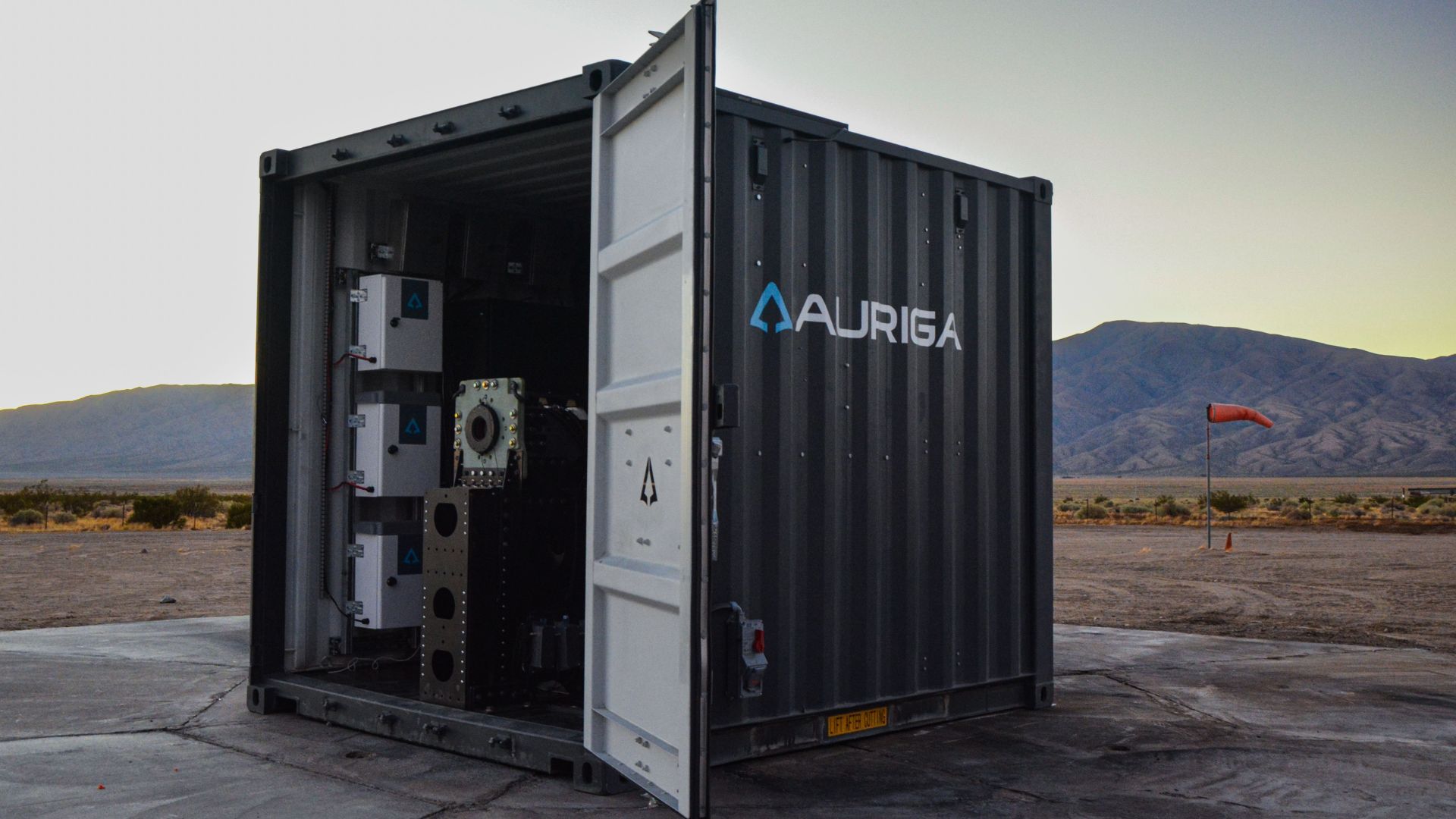
Drone defenses are facing a costly mismatch as low-cost unmanned aircraft can force operators to use far more expensive interceptors. On August 25, Auriga Space announced that it had completed the first field test of Hermes, an electromagnetic launcher that fires low-cost projectiles at drones without using chemical propellants. The company tested Hermes in the Mojave Desert under field conditions, with temperatures reaching about 100°F. The system fits inside a standard 10-foot shipping container, making it easy to move and use in places without existing infrastructure. Hermes takes aim at counter-drone costs Hermes uses Auriga’s electromagnetic launch technology to accelerate projectiles with electricity. This technology is also used in the company’s Prometheus hypersonic test system, which has already brought in revenue from government and commercial clients. In the Mojave test, Hermes launched projectiles more than a dozen times at speeds over Mach 1. The main goal was to show that the system could fire again and again while working in a remote area. The container operated using its own power throughout the test. Internal batteries supplied the system, while onboard solar panels recharged them. Auriga said the setup can support hundreds of launches from a single charge. Field testing moves beyond the lab This was the first time the firm used Hermes outside the lab. They set up the system on a dirt road in the Mojave Desert so engineers could see how it worked in real weather and terrain. “For the first time, we took Hermes out of the lab and deployed it where it will actually be used: on a dirt road, away from existing infrastructure, in real weather conditions,” revealed Winnie Lai, CEO and Founder of Auriga Space. “The launches completed in Mojave are the first of many to come, proving that the future of air defense can be mobile, logistically unconstrained, and rapidly deployed.” By using electricity instead of chemical propellants, the system may not need to be resupplied with ammunition as often. Auriga says this method allows for repeated firing with both inert and guided munitions, while also cutting costs. Hermes 1. (Image Credit: Auriga Space) Next test will harden the system Auriga plans to conduct a second field test in fall 2026. Engineers will use lessons from the Mojave demonstration to ruggedize Hermes for harsher environments and improve its aiming and reloading speed between launches. The company is developing the system as a counter-UAS option for military customers seeking reusable technologies with lower logistical demands. Auriga expands defense work The Hermes test follows several recent developments for Auriga. The company is working under contracts with the U.S. Air Force, U.S. Space Force, and Missile Defense Agency. Auriga has also announced hypersonic materials weather-effects testing with Axiom Materials, which it identified as its first customer for that work. Former MDA director Lt. Gen. (Ret.) Henry “Trey” Obering III recently joined the company’s advisory team. The company has also partnered with the U.S. Army DEVCOM-AC to advance Hermes as a counter-drone technology. Auriga ultimately sees its electromagnetic launch systems supporting applications across defense and space, including hypersonic testing, orbital launch, and lunar mass drivers.Get the latest in engineering, tech, space & science - delivered daily to your inbox.A versatile writer, Sujita has worked with Mashable Middle East and News Daily 24. When she isn't writing, you can find her glued to the latest web series and movies.
New electromagnetic launcher fires projectiles at supersonic speed to fight drones
Full Article
Original Source
Read the full article at Interestingengineering →KhanList aggregates and links to publicly available news content. We do not host full articles from third-party sources. Always verify important information with original sources.