
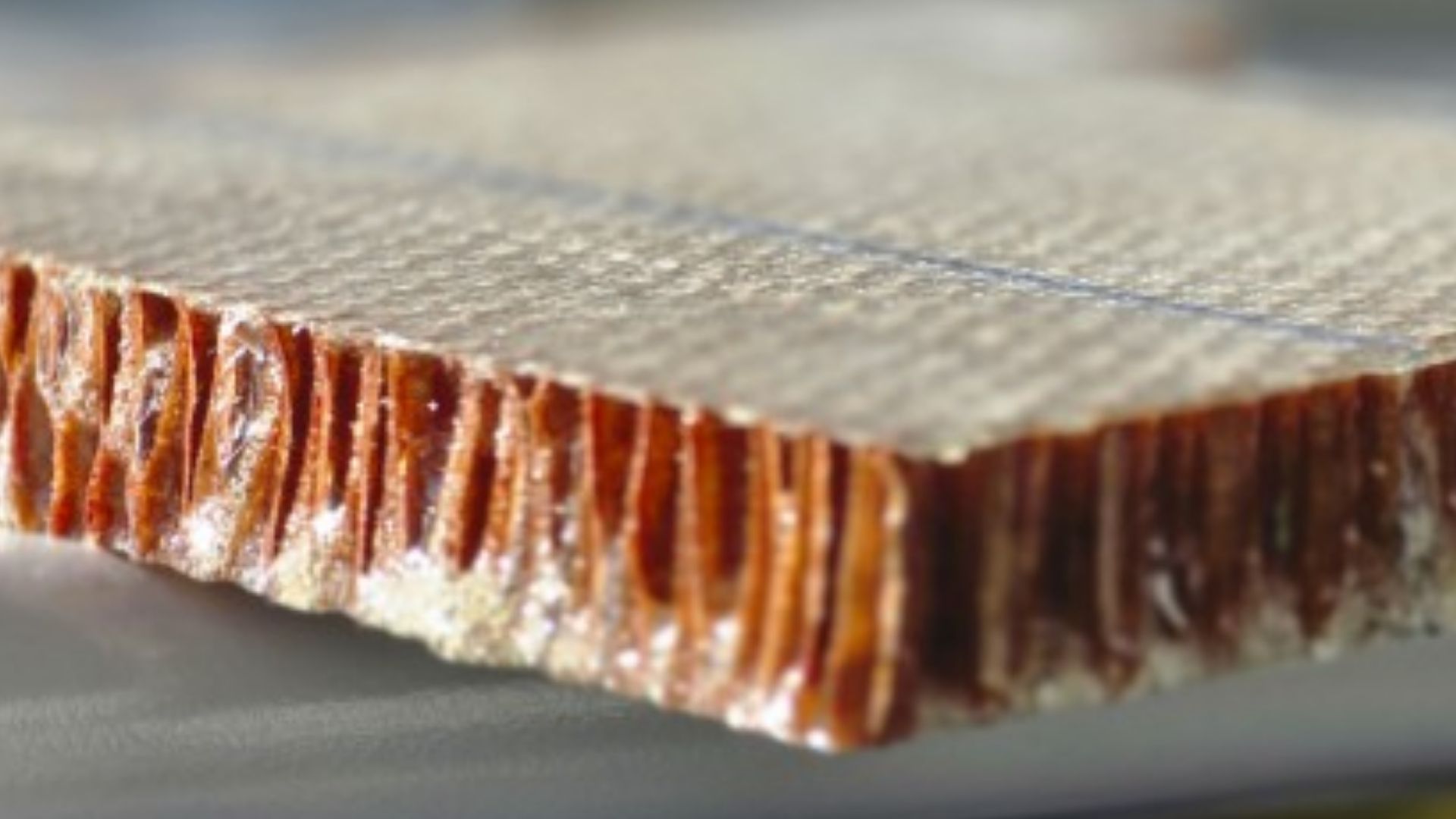
A new flame-retardant epoxy composite developed by researchers at Empa could help address one of the biggest challenges in using lightweight fiber-reinforced materials. What happens to them at the end of their useful life. The material is designed to combine fire safety, mechanical strength, low weight, and recyclability. These properties are particularly important for aircraft and train interiors. Empa, the Swiss Federal Laboratories for Materials Science and Technology, developed the recyclable epoxy system with industrial partner Elantas, part of German specialty chemicals group ALTANA, through an Innosuisse-supported project. A recyclable alternative to conventional epoxy composites The composite investigated by the researchers is a multilayer “sandwich” structure used in applications such as aircraft and train cabin floors. It consists of an aramid honeycomb core surrounded by woven glass or carbon-fiber layers, with epoxy resin acting as the binder. That combination provides a useful balance of strength and weight, but conventional epoxy creates a major problem when the component reaches the end of its life. Unlike thermoplastics, cured epoxy cannot normally be melted and reshaped, while conventional epoxy composites are also difficult to chemically separate. As a result, such materials typically end up being incinerated or sent to landfill. Empa researchers have now developed a phosphorus-containing additive that changes how the epoxy behaves. When incorporated into the resin during manufacturing, the additive provides flame-retardant properties while allowing the cured epoxy to be softened and reshaped under specific conditions. This opens the door to what is known as thermomechanical recycling. The researchers and Elantas then went a step further, demonstrating a process intended to recover the different components of the composite rather than simply reshaping the resin. Breaking the “sandwich” back apart With an appropriate solvent and some heat, the composite can be separated into its individual components, including the aramid honeycomb and woven fiber layers. That could be particularly valuable because materials such as aramid honeycomb and carbon fiber are relatively expensive. Recovering them could therefore have both environmental and economic benefits. Empa says the epoxy itself can potentially be recovered from the solution as well, although the researchers plan to investigate that aspect in future work. The resulting material reportedly retains nearly the same advantageous mechanical properties as conventional epoxy while complying with relevant fire-safety requirements, according to researcher Sabyasachi Gaan. For aircraft interiors, that combination is particularly important. Materials used inside aircraft must satisfy stringent fire-safety requirements while contributing as little weight as possible. Adding recyclability without compromising those properties has been a longstanding materials challenge. “When you make a material flame-retardant, you always end up altering its other properties as well,” Gaan said in Empa’s announcement. The project has so far demonstrated the technology’s potential at an industrial-application level. The next step is to scale up both production and recycling processes. The researchers are also investigating whether the recyclable, flame-retardant epoxy could find applications outside transportation, including in the energy and construction sectors. If the system can be scaled successfully, its significance could extend beyond making individual aircraft or train components recyclable. Fiber-reinforced composites are attractive precisely because they combine high performance with low weight, but their complex construction has historically made end-of-life recovery difficult. A material system that preserves those performance advantages while allowing its components to be separated could make lightweight composites considerably more sustainable.Get the latest in engineering, tech, space & science - delivered daily to your inbox.Kaif Shaikh is a journalist and writer passionate about turning complex information into clear, impactful stories. His writing covers technology, sustainability, geopolitics, and occasionally fiction. A graduate in Journalism and Mass Communication, his work has appeared in the Times of India and beyond. After a near-fatal experience, Kaif began seeing both stories and silences differently. Outside work, he juggles far too many projects and passions, but always makes time to read, reflect, and hold onto the thread of wonder.
New composite material could make trains and airplanes easier to recycle
Full Article
Original Source
Read the full article at Interestingengineering →KhanList aggregates and links to publicly available news content. We do not host full articles from third-party sources. Always verify important information with original sources.