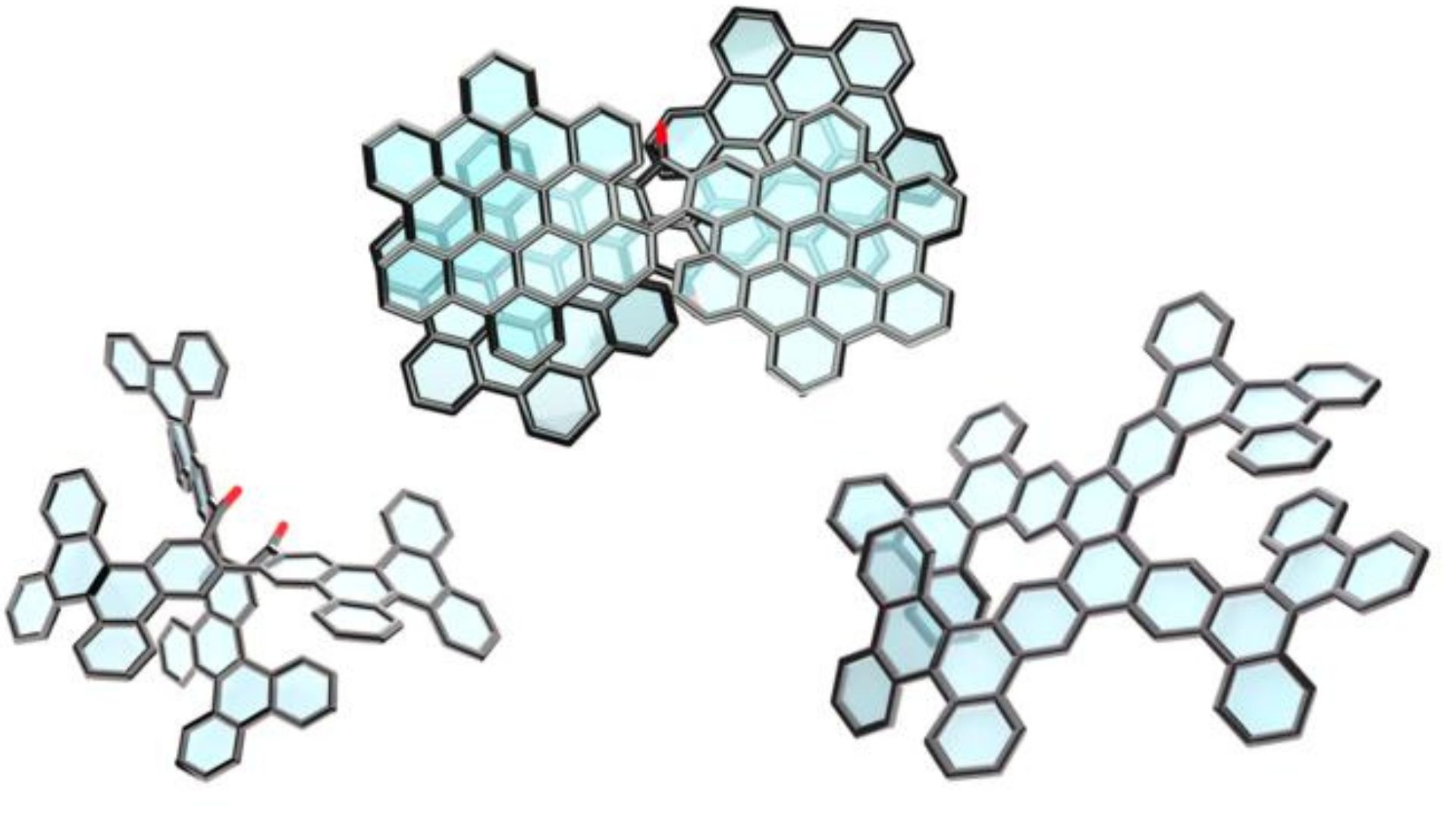
Japan’s Nagoya University has achieved a breakthrough in chemistry by applying skeletal editing to nanocarbon synthesis. Rather than sticking to the outer edges, the team cut and reformed bonds within flat, rigid carbon molecules to build complex, previously unachievable interior structures. This novel approach synthesized unique chiral nanocarbons, which are complex molecular shapes that exist in non-superimposable left- and right-handed mirror images. Interior molecular modification Nanocarbons are tiny carbon structures laying the groundwork for the materials of tomorrow. But chemistry has an unwritten law: you don’t mess with the inside of a carbon sheet. Flat carbon molecules are rigid with inner bonds that lock them into flat hexagonal grids. Try to force a change in the center, and the intense structural strain shatters the molecule. As a result, synthetic chemists played it safe, building next-generation materials exclusively by stitching smaller carbon flakes together around their outer edges. In this new development, the team turned to a precision chemical surgery known as skeletal editing. The technique has long been used in pharmaceutical development, where chemists swap individual atoms inside drug compounds to fine-tune how they interact with the human body. Applying it to bulky, non-biological nanocarbons was once considered a non-starter. The Nagoya team proved the skeptics wrong. Through a precise selection of starting molecules and reactions, the internal bonds were severed and reformed into different shapes. Among the creations was a massive 10-carbon ring embedded inside a chiral framework — a structural feat previously deemed impossible. Plus, a molecular double helix that resembles miniature DNA strands. These molecules are “chiral,” existing in distinct left-handed and right-handed forms, much like human hands. Generating specific left- or right-handed forms of large nanocarbons with such high precision (asymmetric synthesis) has only ever been achieved twice before. Potential applications Interestingly, the newly minted architectures display striking physical properties. When exposed to light, every nanocarbon produced by the technique glows with light that travels in a tight spiral. Two of the synthesized variants can absorb and hold multiple electrical charges without breaking down. Another maintains its twisted shape at temperatures up to 280°C (536°F). Most remarkably, the double-helix molecule self-assembles into a porous, crystal framework full of spiral pathways. These microscopic pores can selectively trap and release carbon dioxide, making the material a promising candidate for carbon capture and gas storage systems. “If you alter the inside of a molecule, it causes significant strain, so most reactions proceed around the molecule instead. Over time, this led to the assumption that the interior could not be modified,” said Norihito Fukui, Associate Professor at the Graduate School of Engineering. “However, with the right method and the right starting molecule, we can change the inside and create molecular shapes and structures that could not be made before,” the senior author added. Interestingly, the team has opened a new realm of material design by proving that carbon sheets can be edited internally without destroying them. Future applications could range from ultra-low-power computing components to high-level optical encryption devices and advanced atmospheric scrubbers.The findings were published in the journal Nature Communications.Recommended ArticlesGet the latest in engineering, tech, space & science - delivered daily to your inbox.Mrigakshi is a science journalist who enjoys writing about space exploration, biology, and technological innovations. Her work has been featured in well-known publications including Nature India, Supercluster, The Weather Channel and Astronomy magazine. If you have pitches in mind, please do not hesitate to email her.
New chiral nanocarbons pave way for ultra-low-power electronics, next-gen encryption
Full Article
Original Source
Read the full article at Interestingengineering →KhanList aggregates and links to publicly available news content. We do not host full articles from third-party sources. Always verify important information with original sources.